


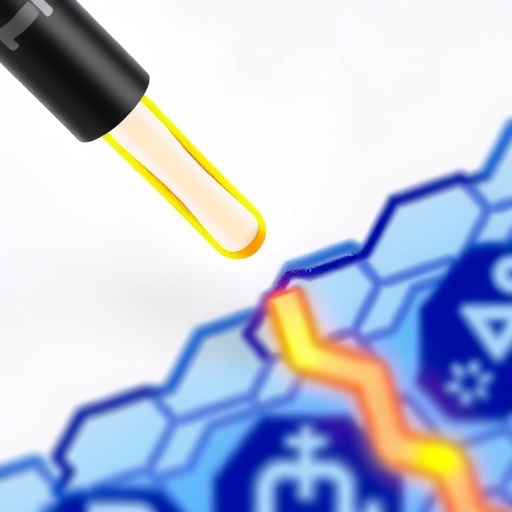
In a groundbreaking advance aimed at pushing the frontier of flexible bioelectronic devices, a team of researchers has unveiled a novel approach to designing conductive polymer inks utilizing physicochemical-informed predictive modeling. Published in the esteemed journal npj Flexible Electronics, this study confronts a long-standing challenge in materials science and soft electronics: how to engineer highly functional conductive polymers from limited experimental datasets without sacrificing accuracy or efficiency.
Conductive polymer inks serve as the lifeblood in the rapidly expanding field of soft bioelectronics, enabling the creation of devices that seamlessly integrate with biological tissues for applications ranging from wearable health monitors to implantable neural interfaces. Despite the promising prospects, traditional methods of formulating these inks demand extensive trial-and-error experiments and substantial amounts of data to optimize their physicochemical properties, a process that is time-consuming and resource-intensive.
The researchers, led by J.M. Lee, X. Gao, and W.Y. Yeong, have pioneered a predictive modeling framework that leverages fundamental physicochemical parameters as informative priors, allowing machine learning algorithms to extrapolate key material characteristics from scarce datasets. This methodology addresses the bottleneck of data scarcity by integrating domain-specific scientific knowledge directly into the computational models, thereby enhancing prediction accuracy and reducing the need for large-scale empirical datasets.
Specifically, the team focused on the interplay between polymer microstructure, electronic conductivity, rheological behavior, and bio-compatibility—critical attributes that determine the performance and applicability of conductive polymer inks. By incorporating these parameters into their models, they constructed robust, multi-scale simulations capable of forecasting ink performance metrics under various chemical compositions and processing conditions, an accomplishment that would have been prohibitively complex through conventional experimental techniques alone.
Their work further demonstrates the predictive model’s ability to identify optimal formulations that balance electrical conductivity with mechanical flexibility and stability, which are essential for bioelectronic devices that must withstand deformation while maintaining signal integrity. This ability to simulate nuanced trade-offs enables designers to tailor inks with unprecedented precision, accelerating innovation cycles from months or years down to mere weeks.
Notably, the integration of physicochemical principles into predictive modeling represents a paradigm shift, redefining how researchers approach material design in fields constrained by limited datasets. Instead of relying solely on brute-force data accumulation, this informed modeling approach facilitates intelligent hypothesis generation, allowing rapid iteration and refinement based on mechanistic insight rather than purely statistical correlations.
The implications extend beyond just polymer inks; this framework holds promise for diverse materials engineering challenges where data collection is costly or impractical. By bridging the gap between theoretical chemistry, physics, and data science, the approach embodies a new class of hybrid models that combine mechanistic understanding with the flexibility of artificial intelligence.
At the heart of this success lies the interdisciplinary collaboration between computational scientists, polymer chemists, and bioengineers who jointly crafted a tailored feature set grounded in physicochemical laws, such as electron transport theory, polymer chain dynamics, and solvation thermodynamics. The team’s meticulous feature engineering enabled the model to capture subtle molecular interactions that dictate macroscopic material properties.
Furthermore, the researchers underscored the importance of validation by subjecting their predicted ink formulations to rigorous experimental tests, revealing high concordance between predicted and observed conductivities, viscosities, and biostability profiles. This tight feedback loop between in silico prediction and experimental verification exemplifies the future of materials discovery workflows.
Beyond its technical achievements, this study carries profound implications for the development of next-generation bioelectronic devices that promise to transform healthcare diagnostics, therapeutics, and patient monitoring. Conductive polymer inks optimized through this physicochemical-informed predictive modeling can enable ultra-thin, stretchable sensors that conform intimately to skin or internal organs, providing continuous real-time data while minimizing discomfort and immune response.
Moreover, the technology accelerates the path toward personalized bioelectronics by allowing ink formulations to be customized for specific tissue types or physiological environments, enhancing biocompatibility and long-term functionality. This customization is particularly vital for neural interfaces where subtle differences in electrical and mechanical characteristics can drastically impact device efficacy and safety.
In terms of commercial and societal impact, this research lowers the barriers to entry for smaller labs and startups by democratizing materials design through accessible predictive tools that reduce dependence on costly experimental facilities. By empowering a wider community with the ability to rapidly iterate and innovate, it fosters an ecosystem of distributed innovation with potential ripple effects across healthcare, wearables, and robotics sectors.
Looking ahead, the authors envision integrating their physicochemical-informed predictive modeling with automated synthesis platforms to create closed-loop materials discovery systems. These autonomous labs would synthesize, test, and iteratively refine polymer inks without human intervention, exponentially expediting the pace of materials innovation and enabling real-time adaptation to application requirements.
This integration of advanced modeling, domain expertise, and automation represents a new era in materials science, redefining traditional boundaries and workflows. It embodies the convergence of AI and physical sciences to solve real-world challenges, marking a transformative milestone in the creation of functional materials for bioelectronics and beyond.
In conclusion, the pioneering work by Lee, Gao, and Yeong showcases the power of intertwining physicochemical understanding with predictive analytics to overcome data scarcity, optimize conductive polymer inks, and accelerate the evolution of soft bioelectronic devices. It stands as a testament to the dynamic possibilities unlocked when cutting-edge computational techniques meet deep scientific intuition.
As researchers and developers worldwide seek to harness flexible bioelectronics for revolutionary health solutions, this study provides a vital toolkit and blueprint—illuminating a path forward where design is no longer constrained by data availability but fueled by insight and innovation, ushering in a future of smarter, more adaptive, and highly functional bioelectronic materials.
Cite Scienmag News
Neil Sanderson. (May 13, 2026). Physicochemical Modeling Advances Conductive Polymer Ink Design. Scienmag. https://scienmag.com/physicochemical-modeling-advances-conductive-polymer-ink-design/
Neil Sanderson. "Physicochemical Modeling Advances Conductive Polymer Ink Design." Scienmag, 13 May 2026, https://scienmag.com/physicochemical-modeling-advances-conductive-polymer-ink-design/. Accessed 5 September 2026.
Neil Sanderson. "Physicochemical Modeling Advances Conductive Polymer Ink Design." Scienmag. May 13, 2026. https://scienmag.com/physicochemical-modeling-advances-conductive-polymer-ink-design/


