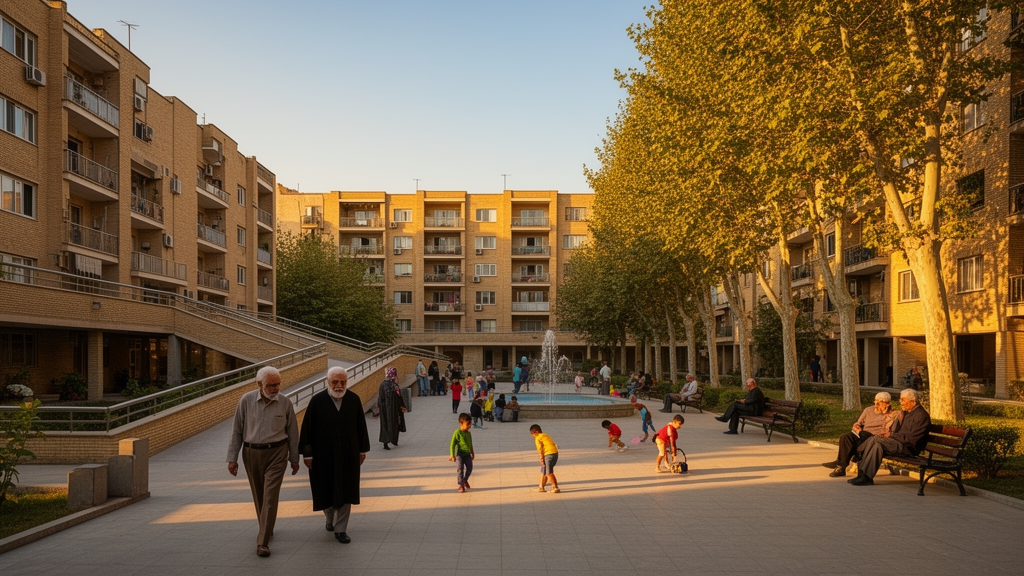
A mixed-methods study of residential complexes in Tehran, Iran, reports that the vitality of public spaces is shaped primarily by physical design factors, with mobility acting as a mediating mechanism. The research, published open access in the journal City, Territory and Architecture on 15 October 2026, used structural equation modeling and path analysis to map how physical, behavioral, and semantic components interact to promote liveliness in shared residential environments.
Importantly, the study takes a normative, expert-based approach rather than measuring residents’ perceptions or lived experiences directly. Data were collected through structured questionnaires administered to 500 housing experts recruited via snowball sampling. The authors state that adequate sample representation was confirmed by the KMO test, while the reliability and validity of the questionnaire were verified using Cronbach’s alpha and model fit indices. The findings therefore reflect expert judgments about the determinants of residential vitality, not observational measurements of how residents actually use or experience these spaces.
The analysis, conducted in SPSS and AMOS, identified three key relationships within the structural model. First, physical attributes enhance residents’ vitality when mediated by mobility variables. Second, behavioral patterns also contribute to increased vitality through the same mobility pathway. Third, perceptual-semantic values, described as the dependent dimension of vitality, are significantly influenced by physical factors. Across all three pathways, mobility emerged as essential, encompassing physical, behavioral, and semantic dimensions.
Among the individual physical factors examined, integrity played the most important role in enhancing residents’ vitality, according to the path analysis. The authors also highlight collectivism as one of the most influential determinants of vitality in the model.
The study is framed as addressing a gap in understanding the structural components that promote vitality in the public spaces of residential complexes in Tehran, Iran. Because the model rests on expert opinion gathered through a snowball-sampled questionnaire, the authors’ conclusions about causal structure come from statistical modeling of those judgments rather than from longitudinal or observational field data. The sample size of 500 and the reported reliability and fit checks support the internal coherence of the model, but generalization to residents’ actual day-to-day experience would require further research measuring perceptions directly.
For readers following urban design research, the paper’s central contribution is its integrated structural model linking three factor families: physical attributes, behavioral patterns, and perceptual-semantic values, all connected through mobility.
Subject of Research: Structural modeling of physical, behavioral, and semantic factors influencing vitality in the public spaces of residential complexes in Tehran
Article Title: Structural modeling of factors influencing vitality in residential complexes: a mixed method study
Article References: Sadat, S. A., Taher Tolou Del, M. S., & Saleh Sedghpour, B. (2026). Structural modeling of factors influencing vitality in residential complexes: a mixed method study. City, Territory and Architecture. https://doi.org/10.1186/s40410-026-00332-9
Image Credits: AI Generated
DOI: 10.1186/s40410-026-00332-9
Keywords: residential complexes, urban vitality, structural equation modeling, mobility, public spaces, Tehran, housing experts, path analysis, physical design, collectivism, Structural, modeling
Cite Scienmag News
Denise Maddox. (October 28, 2026). Physical Design and Mobility Drive Vitality in Tehran Residential Complexes. Scienmag. https://scienmag.com/physical-design-and-mobility-drive-vitality-in-tehran-residential-complexes/
Denise Maddox. "Physical Design and Mobility Drive Vitality in Tehran Residential Complexes." Scienmag, 28 October 2026, https://scienmag.com/physical-design-and-mobility-drive-vitality-in-tehran-residential-complexes/. Accessed 28 October 2026.
Denise Maddox. "Physical Design and Mobility Drive Vitality in Tehran Residential Complexes." Scienmag. October 28, 2026. https://scienmag.com/physical-design-and-mobility-drive-vitality-in-tehran-residential-complexes/