
Saturday, April 11, 2026
Science
No Result
View All Result
  • Login
  • HOME
  • SCIENCE NEWS
  • CONTACT US
  • HOME
  • SCIENCE NEWS
  • CONTACT US
No Result
View All Result
Scienmag
No Result
View All Result
Home Science News Chemistry

Photocrosslinking, not Ojak bridge, facilitates transistor functionality

May 2, 2024
in Chemistry
Reading Time: 3 mins read
0
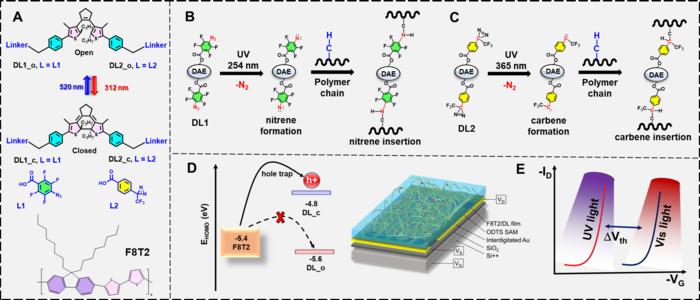
A schematic depiction showcasing the Photophore-Anchored Molecular Switch for High-Performance Nonvolatile Organic Memory Transistor
66
SHARES
597
VIEWS
Share on FacebookShare on Twitter
ADVERTISEMENT

In the tale of the herdsman and the weaver, “Ojak Bridge” stood as a testament to the enduring love between them, crafted by the crow and the magpie. Similarly, in the realm of chemical engineering, functional molecules forge bonds much like the avian duo once did.

A schematic depiction showcasing the Photophore-Anchored Molecular Switch for High-Performance Nonvolatile Organic Memory Transistor

Credit: POSTECH

In the tale of the herdsman and the weaver, “Ojak Bridge” stood as a testament to the enduring love between them, crafted by the crow and the magpie. Similarly, in the realm of chemical engineering, functional molecules forge bonds much like the avian duo once did.


A research team led by Professor Dae Sung Chung and Dr. Syed Zahid Hassan from the Department of Chemical Engineering at Pohang University of Science and Technology (POSTECH) has developed a memory transistor capable of adjusting its threshold voltage. This innovation combines two molecules that form a stable bond with a polymeric semiconductor, situated at the end of a molecular switch. The research recently featured in the online edition of “Advanced Science,” an international materials science journal.


These molecular switches control electrical signals by leveraging the conversion properties of diverse organic molecular isomers. When integrated into field-effect transistors (FETs), they govern electron flow at the molecular scale. While molecular switch-based FETs have been a key technology for implementing organic FETs (OFETs) in recent years, their longevity has been hampered by the limited ability of the molecules that act as switch molecules to serve as efficient deep traps for capturing and storing electrons within the semiconductor layer.


In this research, the team tackled this challenge by constructing a bridge illuminated by “light.” They pioneered a novel method to establish a “photonic bridge,” a light-triggered chemical linkage between a molecular switch molecule and a polymeric organic semiconductor. At the terminus of the molecular switch, consisting of diarylethene (DAE), the team combined an azide and a diazirine. Under light exposure, these two functional groups forge a chemical connection with the organic polymer semiconductor, stabilizing the typically precarious closed isomer of DAE in a deep-trapped state.


In experimental trials, the OFETs incorporating the team’s DAE compounds demonstrated remarkable endurance, maintaining stable deep-trap states for durations exceeding a million seconds. Furthermore, they showcased exceptional photoprogrammable on-off switching ratios surpassing 1,000 at a voltage of 22 V, alongside outstanding storage performance, enduring stability through more than 100 cycles.


Specifically, the team’s OFETs boast precise patterning through photocrosslinking, enabling meticulous control of the semiconductor layer’s structure. The researchers identified diverse applications for their findings, spanning microelectronics and optoelectronics.


Professor Dae Sung Chung of POSTECH expressed his expectation by saying, “This research unveils fresh prospects in memory transistor realms, impacting data storage and processing technologies profoundly. It holds promise for innovation across a spectrum of disciplines, extending beyond the domain of transistors.”


The research was conducted with support from the BK21 Innovative Chemical Engineering Leadership Program of the National Research Foundation of Korea and a program of Toray Advanced Materials Korea.


Journal

Advanced Science

DOI

10.1002/advs.202401482

Article Title

Photophore-Anchored Molecular Switch for High-Performance Nonvolatile Organic Memory Transistor

Article Publication Date

30-Mar-2024

Share26Tweet17
Previous Post

Nicola Fuchs-Schündeln to become the new President of the WZB Berlin Social Science Center

Next Post

Webb telescope probably didn’t find life on an exoplanet — yet

Related Posts

blank
Chemistry

Local Universe Expansion Rate More Precise Than Ever — Yet Still Mysteriously Inconsistent

April 10, 2026
blank
Chemistry

Breakthrough in Mainz: New Dual-Frequency Paul Trap Achieves Milestone Toward Antihydrogen Creation

April 10, 2026
blank
Chemistry

Ultra-Low Efficiency Roll-Off and Over 20% Efficiency Achieved in High Color Purity Blue Perovskite QLEDs

April 10, 2026
blank
Chemistry

Bumblebee Bacterium Enables Vitamin B2 Production in Soya Drinks

April 10, 2026
blank
Chemistry

Pharma.AI Spring Kickoff 2026: Advancing the Future of Pharmaceutical Intelligence

April 10, 2026
blank
Chemistry

Rice scientists uncover novel metal-oxygen binding mechanism, opening a ‘new chapter’ in chemistry

April 9, 2026
Next Post
Hycean world

Webb telescope probably didn’t find life on an exoplanet — yet

  • Mothers who receive childcare support from maternal grandparents show more parental warmth, finds NTU Singapore study

    Mothers who receive childcare support from maternal grandparents show more parental warmth, finds NTU Singapore study

    27634 shares
    Share 11050 Tweet 6906
  • University of Seville Breaks 120-Year-Old Mystery, Revises a Key Einstein Concept

    1036 shares
    Share 414 Tweet 259
  • Bee body mass, pathogens and local climate influence heat tolerance

    675 shares
    Share 270 Tweet 169
  • Researchers record first-ever images and data of a shark experiencing a boat strike

    538 shares
    Share 215 Tweet 135
  • Groundbreaking Clinical Trial Reveals Lubiprostone Enhances Kidney Function

    523 shares
    Share 209 Tweet 131
Science

Embark on a thrilling journey of discovery with Scienmag.com—your ultimate source for cutting-edge breakthroughs. Immerse yourself in a world where curiosity knows no limits and tomorrow’s possibilities become today’s reality!

RECENT NEWS

  • Butterfly-Inspired Heart Chip Unveils Cardiomyocyte Mechanics
  • China’s Flexible Path to Net-Zero Energy Transition
  • Female Sexual Dysfunction After Anal Cancer Radiotherapy
  • CRISPR-Engineered Stem Cells for Parkinson’s Therapy

Categories

  • Agriculture
  • Anthropology
  • Archaeology
  • Athmospheric
  • Biology
  • Biotechnology
  • Blog
  • Bussines
  • Cancer
  • Chemistry
  • Climate
  • Earth Science
  • Editorial Policy
  • Marine
  • Mathematics
  • Medicine
  • Pediatry
  • Policy
  • Psychology & Psychiatry
  • Science Education
  • Social Science
  • Space
  • Technology and Engineering

Subscribe to Blog via Email

Success! An email was just sent to confirm your subscription. Please find the email now and click 'Confirm Follow' to start subscribing.

Join 5,145 other subscribers

© 2025 Scienmag - Science Magazine

Welcome Back!

Login to your account below

Forgotten Password?

Retrieve your password

Please enter your username or email address to reset your password.

Log In
No Result
View All Result
  • HOME
  • SCIENCE NEWS
  • CONTACT US

© 2025 Scienmag - Science Magazine