Wednesday, October 28, 2026
Science
No Result
View All Result
  • Login
  • HOME
  • SCIENCE NEWS
  • CONTACT US
  • HOME
  • SCIENCE NEWS
  • CONTACT US
No Result
View All Result
Scienmag
No Result
View All Result
Home Science News Technology and Engineering

Phase Mix Dictates Strength and Stability of Al0.6CoCrFeNi High-Entropy Alloy

October 28, 2026
in Technology and Engineering
Neil Sanderson
By Neil Sanderson Scienmag Editorial Profile - Materials Characterization
Reading Time: 3 mins read
0
Phase Mix Dictates Strength and Stability of Al0.6CoCrFeNi High-Entropy Alloy

Phase Mix Dictates Strength and Stability of Al0.6CoCrFeNi High-Entropy Alloy

65
SHARES
587
VIEWS
Share on FacebookShare on Twitter
ADVERTISEMENT

The Al0.6CoCrFeNi high-entropy alloy is unusual even by the standards of its class: depending on how it is processed, it can host not one but three coexisting crystal structures, the face-centered cubic (FCC), body-centered cubic (BCC) and ordered B2 phases.

Because the role of phase constitution in deformation stability under thermal and high-rate loading had remained insufficiently understood, Quang-Nguyen Pham, Thi-Nhai Vu, Chi-Jen Shih, Te-Hua Fang and colleagues used molecular dynamics simulations to build a direct comparison. They modeled seven representative microstructures: single-phase FCC, BCC and B2; the dual-phase combinations FCC+BCC, FCC+B2 and BCC+B2; and a multiphase BCC+FCC+B2 state.

Temperature emerged as the dominant governor of mechanical response. FCC-rich microstructures retained the highest strength as conditions changed, whereas configurations rich in BCC or B2 softened rapidly. The degradation was most severe in the BCC+B2 dual-phase combination, where the ultimate tensile strength fell to 1.11 GPa and Young’s modulus dropped from 76.24 to 31.35 GPa.

The deformation mechanisms behind these numbers proved strongly phase dependent. Structures containing FCC accommodated strain mainly through dislocation activity and FCC-to-HCP planar faulting, the classic signatures of defect-mediated plasticity. BCC- and B2-rich structures, by contrast, took a different route: they absorbed strain through lattice distortion, shear localization and structural disordering.

Above 900 K, the BCC/B2-containing structures showed a pronounced increase in highly distorted local environments. The authors are careful about what this means: the simulations indicate a loss of BCC-compatible local topology rather than a confirmed thermodynamic phase transformation, a distinction that matters for how the results should be interpreted.

Not all mixed structures behaved alike. Among the seven microstructures, FCC+B2 reached its peak tensile stress at the largest strain, approximately 0.150, indicating delayed post-peak softening and improved deformation stability in that configuration. The multiphase BCC+FCC+B2 state occupied a distinct intermediate position: its ultimate tensile strength decreased from 4.47 to 2.47 GPa, and its Young’s modulus fell from 77.52 to 26.60 GPa between 300 and 1100 K.

Strain rate added a further layer of differentiation. At 300 K, single-phase FCC showed the strongest strain-rate sensitivity of all the configurations tested. The FCC-containing dual-phase structures displayed non-monotonic, interface-sensitive responses, meaning their behavior did not scale simply with loading speed and depended on how the phase boundaries were arranged. The multiphase BCC+FCC+B2 state again remained intermediate, with its rate-dependent response governed by the competition between FCC-assisted planar-defect activity and BCC/B2-assisted disordering.

The study is a computational one, based on molecular dynamics simulations of seven idealized microstructures rather than experiments on bulk specimens, so its conclusions describe modeled deformation mechanisms at the simulated scales. Even so, the authors draw a broad lesson from the comparison: phase constitution in Al-containing high-entropy alloys controls not only strength and stiffness, but also the transition from defect-mediated plasticity to disorder-assisted strain localization.

Subject of Research: Simulation study of how FCC, BCC and B2 phase constitution controls tensile deformation of Al0.6CoCrFeNi high-entropy alloys

Article Title: Effects of phase constitution on the tensile deformation of Al0.6CoCrFeNi high-entropy alloys

Article References: Pham, Q.-N., Vu, T.-N., Shih, C.-J., & Fang, T.-H. (2026). Effects of phase constitution on the tensile deformation of Al0.6CoCrFeNi high-entropy alloys. Journal of Materials Science. https://doi.org/10.1007/s10853-026-13695-8

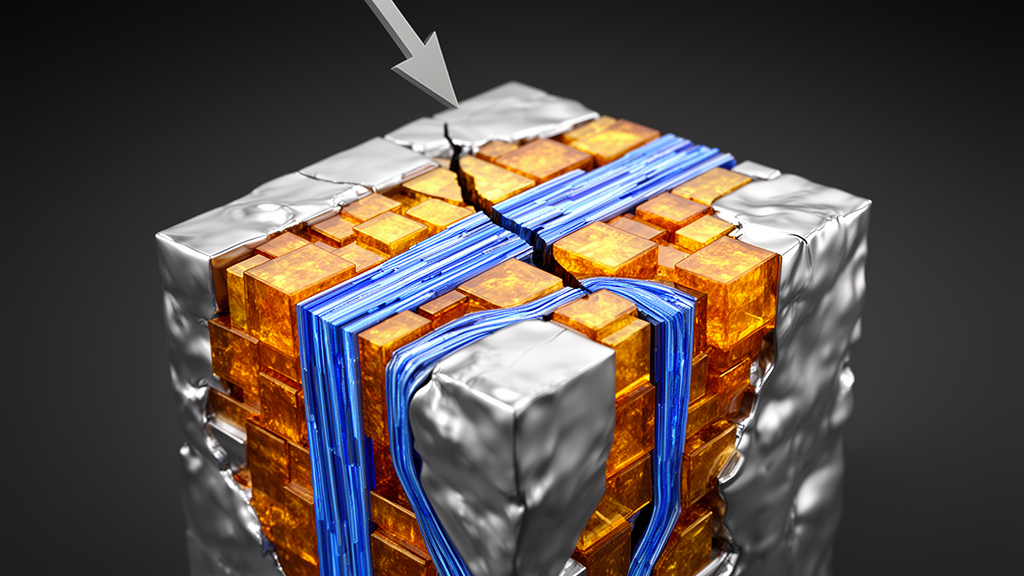
Image Credits: AI Generated

DOI: 10.1007/s10853-026-13695-8

Keywords: high-entropy alloys, Al0.6CoCrFeNi, molecular dynamics, tensile deformation, FCC, BCC, B2 phase, ultimate tensile strength, Young's modulus, strain rate sensitivity, dislocation, shear localization

Cite Scienmag News

Neil Sanderson. (October 28, 2026). Phase Mix Dictates Strength and Stability of Al0.6CoCrFeNi High-Entropy Alloy. Scienmag. https://scienmag.com/phase-mix-dictates-strength-and-stability-of-al0-6cocrfeni-high-entropy-alloy/


Neil Sanderson. "Phase Mix Dictates Strength and Stability of Al0.6CoCrFeNi High-Entropy Alloy." Scienmag, 28 October 2026, https://scienmag.com/phase-mix-dictates-strength-and-stability-of-al0-6cocrfeni-high-entropy-alloy/. Accessed 28 October 2026.

Neil Sanderson. "Phase Mix Dictates Strength and Stability of Al0.6CoCrFeNi High-Entropy Alloy." Scienmag. October 28, 2026. https://scienmag.com/phase-mix-dictates-strength-and-stability-of-al0-6cocrfeni-high-entropy-alloy/
Tags: Al0.6CoCrFeNiAl0.6CoCrFeNi microstructure analysisB2 phaseB2 phases in high-entropy alloysBCCdefect-mediated plasticity in FCC phasesdislocationFCChigh entropy alloysHigh-entropy alloy phase stabilityinfluence of phase composition on high-rate loadingmolecular dynamicsmolecular dynamics simulations of alloy microstructuresmulti-phase high-entropy alloy deformation mechanismsphase-dependent deformation mechanisms in alloysshear localizationstrain accommodation in multi-phase alloysstrain-rate sensitivitytemperature effects on alloy strength and ductilitytensile deformationtensile strength and Young's modulus in complex alloysultimate tensile strengthYoung's modulus
Share26Tweet16
Previous Post

Heat and illness compound to squeeze rural Ugandan household consumption

Next Post

Genetic Testing Could Reshape Emergency Prescribing, but the Evidence Is Not There Yet

Related Posts

Saliva proteins may flag orthodontic root resorption, pilot study suggests
Biotechnology

Saliva proteins may flag orthodontic root resorption, pilot study suggests

October 28, 2026
Magnesium-Doped Bioactive Glass Hydrocolloid Dressing Associated With Faster Acute Wound Closure in Rabbit Model
Technology and Engineering

Magnesium-Doped Bioactive Glass Hydrocolloid Dressing Associated With Faster Acute Wound Closure in Rabbit Model

October 28, 2026
Dual Solutions Reveal Which Shrinking-Cylinder Nanofluid Flows Can Truly Exist
Technology and Engineering

Dual Solutions Reveal Which Shrinking-Cylinder Nanofluid Flows Can Truly Exist

October 28, 2026
Coal mine overburden sand matches conventional concrete performance in M20 mixes
Technology and Engineering

Coal mine overburden sand matches conventional concrete performance in M20 mixes

October 28, 2026
Chemical potentials offer a new way to explain capillary pressure in tubes
Technology and Engineering

Chemical potentials offer a new way to explain capillary pressure in tubes

October 28, 2026
ResNet50 Meets Transformer to Push Facial Emotion Recognition to 89.7 Percent on FER2013
Technology and Engineering

ResNet50 Meets Transformer to Push Facial Emotion Recognition to 89.7 Percent on FER2013

October 28, 2026
Next Post
Genetic Testing Could Reshape Emergency Prescribing, but the Evidence Is Not There Yet

Genetic Testing Could Reshape Emergency Prescribing, but the Evidence Is Not There Yet

  • Mothers who receive childcare support from maternal grandparents show more optimized

    Mothers who receive childcare support from maternal grandparents show more parental warmth, finds NTU Singapore study

    27656 shares
    Share 11059 Tweet 6912
  • University of Seville Breaks 120-Year-Old Mystery, Revises a Key Einstein Concept

    1061 shares
    Share 424 Tweet 265
  • Bee body mass, pathogens and local climate influence heat tolerance

    682 shares
    Share 273 Tweet 171
  • Researchers record first-ever images and data of a shark experiencing a boat strike

    546 shares
    Share 218 Tweet 137
  • Groundbreaking Clinical Trial Reveals Lubiprostone Enhances Kidney Function

    531 shares
    Share 212 Tweet 133
Science

Embark on a thrilling journey of discovery with Scienmag.com—your ultimate source for cutting-edge breakthroughs. Immerse yourself in a world where curiosity knows no limits and tomorrow’s possibilities become today’s reality!

RECENT NEWS

  • Stress Hyperglycemia Ratio Predicts Death in Atrial Fibrillation Only in Patients With Normal Glucose
  • HSP90B1 drives cardiomyocyte pyroptosis and inflammation after heart attack, mouse study finds
  • Saliva proteins may flag orthodontic root resorption, pilot study suggests
  • Ciprofol eases emergence agitation after laparoscopic surgery better than propofol

Categories

  • Agriculture
  • Anthropology
  • Archaeology
  • Athmospheric
  • Biology
  • Biotechnology
  • Blog
  • Bussines
  • Cancer
  • Chemistry
  • Climate
  • Earth Science
  • Editorial Policy
  • Marine
  • Mathematics
  • Medicine
  • Pediatry
  • Policy
  • Psychology & Psychiatry
  • Science Education
  • Science News
  • Social Science
  • Space
  • Technology and Engineering

Subscribe to Blog via Email

Enter your email address to subscribe to this blog and receive notifications of new posts by email.

Join 5,151 other subscribers

© 2025 Scienmag - Science Magazine

Welcome Back!

Login to your account below

Forgotten Password?

Retrieve your password

Please enter your username or email address to reset your password.

Log In
No Result
View All Result
  • HOME
  • SCIENCE NEWS
  • CONTACT US

© 2025 Scienmag - Science Magazine

Discover more from Science

Subscribe now to keep reading and get access to the full archive.

Continue reading