


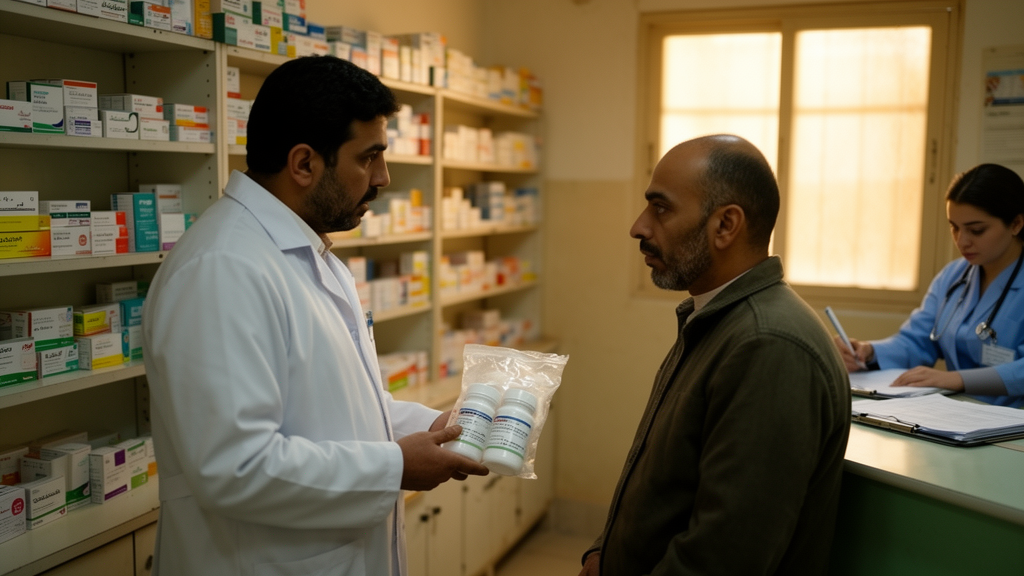
Kidney transplantation is often described as the beginning of a new life for patients with end-stage renal disease, but the surgery itself is only one chapter of a much longer story. What follows is a lifelong dependence on immunosuppressive medications, careful monitoring of drug interactions, and continuous education about how to take complex regimens safely. In wealthy health systems, a multidisciplinary team of nephrologists, transplant surgeons, clinical pharmacists, and nurses shares this burden. In many low-resource countries, however, the structure that supports such teamwork is thin or missing altogether. A new qualitative study from Baghdad, published in PLOS One, offers a rare, ground-level view of how kidney transplant care actually functions in Iraq, told through the eyes of the professionals who manage its medications: hospital pharmacists.
The research, conducted by Sarah M. Faisal and Samer Imad Mohammed, set out to explore the barriers and enablers that shape transplant care delivery in Iraq from the perspective of pharmacists working at the front line. The investigators chose a qualitative design, conducting face-to-face, semi-structured interviews with every eligible pharmacist at the two major governmental hospitals in Baghdad that care for kidney transplant recipients. In total, thirteen pharmacists participated: five worked inside the clinical transplant wards, embedded directly with inpatient care, while the remaining eight operated in outpatient consultation settings, where transplant recipients return for follow-up and prescriptions. By interviewing the full eligible population rather than a sample, the study captured a complete picture of pharmacist experience within these two institutions.
To make sense of the interview material, the researchers applied Braun and Clarke’s reflexive thematic analysis, a widely used qualitative method in which researchers systematically code transcripts and iteratively group codes into themes that capture shared patterns of meaning. Reflexive thematic analysis is particularly suited to exploratory questions about how professionals experience their roles, because it treats the analyst’s interpretive engagement with the data as an explicit part of the process rather than pretending that themes simply emerge on their own. From this analysis, four descriptive themes crystallized, and together they sketch a portrait of a health system that is simultaneously constrained and remarkably resourceful.
The first theme concerns the pharmacists’ professional role itself: dispensing-centered practice within a constrained and evolving role. In principle, modern clinical pharmacy envisions pharmacists as medication experts who review prescriptions, adjust dosing for kidney function, counsel patients on immunosuppressant adherence, and flag dangerous interactions between transplant drugs and other medications. In practice, the Iraqi pharmacists described roles that remained anchored to the dispensing bench. The demands of high patient volumes, limited staffing, and entrenched institutional expectations kept much of their time tied to supplying medicines rather than optimizing their use. Yet the interviews also revealed evolution: pharmacists were gradually extending their contributions into patient-facing territory, even when formal job descriptions and organizational structures had not caught up with what they were actually doing on the ward.
The second theme, fragmented yet adaptive interprofessional collaboration, addresses how pharmacists work alongside physicians and nurses. Effective transplant care depends on seamless communication, because immunosuppressive regimens are narrow-therapeutic-index therapies in which small errors can trigger rejection or toxicity. The study found that collaboration between professions existed but ran through informal channels rather than structured pathways. Pharmacists described adapting to this fragmentation by building personal relationships with clinicians, seeking out information when systems did not deliver it, and improvising communication workarounds to make sure patients did not fall through the cracks. These adaptive behaviors kept care moving, but the researchers emphasize that they are no substitute for the formal communication infrastructure that transplant medicine requires.
Patient education formed the third theme, described as an informal and inconsistently delivered practice. For transplant recipients, understanding how and when to take medications, recognizing warning signs of rejection or infection, and knowing which drugs to avoid are not optional extras; they are core determinants of graft survival. The pharmacists in the study reported that education happened, but unevenly, depending on individual initiative, available time, and the pressures of the moment rather than on a standardized protocol. Some patients received thorough counseling; others left with far less. The inconsistency means that the quality of a patient’s medication knowledge may depend less on clinical need than on circumstance, a finding with direct implications for adherence and long-term outcomes.
The fourth theme examined medication availability within a constrained and variably regulated supply system. Even the best clinical advice is meaningless if the medicine is not on the shelf. The pharmacists described a supply environment marked by shortages, variability, and uneven regulation, forcing them to find creative routes to maintain access to essential transplant medications. They worked around gaps in stock, navigated an imperfectly regulated marketplace, and improvised solutions so that patients could continue their regimens without interruption. The study highlights these adaptive approaches as evidence of professional commitment, but it also makes clear that such improvisation places a fragile bridge between patients and the consistent drug supply that transplantation demands.
What makes this study notable is not simply that it documents shortages or staffing gaps, problems familiar across many low-resource health systems, but that it frames them through the specific lens of pharmacy in transplant care. Immunosuppressive therapy sits at the intersection of pharmacology, monitoring, and patient behavior, making pharmacists uniquely positioned to identify where the system strains. Their testimony suggests that the challenges of Iraqi transplant care extend beyond what any individual professional can resolve. A pharmacist can counsel a patient about tacrolimus timing, but cannot single-handedly build a regulated supply chain, formalize communication pathways, or redesign institutional role definitions. The authors argue that the findings point toward the need for structured organizational support, clearer communication channels between professions, and an integrated system to strengthen transplant care practices in Iraqi governmental hospitals and comparable settings.
The research also carries a broader message for global transplant medicine. Kidney transplantation is expanding worldwide, and as it reaches countries with limited resources, the question of how medication expertise is integrated into care becomes decisive. The Baghdad study suggests that pharmacists in these settings are already performing many of the functions of clinical pharmacy informally, without recognition, protocols, or adequate resources. Formalizing what they already do, through defined clinical roles, standardized patient education, and reliable medication supply, could convert individual improvisation into system-level resilience. In that sense, the experiences of thirteen pharmacists in two Baghdad hospitals illuminate a challenge that resonates far beyond Iraq: transplantation saves lives, but only when the medication systems behind it are built to last.
Published in PLOS One, the study adds an important qualitative dimension to a literature dominated by clinical outcome data, reminding the field that behind every graft survival statistic stands a web of human workarounds, informal collaborations, and quiet professional persistence. For policymakers in Iraq and similar health systems, the message from the pharmacists is clear: the will and the skill are already present at the dispensary window. What is missing is the organizational architecture to let them operate at full strength.
Subject of Research: Pharmacists' perspectives on barriers and enablers in kidney transplant care delivery in Iraqi governmental hospitals
Article Title: Barriers and enablers shaping kidney transplant care delivery: Insights from Iraqi pharmacists
Article References: Barriers and enablers shaping kidney transplant care delivery: Insights from Iraqi pharmacists. (n.d.). https://doi.org/10.1371/journal.pone.0360647
Image Credits: AI Generated
DOI: 10.1371/journal.pone.0360647
Keywords: kidney transplantation, pharmacists, Iraq, qualitative research, thematic analysis, medication access, interprofessional collaboration, patient education, immunosuppressive therapy, health systems, PLOS One, Baghdad
Cite Scienmag News
Courtney Benton. (October 14, 2026). Pharmacists Reveal Hidden Struggles in Iraq’s Kidney Transplant Care. Scienmag. https://scienmag.com/pharmacists-reveal-hidden-struggles-in-iraqs-kidney-transplant-care/
Courtney Benton. "Pharmacists Reveal Hidden Struggles in Iraq’s Kidney Transplant Care." Scienmag, 14 October 2026, https://scienmag.com/pharmacists-reveal-hidden-struggles-in-iraqs-kidney-transplant-care/. Accessed 14 October 2026.
Courtney Benton. "Pharmacists Reveal Hidden Struggles in Iraq’s Kidney Transplant Care." Scienmag. October 14, 2026. https://scienmag.com/pharmacists-reveal-hidden-struggles-in-iraqs-kidney-transplant-care/


