


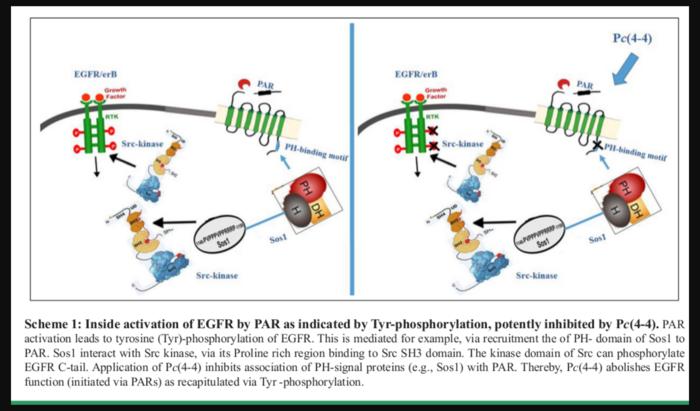
“We have identified binding motifs within the C-tails of PAR1,2&4, indispensable for cancer growth and development.”

Credit: 2024 Nag et al.
“We have identified binding motifs within the C-tails of PAR1,2&4, indispensable for cancer growth and development.”
BUFFALO, NY- May 24, 2024 – A new editorial paper was published in Oncoscience (Volume 11) on April 25, 2024, entitled, “PH-binding motifs as a platform for drug design: Lessons from protease-activated receptors; PARs.”
While targeted cancer therapy is greatly dependent on specific oncogenic pathways or conferred by genetic alterations, it remains yet challenging and somewhat disappointing. The high level of failure relies on the interplay between the dose for desired therapy versus toxicity, namely the therapeutic index. Furthermore, one should take into consideration resistance response that develops with time to a given drug, contributing immensely to the given drawback.
In this new editorial, researchers Jeetendra Kumar Nag, Amnon Hoffman, Chaim Gilon, Beatrice Uziely, and Rachel Bar-Shavit from Hadassah-Hebrew University Medical Center and The Hebrew University highlight the need for alternative targeting routes.
“Although the contribution of G-protein-coupled receptors (GPCRs) in cancer malignancy is growing, GPCR-based therapies are rare.”
Importantly, GPCRs are involved in many aspects of tumorigenesis, including proliferation, invasion, survival at secondary sites, cancer stemness and cancer associated signaling pathways. Indeed, big data population analyses indicate the significance of GPCRs as valuable targets for therapy in cancer. Protease activated receptors (PARs), a subgroup of GPCRs, form a family of four members; PAR1-4.
“TCGA and GTEx database show that PAR2/F2RL1 is significantly overexpressed in many types of epithelial malignancies among of which are colon [3], breast [4] and ovarian cancers [5].”
Continue reading: DOI: https://doi.org/10.18632/oncoscience.599
Correspondence to: Rachel Bar-Shavit
Email: rachelbar@ekmd.huji.ac.il
About Oncoscience:
Oncoscience is a peer-reviewed, open-access, traditional journal covering the rapidly growing field of cancer research, especially emergent topics not currently covered by other journals. This journal has a special mission: Freeing oncology from publication cost. It is free for the readers and the authors.
To learn more about Oncoscience, visit Oncoscience.us and connect with us on social media:
For media inquiries, please contact media@impactjournals.com.
Oncoscience Journal Office
6666 East Quaker Str., Suite 1D
Orchard Park, NY 14127
Phone: 1-800-922-0957, option 4
###
Journal
Oncoscience
Method of Research
Commentary/editorial
Subject of Research
People
Article Title
PH-binding motifs as a platform for drug design: Lessons from protease-activated receptors; PARs
Article Publication Date
25-Apr-2024
Cite Scienmag News
Nathaniel Bowman. (May 24, 2024). PH-binding motifs as a platform for drug design: Lessons from protease-activated receptors (PARs). Scienmag. https://scienmag.com/ph-binding-motifs-as-a-platform-for-drug-design-lessons-from-protease-activated-receptors-pars/
Nathaniel Bowman. "PH-binding motifs as a platform for drug design: Lessons from protease-activated receptors (PARs)." Scienmag, 24 May 2024, https://scienmag.com/ph-binding-motifs-as-a-platform-for-drug-design-lessons-from-protease-activated-receptors-pars/. Accessed 4 September 2026.
Nathaniel Bowman. "PH-binding motifs as a platform for drug design: Lessons from protease-activated receptors (PARs)." Scienmag. May 24, 2024. https://scienmag.com/ph-binding-motifs-as-a-platform-for-drug-design-lessons-from-protease-activated-receptors-pars/

