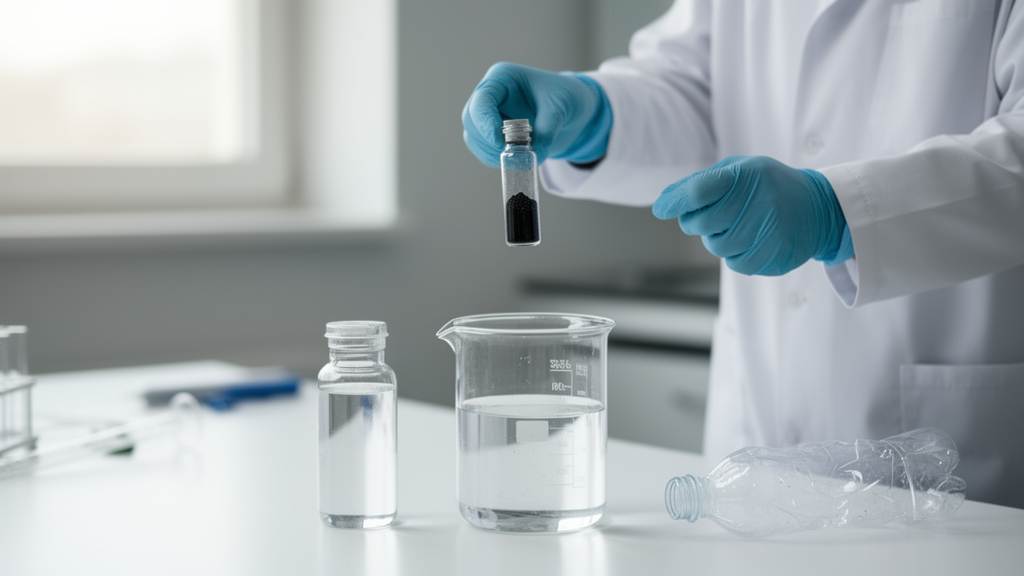
Researchers have converted discarded polyethylene terephthalate bottles, together with acid mine drainage, into a magnetic mesoporous carbon that removes two persistent per- and polyfluoroalkyl substances from water. The material, named AMD-mag@PET-MPC, was tested as an adsorbent for perfluorooctanoic acid (PFOA) and perfluoroundecanoic acid (PFUnDA), and was also deployed as the extraction phase in a magnetic solid phase extraction method paired with ultra-high-performance liquid chromatography tandem mass spectrometry.
The study, published in BMC Chemistry on 15 October 2026 as an open access research article, was authored by Bongiwe Apatia Mvala, Tshimangadzo S. Munonde, Mokae Fanuel Bambo, Kgabo Phillemon Matabola and Philiswa Nosizo Nomngongo. The publisher notes that the article is being shared early as a peer-reviewed, accepted version that is citable and carries a permanent DOI, subject to further edits before the final Version of Record.
Under optimised conditions, the equilibrium adsorption data were best described by the Langmuir isotherm model. The maximum adsorption capacities reached 356 milligrams per gram for PFOA and 225 milligrams per gram for PFUnDA, indicating that the material took up both compounds efficiently, with somewhat higher capacity for the shorter-chain PFOA molecule.
Kinetic analysis showed that the adsorption data best fit the pseudo-second-order model, which the authors interpret as evidence that chemisorption is involved in the uptake process. Thermodynamic data indicated that the adsorption is feasible, random and spontaneous in nature, meaning the process proceeds favourably under the tested conditions without requiring external driving forces.
The proposed adsorption mechanism involves three types of interactions: hydrogen bonding, pi–pi interactions and electrostatic interactions.
Beyond batch adsorption, the team used the AMD-mag@PET-MPC adsorbent as the extraction phase in magnetic solid phase extraction of PFOA and PFUnDA from surface water and wastewater samples. The magnetic character of the material allows it to be separated from the sample solution simply and then used for enrichment of the target compounds before instrumental analysis.
The analytical performance of the resulting MSPE/UHPLC-MS/MS method was assessed under optimised conditions. Linear ranges of 1.7 to 5000 nanograms per litre for PFOA and 0.6 to 5000 nanograms per litre for PFUnDA were obtained, with correlation coefficients above 0.99 for both analytes. Limits of detection ranged from 0.19 to 0.5 nanograms per litre, and limits of quantification ranged from 0.6 to 1.7 nanograms per litre.
Precision testing showed relative standard deviations below 5 percent for both intraday and interday measurements, indicating that the method produces repeatable results across repeated analyses within a single day and across different days.
The feasibility of the developed method was evaluated in real surface water and wastewater samples. Relative extraction recoveries ranged from 80 to 99 percent in wastewater and from 87 to 105 percent in surface water, demonstrating that the extraction performs reliably across different water matrices at environmentally relevant concentrations.
By deriving the adsorbent from PET bottle waste and acid mine drainage, the work links two waste streams to the treatment of a third environmental problem, PFAS contamination. The reported capacities, detection limits and recovery figures together describe a laboratory-validated adsorbent and analytical workflow whose performance in broader field applications would need to be established by further testing.
Subject of Research: A PET-waste-derived magnetic mesoporous carbon for adsorptive removal and magnetic solid phase extraction of PFOA and PFUnDA in water.
Article Title: Adsorptive removal and enrichment of perfluorooctanoic acid and perfluoroundecanoic acid in water using polyethylene terephthalate bottle waste-derived magnetic mesoporous carbon
Article References: Mvala, B. A., Munonde, T. S., Bambo, M. F., Matabola, K. P., & Nomngongo, P. N. (2026). Adsorptive removal and enrichment of perfluorooctanoic acid and perfluoroundecanoic acid in water using polyethylene terephthalate bottle waste-derived magnetic mesoporous carbon. BMC Chemistry. https://doi.org/10.1186/s13065-026-01946-3
Image Credits: AI Generated
DOI: 10.1186/s13065-026-01946-3
Keywords: PFAS, PFOA, PFUnDA, PET bottle waste, magnetic mesoporous carbon, acid mine drainage, adsorption, magnetic solid phase extraction, water treatment, UHPLC-MS/MS, wastewater analysis, Adsorptive
Cite Scienmag News
Bethany Barker. (October 28, 2026). PET Bottle Waste Turned Into Magnetic Carbon That Captures PFAS From Water. Scienmag. https://scienmag.com/pet-bottle-waste-turned-into-magnetic-carbon-that-captures-pfas-from-water/
Bethany Barker. "PET Bottle Waste Turned Into Magnetic Carbon That Captures PFAS From Water." Scienmag, 28 October 2026, https://scienmag.com/pet-bottle-waste-turned-into-magnetic-carbon-that-captures-pfas-from-water/. Accessed 28 October 2026.
Bethany Barker. "PET Bottle Waste Turned Into Magnetic Carbon That Captures PFAS From Water." Scienmag. October 28, 2026. https://scienmag.com/pet-bottle-waste-turned-into-magnetic-carbon-that-captures-pfas-from-water/