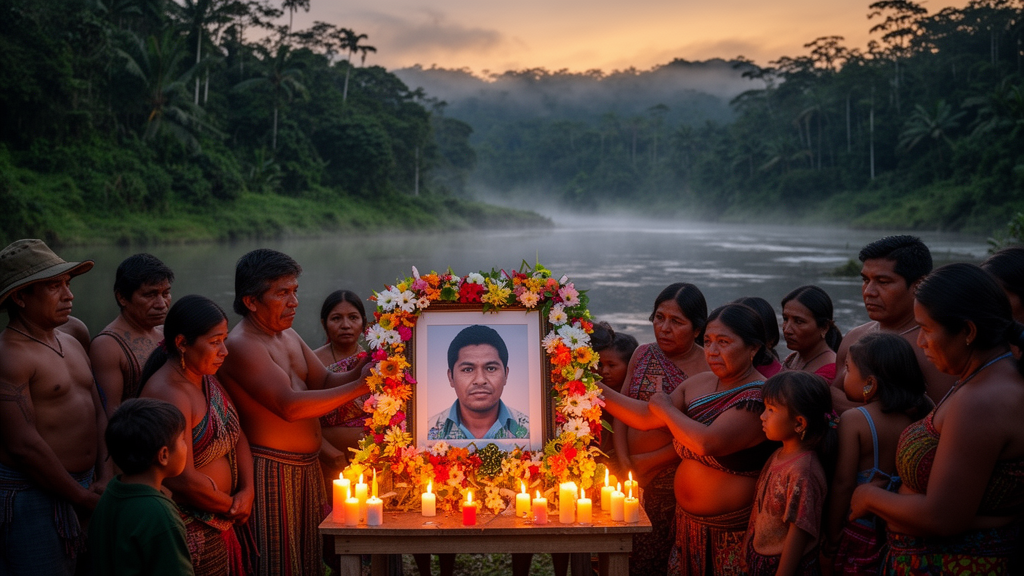
A new survey-based study finds a striking disconnect between broad public approval of environmental protection and concrete awareness of the lethal violence that those who defend forests, water, and territory actually face. The research, published in Frontiers in Political Science, argues that this gap leaves Peru’s protection policies resting on shallow foundations.
The study, conducted by Yasmin Calmet of the Federal University of Santa Catarina and Fátima Véliz of the Universidad Nacional Pedro Ruiz Gallo, drew on an anonymous online survey of 427 Peruvian adults collected through non-probabilistic convenience sampling. Respondents answered closed questions on five-point Likert scales about their environmental attitudes, their views of environmental defenders, and their support for protective laws, alongside yes-or-no knowledge items. The researchers are careful to note the design’s limits: convenience samples recruited through social media overrepresent people with internet access and higher education, so the results describe the sampled population rather than the country as a whole.
The central finding is a numerical paradox. When asked how important the work of environmental defenders is, 79.4 percent of respondents rated it as important or very important. Yet only 33.0 percent said they were aware of the murders of defenders recorded between 2013 and 2023. The 46.4 percentage-point difference between those two proportions was statistically significant on a McNemar test for paired proportions (chi-squared = 174.815, df = 1, p < 0.001). In plain terms, Peruvians in this sample overwhelmingly honored defenders in the abstract while remaining largely ignorant of the deadliest risk those defenders confront.
That ignorance cuts across education. The gap between recognizing defenders’ importance and knowing about the killings remained wide among respondents with basic education (47.8 percentage points) and among those with higher education (46 points). A chi-square test of independence found no statistically significant association between educational level and knowledge of the murders (chi-squared = 0.72, df = 1, p = 0.398, Cramer’s V = 0.041). Because 78.4 percent of the sample had higher education, the authors argue the true knowledge gap in the general population is probably larger, not smaller, than what they measured.
The survey also probed what actually drives support for protective legislation. Respondents showed strong backing for laws protecting defenders, with a mean rating of 4.3 out of 5, and 84.8 percent agreed or strongly agreed that such laws should be created. Spearman rank correlations showed that this support was positively associated with valuing defenders (r = 0.546), with rating environmental defense as important (r = 0.464), and with general environmental concern (r = 0.335), all significant at p < 0.01. Correlations between knowledge of the murders and the attitude variables, by contrast, were uniformly weak, ranging from 0.141 to 0.204 on Somer’s d.
To test whether factual knowledge shapes the attitude-support link, the researchers split the sample into those aware of the killings (n = 141) and those unaware (n = 286) and compared correlations within each group using Fisher’s z transformation. The results were nearly identical: for the importance of defenders, r = 0.523 versus 0.518 (p = 0.945); for environmental defense, r = 0.432 versus 0.447 (p = 0.861); for environmental concern, r = 0.329 versus 0.305 (p = 0.804). None of the differences approached significance. Knowing about the violence, in other words, did not make pro-environmental citizens more supportive of protection policies than those who did not know.
The authors interpret this pattern through political scientist David Beetham’s distinction between normative and substantive legitimacy. Normative legitimacy means accepting that an actor or institution matters; substantive legitimacy requires understanding why that acceptance is justified. Peruvian citizens in this sample displayed the first without the second. They recognized defenders as important, but their support for protection laws was anchored in general environmental values rather than in any informed reaction to the documented violence.
The context gives these numbers their weight. According to figures the authors cite from Global Witness and the Coordinadora Nacional de Derechos Humanos, 89 deaths of environmental and Indigenous rights defenders were recorded in Peru between 2000 and 2025, and 741 defenders were criminalized or prosecuted. Peru signed the Escazú Agreement, the only international treaty with specific provisions for protecting environmental defenders, in 2018, but the Foreign Relations Commission of the Peruvian Congress refused to ratify it in 2021, and the country is not a full party. The authors argue that without an informed citizenry, political pressure to change that outcome will remain weak, because abstract goodwill does not translate into sustained demands for implementation.
Why does the information gap persist even among the highly educated? The authors offer three candidate mechanisms, while stressing that their data cannot confirm them. First, a discursive asymmetry: environmental discourse circulates widely in abstract terms such as nature, climate change, and biodiversity, while violence against defenders stays invisible; open-ended survey answers supported this, with respondents defining the environment in generic terms and naming global concerns without ever mentioning defenders. Second, geographic and psychological distance, since killings occur mostly in Amazonian and Andean territories far from urban middle-class life, though exploratory cross-tabulations found no significant regional association, leaving this a conjecture for future research. Third, an institutional visibility gap, in which legislative changes affecting defenders, such as the 2024 forestry law amendment criticized for relaxing land-use restrictions without consulting Indigenous communities, remain largely unknown to the public.
The study’s conclusions carry clear caveats. The cross-sectional design cannot establish causality, so the authors cannot say whether learning about the killings would increase support for protection. The single-item measure of policy support limits reliability, and knowledge was assessed only for lethal violence, not for criminalization or institutional vulnerability. The convenience sample prevents generalization to all Peruvians. What the data do establish is narrower but consequential: within this sample, recognition of defenders ran far ahead of knowledge of their risks, the gap did not close with schooling, and support for protection rested on values rather than facts. The authors propose longitudinal surveys, samples from rural and Indigenous communities, media content analysis, and experimental tests of communication strategies as next steps for converting normative approval into the informed public pressure that effective protection policies would require.
Subject of Research: Citizen perceptions of environmental defenders in Peru and the gap between public recognition and knowledge of violence against them
Article Title: Environmental defenders in Peru: the paradox of citizen perceptions and its implications for public policy
Article References: Calmet, Y., & Véliz, F. (2026). Environmental defenders in Peru: the paradox of citizen perceptions and its implications for public policy. Frontiers in Political Science, 8, 1883904. https://doi.org/10.3389/fpos.2026.1883904
Image Credits: AI Generated
DOI: 10.3389/fpos.2026.1883904
Keywords: environmental defenders, Peru, public opinion, social legitimacy, Escazú Agreement, environmental governance, McNemar test, convenience sampling, extractivism, protection policies, criminalization, survey research
Cite Scienmag News
Courtney Benton. (October 28, 2026). Peruvians Value Environmental Defenders but Ignore the Killings They Face. Scienmag. https://scienmag.com/peruvians-value-environmental-defenders-but-ignore-the-killings-they-face/
Courtney Benton. "Peruvians Value Environmental Defenders but Ignore the Killings They Face." Scienmag, 28 October 2026, https://scienmag.com/peruvians-value-environmental-defenders-but-ignore-the-killings-they-face/. Accessed 28 October 2026.
Courtney Benton. "Peruvians Value Environmental Defenders but Ignore the Killings They Face." Scienmag. October 28, 2026. https://scienmag.com/peruvians-value-environmental-defenders-but-ignore-the-killings-they-face/