


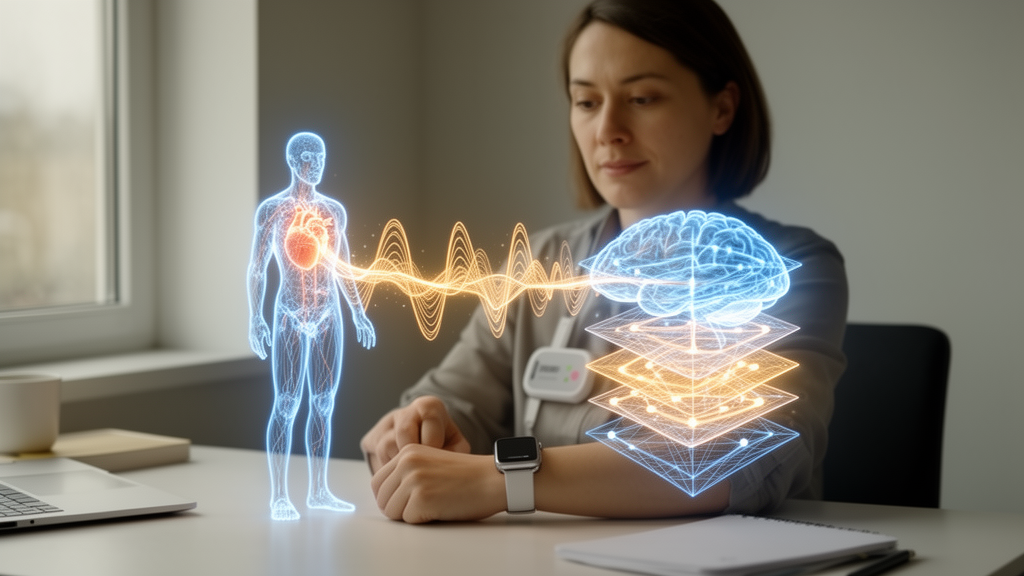
Chronic stress has become one of the defining health burdens of the modern era, quietly fueling hypertension, depression, burnout, and cognitive decline while remaining stubbornly difficult to measure. The standard tools of clinical practice, self-report questionnaires and one-off evaluations, are subjective, episodic, and fundamentally mismatched to a physiological response that fluctuates minute by minute. Now, a study published in Frontiers in Physiology proposes a strikingly elegant solution: give every stress-detection algorithm its own miniature digital twin, a learned physiological fingerprint of each wearer, and let that fingerprint guide the interpretation of every heartbeat, sweat response, and movement artifact the smartwatch records.
The research, led by Hadeel Alharbi of the University of Ha’il in Saudi Arabia, introduces a framework called DT-GRU, short for Digital Twin-Enhanced Gated Recurrent Unit. The core insight is disarmingly simple. When the same external stressor strikes two different people, it elicits qualitatively different physiological patterns, shaped by physical characteristics, prior stress exposure, and personality. A signal pattern that screams stress in one individual may be entirely unremarkable in another. Yet most existing deep learning models are trained in a subject-agnostic manner, learning population-level representations that average away exactly the individual variability that matters most. Alharbi’s answer is to encode subject identity directly into the model’s inference pathway as a trainable latent embedding, a compact parametric digital twin that captures each person’s unique physiological traits without any post-training calibration.
The technical machinery behind this idea is worth unpacking. The framework draws on the WESAD dataset, the community’s standard benchmark for wearable stress and affect detection, which provides synchronized multimodal physiological recordings from 15 subjects across baseline, stress, and amusement conditions. Raw wrist-worn signals, including three-axis accelerometry, blood volume pulse, electrodermal activity, and skin temperature, are resampled to a common 4 Hz frequency using Fourier-based resampling, then fused into a six-channel multivariate time series encoding the wearer’s complete physiological state at every timestep. Each channel is normalized per subject using Z-score standardization, a crucial step that removes natural inter-subject scale differences, such as widely varying baseline electrodermal levels, so the model learns deviations from each person’s own baseline rather than the population average.
The normalized signals are then segmented into 30-second sliding windows with a 10-second step size, yielding 120 samples per window at the target sampling rate. These windows flow through a dual-branch architecture. The first branch is a stacked GRU temporal encoder, with 64 units in the first layer and 32 in the second, that sequentially processes each window to capture stress-related temporal dynamics, from low-level patterns to higher-level physiological sequences. The second branch is the digital twin embedding module, a trainable matrix in which each row corresponds to one of the 15 subjects and each column is a learned latent physiological dimension. A simple lookup on the integer subject identity yields a 16-dimensional vector that is updated end-to-end during training via backpropagation, with L2 regularization preventing the embeddings from fitting to subject-specific noise.
The two branches are then concatenated into a 48-dimensional fused representation, preserving the full information content of both the temporal dynamics and the subject identity without compression. A fully connected Dense layer with ReLU activation learns flexible interactions between these features, a Dropout layer guards against overfitting, and a single-unit sigmoid output produces the binary stress probability. The entire model contains just 25,073 trainable parameters, roughly 98 KB in memory, a strikingly lightweight footprint compared to the CNN-LSTM hybrids and attention-based networks that dominate the field. Training uses the Adam optimizer with weighted binary cross-entropy loss to handle class imbalance, and early stopping halts training when validation loss stops improving.
The results are impressive. Under a standard subject-independent train-test split, where roughly one-third of subjects are held out entirely from training, the DT-GRU model achieves 97.29 percent test accuracy and an area under the ROC curve of 0.9932 on 1,107 held-out windows. The confusion matrix reveals just 11 false negatives among 335 actual stressed windows, meaning the model misses fewer than 3.3 percent of real stress episodes, and 19 false positives among 772 non-stressed windows, a negligible 2.5 percent false alarm rate. Precision for the stressed class reaches 0.94 with recall of 0.97, and the ROC curve hugs the upper-left corner of the graph, the hallmark of a classifier operating near the theoretical ideal across all decision thresholds.
The more demanding evaluation, Leave-One-Subject-Out cross-validation, tells a more nuanced story. Here, a fresh model is trained from scratch 15 times, each time holding out one subject entirely, to test whether the framework generalizes to unseen individuals. The mean LOSO AUC comes in at 0.8816, with 10 of 15 subjects achieving an AUC above 0.96 and five subjects, S2, S4, S10, S13, and S15, attaining a perfect 1.0000. However, the standard deviation of 0.2268 is driven primarily by three underperforming subjects, including one with an AUC of just 0.1502, an outlier whose physiological response to the laboratory stress induction protocol appears fundamentally atypical. This subject-level variability is consistent with well-documented inter-subject physiological heterogeneity in stress responses and highlights the inherent challenge of cross-subject generalization, suggesting that future work should explore few-shot calibration or subject-specific fine-tuning for physiologically atypical individuals.
An ablation study confirms that the digital twin embedding is doing real work. Removing it drops accuracy from 96.57 to 96.30 percent under the same evaluation protocol, while varying the embedding dimension reveals a sweet spot: too small an embedding slightly reduces performance, while too large an embedding, at 32 dimensions, actually degrades results, presumably because it overfits the limited number of subjects in WESAD. A larger GRU stack with 128 and 64 units pushes accuracy to 98.10 percent but nearly quadruples the parameter count to 92,337, while a single GRU layer with the digital twin embedding remains competitive with just 16,689 parameters. The proposed configuration, GRU(64,32) with a 16-dimensional embedding, strikes a deliberate balance between classification performance, computational efficiency, and suitability for deployment on wearable edge devices.
Feature importance analysis adds clinical interpretability to what might otherwise be a black-box system. By independently zeroing out each physiological channel and measuring the resulting AUC degradation, the study finds that electrodermal activity dominates the classification, with an AUC reduction of 0.4342 when removed, far exceeding all other modalities. This aligns squarely with the physiology, as EDA directly reflects sympathetic nervous system activation and sweat gland activity, both tightly linked to psychological stress. Skin temperature contributes minimally but measurably, while blood volume pulse and accelerometry channels show negligible degradation in this experimental context, indicating the model primarily leverages EDA signals with supplementary information from the other modalities.
Perhaps most compelling is the deployment story. The model was successfully converted to TensorFlow Lite, producing a compact 56.90 KB artifact compatible with standard mobile and edge inference pipelines, including ARM-based devices like Raspberry Pi, Android, and iOS platforms. Average single-window inference time on CPU measured 96.50 milliseconds, consuming less than 1 percent of the available decision budget per 10-second window, and batch-mode throughput exceeds 500 windows per second. In a real-world scenario, physiological data from a wrist-worn sensor would stream over Bluetooth Low Energy to a co-located smartphone, where the GRU encoder continuously reads the updated temporal buffer and the digital twin embedding provides lightweight personalization for each subject during inference. The system can compute a new stress prediction every 10 seconds using only the latest 30 seconds of physiological data, an accurate, low-latency pipeline for continuous monitoring. Data augmentation with Gaussian noise and window jittering further strengthens the framework, pushing test accuracy to 97.65 percent and AUC to 0.9967, and future cross-dataset validation on SWELL-KW, UBFC-Phys, and K-EmoCon will test robustness across larger, more ecologically representative populations. The digital twin paradigm, long confined to modeling anatomy and disease progression, has now formally entered affective computing, and the implications for scalable mental health monitoring are hard to overstate.
Subject of Research: Personalized stress detection from wearable physiological signals via Digital Twin-inspired subject embeddings and recurrent neural networks
Article Title: Personalized stress detection from wearable physiological signals via Digital Twin-inspired subject embeddings and recurrent neural networks
Article References: Alharbi, H. (2026). Personalized stress detection from wearable physiological signals via Digital Twin-inspired subject embeddings and recurrent neural networks. Frontiers in Physiology, 17, Article 1881803. https://doi.org/10.3389/fphys.2026.1881803
Image Credits: AI Generated
DOI: 10.3389/fphys.2026.1881803
Keywords: stress detection, wearables, digital twin, GRU, recurrent neural networks, subject embeddings, WESAD, personalization, physiological signals, machine learning, mental health monitoring, edge deployment
Cite Scienmag News
Cassandra Pierce. (October 16, 2026). Personalized stress detection from wearable physiological signals via Digital Twin-inspired subject embeddings and recurrent neural networks. Scienmag. https://scienmag.com/personalized-stress-detection-from-wearable-physiological-signals-via-digital-twin-inspired-subject-embeddings-and-recurrent-neural-networks/
Cassandra Pierce. "Personalized stress detection from wearable physiological signals via Digital Twin-inspired subject embeddings and recurrent neural networks." Scienmag, 16 October 2026, https://scienmag.com/personalized-stress-detection-from-wearable-physiological-signals-via-digital-twin-inspired-subject-embeddings-and-recurrent-neural-networks/. Accessed 16 October 2026.
Cassandra Pierce. "Personalized stress detection from wearable physiological signals via Digital Twin-inspired subject embeddings and recurrent neural networks." Scienmag. October 16, 2026. https://scienmag.com/personalized-stress-detection-from-wearable-physiological-signals-via-digital-twin-inspired-subject-embeddings-and-recurrent-neural-networks/


