


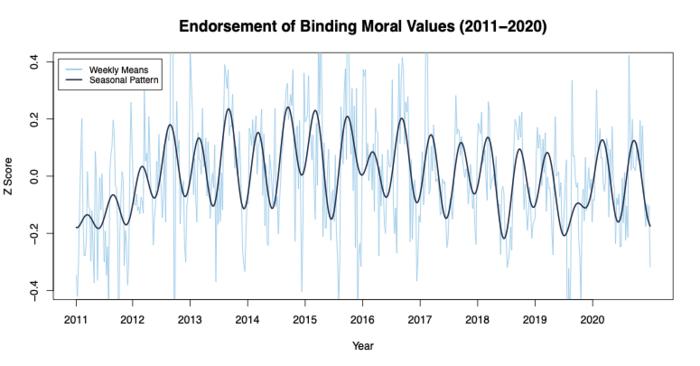
A new UBC study has revealed regular seasonal shifts in people’s moral values.

Credit: Evolutionary Social Cognition Laboratory at UBC
A new UBC study has revealed regular seasonal shifts in people’s moral values.
The finding has potential implications for politics, law and health—including the timing of elections and court cases, as well as public response to a health crisis.
The research published this week in Proceedings of the National Academy of Sciences (PNAS) analyzed survey responses from more than 230,000 people in the U.S. over 10 years and revealed that people’s embrace of certain moral values fluctuates depending on the time of year. The seasonal patterns also emerged in smaller data samples from Canada and Australia.
“People’s endorsement of moral values that promote group cohesion and conformity is stronger in the spring and fall than it is in the summer and winter,” said Ian Hohm, the study’s first author and a doctoral student in UBC’s psychology department. “Moral values are a fundamental part of how people make decisions and form judgments, so we think this finding might just be the tip of the iceberg in that it has implications for all sorts of other downstream effects.”
Since 2009, a website established by social psychology researchers has been collecting survey data that measures participants’ endorsement of five moral values:
- Loyalty: Valuing devotion to one’s group and maintaining strong group bonds.
- Authority: Respecting and following leadership and established rules.
- Purity: Emphasizing cleanliness, sanctity and upholding tradition.
- Care: Prioritizing kindness and preventing harm to others.
- Fairness: Ensuring equal treatment for everyone.
Loyalty, authority and purity are referred to by researchers as “binding” values because they encourage conformity to group norms. They also align closely with modern political conservatism. Care and fairness may be considered more liberal values, with their focus on individual rights and welfare. All have been shown by research to guide people’s judgments about right and wrong.
The researchers found that respondents endorsed the “binding” values more strongly in spring and fall, but not as much in summer and winter—a pattern that was remarkably consistent over 10 years.
They also found evidence that the summer decrease in endorsement of binding moral values was more pronounced in areas with more extreme seasonal climate differences.
Anxiety a possible explanation
The study observed a potential link between these seasonal moral shifts and levels of anxiety, using large-scale data on seasonal anxiety provided by Dr. Brian O’Shea, a co-author of the paper and assistant professor of psychology at the University of Nottingham.
“We noticed that anxiety levels peak in the spring and autumn, which coincides with the periods when people endorse binding values more strongly,” said Dr. Mark Schaller, the study’s senior author and a professor of psychology at UBC. “This correlation suggests that higher anxiety may drive people to seek comfort in the group norms and traditions upheld by binding values.”
Implications for politics, law, health, social relations
The findings have wide-reaching implications, with potential examples including:
- Elections: The timing of elections could have an impact on outcomes, as shifts in moral values influence political opinions and behaviours.
- Legal judgments: The timing of trials and legal decisions could be influenced by seasonal variations in moral values, because those who endorse “binding” values tend to be more punitive of those who commit crimes and violate social norms.
- Disease response: During the COVID-19 pandemic, the extent to which people followed social distancing guidelines and were vaccinated was influenced by their moral values. Knowing these values change with the seasons could help tailor more effective health campaigns.
- Intergroup prejudice: Seasonal changes in moral values might affect how people view outsiders or those who don’t conform to group norms.
The research team plans to delve deeper into the connections between anxiety and moral values and to investigate how these seasonal patterns influence prejudices and legal judgments.
Interview language(s): English
Journal
Proceedings of the National Academy of Sciences
Method of Research
Data/statistical analysis
Subject of Research
People
Article Title
Do moral values change with the seasons?
Article Publication Date
5-Aug-2024
Cite Scienmag News
Courtney Benton. (August 6, 2024). People’s moral values change with the seasons. Scienmag. https://scienmag.com/peoples-moral-values-change-with-the-seasons/
Courtney Benton. "People’s moral values change with the seasons." Scienmag, 6 August 2024, https://scienmag.com/peoples-moral-values-change-with-the-seasons/. Accessed 4 September 2026.
Courtney Benton. "People’s moral values change with the seasons." Scienmag. August 6, 2024. https://scienmag.com/peoples-moral-values-change-with-the-seasons/

