


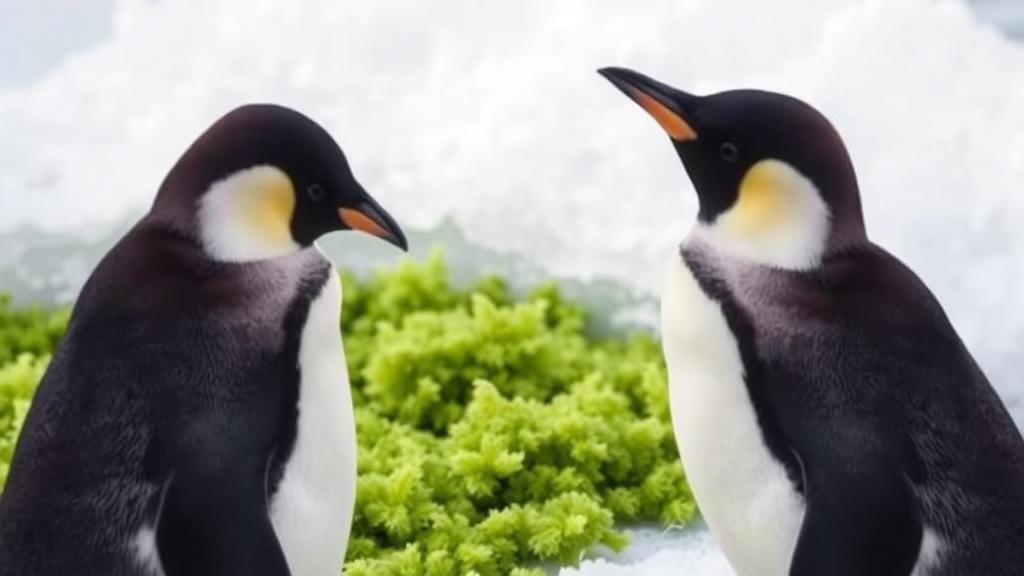
Along the rocky coastline of the West Antarctic Peninsula, something deceptively colorful is happening to the snow. Vast patches of green algae, some of them dense enough to stain entire snowfields the color of fresh grass, are spreading across the coastal snowpack, and a new study suggests that penguins are quietly fertilizing the bloom. According to research published in the Journal of Geophysical Research: Biogeosciences, the droppings that penguins track across the snow as they waddle between their colonies and the sea supply a critical nutrient, phosphate, that keeps snow algae in a green, fast-growing state. That green state matters far beyond aesthetics: green snow absorbs substantially more solar energy than clean white snow, which means these algae-tinted patches melt faster and could accelerate the expansion of ice-free terrain across Antarctica.
The study, led by Elise Ryan of Western Washington University and senior author Alia Khan, a cryosphere biogeochemist now at the University of Colorado Boulder, is the first to draw a direct link between penguin guano and the different pigmented stages of the snow algae life cycle. Khan, who began the research while at Western Washington University, argues that this biological darkening effect has been a blind spot in polar science. Without accounting for the way wildlife nutrients fuel algal blooms, she says, scientists are likely underestimating how rapidly coastal snowpacks are melting and how quickly ice-free areas will spread across the continent. In a warming Antarctic, where snow algae habitats are already expanding along the coasts, that missing piece could meaningfully reshape projections of the peninsula’s future.
To understand why penguin poop matters, it helps to understand the strange biology of Antarctic snow algae. These microscopic organisms live in the top layers of coastal snowpack and can grow densely enough to visibly change the color of the snow itself. Their appearance is not random; it reflects their physiological state. When nutrients are abundant and conditions are favorable, the algae remain metabolically active, packing their cells with green pigments such as chlorophyll to maximize photosynthesis during the brief Antarctic summer. In effect, green snow is growing snow, with the algae racing to convert sunlight into biomass during a short window of liquid water and daylight.
When nutrients run scarce or conditions turn harsh, the algae switch strategies. Instead of growing, they hunker down, producing red, sunscreen-like pigments that shield their cells from intense solar radiation while putting growth on hold. This is the phenomenon popularly known as red snow, or watermelon snow, which has long been documented in polar and alpine environments. Both colored states darken the snow relative to its clean white baseline, but they do so to very different degrees. Red snow absorbs roughly 20 percent more energy from sunlight than clean snow, and that extra absorbed energy heats the snow surface and drives additional melt.
Green snow, however, is in a league of its own. Where nutrients fuel more green pigment and a higher overall density of algae cells, the snow absorbs twice the amount of extra energy compared with the red state, about 40 percent more than clean white snow. That doubled radiative forcing translates directly into a faster melt rate, because every additional unit of solar energy absorbed at the surface goes into warming and melting the snowpack rather than being reflected back to space. In this way, a nutrient subsidy from the marine food web can cascade into a physical feedback loop: more nutrients produce greener algae, greener algae absorb more sunlight, more absorbed sunlight melts more snow, and more melting creates the wet conditions that allow algae habitats to expand further.
Gathering the evidence for this chain required some unglamorous fieldwork. The team traveled by boat across the notoriously rough seas of the Drake Passage to sample both red and green snow algae along the coast of the West Antarctic Peninsula, covering five degrees of latitude and visiting sites both with and without penguin colonies. Sampling near the colonies meant working up close with smelly bird droppings, using ceramic spoons to scoop algae-tinted snow into bags while penguins waddled through their own waste and tracked it across the snow. Khan noted that penguin poop can even visually resemble red snow algae in the field, making the work both stinky and occasionally confusing.
In the laboratory, the distinction became far clearer. Ryan and other members of Khan’s lab counted algae cells in each snow sample under a microscope and chemically extracted the pigments and nutrients each sample contained. The pattern that emerged was striking: wherever the algae cells carried predominantly green pigments, the surrounding snow contained far more phosphate, a critical nutrient found in guano, than samples where the algae displayed predominantly red, protective pigments. That correlation ties the nutritional status of the algae directly to the presence of wildlife-derived fertilizer, and it explains why blooms near penguin colonies tend to stay in their green, high-melt state rather than reverting to the redder dormant phase.
The finding, Khan explained, links the marine food web to snow ecology. After feasting on marine creatures at sea, penguins and seabirds such as skuas spread the resulting nutrients, including phosphate, over the coastal snowpack in the form of their droppings. The guano effectively acts as a fertilizer that fuels dense green snow algae blooms, connecting the productivity of the Southern Ocean to the energy balance of the snow surface above it. It is a vivid example of how biological processes and cryospheric physics interact in polar environments, and of how a colony of seabirds can influence the melt rate of the landscape around it simply by going about their daily routines.
The implications reach into how scientists model the future of Antarctica. As temperatures rise across the continent, snow algae habitats are already expanding along the coasts, darkening the surface and amplifying warming and snowmelt in a classic positive feedback. At the same time, penguins are shifting their ranges, waddling closer to the South Pole in response to changing environmental conditions. That movement creates the potential for guano-fertilized algae habitats to spread their melt-enhancing effects over a larger area than they occupy today. Yet current projections of Antarctic melting do not account for this phenomenon, because until now no study had demonstrated a direct connection between wildlife nutrient inputs and the pigmentation states that control how much energy the snow absorbs.
Khan’s team is the first to show that link, but the researchers caution that more data is needed before guano-fueled greening can be incorporated into snowmelt projections for the Antarctic Peninsula. Quantifying the effect across seasons, colonies, and latitudes will be essential to determine how much of the peninsula’s future ice-free expansion this biological darkening can explain. Still, the study makes clear that the missing component is significant: the interplay between wildlife, nutrients, and snow algae is, in Khan’s words, a critical missing component in projections of ice-free area expansion. If the green patches keep growing on the strength of penguin fertilizer, the map of Antarctica’s coastline may be redrawn faster than current models predict, one fertilized snowfield at a time.
Subject of Research: The role of penguin guano nutrients in driving green snow algae blooms and accelerated snowmelt on the West Antarctic Peninsula
Article Title: Penguin poop is melting Antarctic snow by keeping algae green
Article References: Penguin poop is melting Antarctic snow by keeping algae green. (n.d.). Original publication
Image Credits: AI Generated
DOI: Not provided
Keywords: Antarctica, snow algae, penguin guano, phosphate, snowmelt, Antarctic Peninsula, chlorophyll, albedo, cryosphere, biogeosciences, ice-free expansion, marine food web
Cite Scienmag News
Russell Cooper. (October 8, 2026). Penguin Guano Fuels Green Snow Algae That Accelerate Antarctic Melting. Scienmag. https://scienmag.com/penguin-guano-fuels-green-snow-algae-that-accelerate-antarctic-melting/
Russell Cooper. "Penguin Guano Fuels Green Snow Algae That Accelerate Antarctic Melting." Scienmag, 8 October 2026, https://scienmag.com/penguin-guano-fuels-green-snow-algae-that-accelerate-antarctic-melting/. Accessed 8 October 2026.
Russell Cooper. "Penguin Guano Fuels Green Snow Algae That Accelerate Antarctic Melting." Scienmag. October 8, 2026. https://scienmag.com/penguin-guano-fuels-green-snow-algae-that-accelerate-antarctic-melting/


