


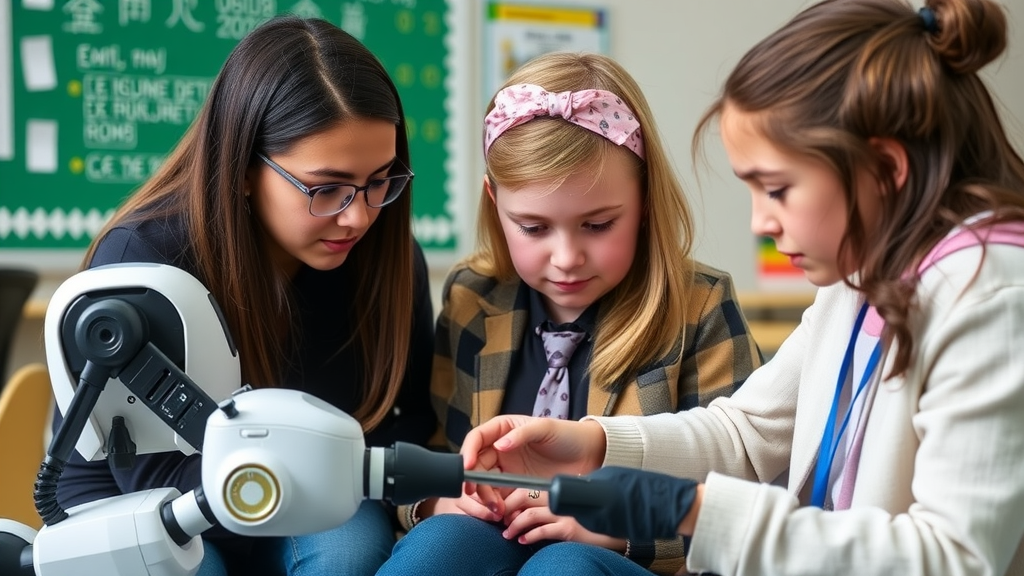
When schools hand teachers a box of robots and ask them to bring coding, engineering and computational thinking into the classroom, the technology is only half the challenge. The other half is the teacher, whose confidence and competence with digital tools ultimately determine whether those robots become powerful learning instruments or expensive shelf ornaments. A new study from Barcelona suggests that the most effective upgrade may not come from more training hours or flashier software, but from something far simpler: teachers watching each other teach, and then talking about it.
Researchers Mireia Soler, Mariona Corcelles-Seuba and David Duran of the Universitat Autònoma de Barcelona examined whether reciprocal peer observation, or RPO, could strengthen the digital competence of in-service schoolteachers who were learning to implement educational robotics. Their quasi-experimental study, published in the Journal of New Approaches in Educational Research, followed 51 teachers from 13 public early childhood and primary schools in Barcelona’s Ciutat Vella district over a six-month training program running from November 2023 to May 2024, part of a project titled Robots for Peer Learning.
The design was elegantly simple. All participants completed the same core training: two self-paced online modules covering educational robotics devices and their pedagogical applications for promoting computational thinking, along with a requirement to implement robotics in their own classrooms and reflect on the results. But one group, 27 teachers, completed an additional third module requiring a full RPO cycle during their classroom implementation, while the remaining 24 teachers, the comparison group, completed the training without it. Because RPO inherently demands voluntary participation and active engagement, entire schools rather than individual teachers were assigned to each condition, with all teachers in a given school belonging to the same group.
RPO is a structured form of collaborative professional development in which pairs of teachers with similar levels of experience agree to observe specific pedagogical aspects of each other’s teaching. The cycle unfolds in four phases: a pre-observation meeting where the pair agrees on goals, indicators and data-collection methods; the observation itself, in which the observer gathers evidence; a feedback session built on a post-observation report, where constructive and exploratory dialogue identifies professional development objectives; and a final reflective synthesis written by the observed teacher. Crucially, the approach works only when it is voluntary, confidential and centered on mutually agreed objectives, supported by constructive feedback and a trusting environment.
To measure outcomes, the researchers used two complementary instruments. The first was a questionnaire drawing on validated items from SELFIEforTEACHERS, the European Commission’s self-reflection tool for teachers’ digital competence, covering four of the six areas defined by the European DigCompEdu framework: professional engagement, teaching and learning, empowering learners, and facilitating students’ digital competence. The second was an ad hoc competency-based case study, a formative practical test scored out of 20 points, aligned with B2-level indicators of Spain’s Teachers’ Digital Competence Benchmark. Participants completed the case study without access to training materials or the internet, both before and after the intervention, and scoring was performed by an educational robotics expert who was blinded to participants’ group assignments and assessment time points.
The results were striking. On self-perceived digital competence, the intervention group outperformed the comparison group significantly in two key areas. In teaching and learning, teachers who participated in the RPO cycle reported a mean improvement rate of 44.7 percent, compared with just 16 percent for the comparison group, a statistically significant difference. In empowering learners, the gap was even wider in relative terms: 43.9 percent versus 14.5 percent, roughly a threefold advantage, again statistically significant. Across overall perceptions of digital competence, the intervention group’s improvement rate of 32.3 percent was more than double the comparison group’s 13.7 percent, and while this fell just short of conventional statistical significance, the researchers suggest the trend could be confirmed with a larger sample.
Analyzing each group separately revealed an equally telling pattern. The comparison group showed no significant pretest-to-posttest gains in any specific area of self-perceived competence, only a modest improvement in overall perceptions, from a mean score of 2.32 to 2.54. The intervention group, by contrast, showed statistically significant improvements across every assessed area as well as overall perceptions, with effect sizes equal to or approaching 1, indicating a very large impact. In other words, the robotics training alone left most self-perceptions largely unchanged, while adding the peer observation cycle transformed how teachers viewed their own digital capabilities.
Perception, of course, is not the same as performance, and this is where the study makes a distinctive contribution. On the practical case study, both groups improved significantly from pretest to posttest in all areas, confirming that hands-on robotics training does build real skills. But the between-group comparison of absolute change showed statistically significant differences favoring the RPO group in every area and in the overall score. The area of empowering learners, which encompasses accessibility, inclusion, differentiation and active student engagement, stood out dramatically: the intervention group posted an average absolute percentage improvement of 307 percent, compared with 125 percent for the comparison group, with a large effect size of 0.55.
The authors are candid about the study’s limitations. With only 51 participants, statistical power is constrained, and although schools were randomized to condition, analyses were conducted at the teacher level, so the findings should be read as exploratory evidence rather than definitive causal estimates. The higher number of certified training hours in the intervention group, 30 versus 10, reflects institutional recognition of the structured observations and feedback inherent to the RPO cycle, which unfolded within the same six-month period rather than adding extra time. The researchers also note that qualitative analysis of the RPO documentation itself could deepen understanding of the mechanisms at work, and they call for future research with larger samples, longitudinal designs and, importantly, measurement of downstream effects on student outcomes.
Even so, the implications are considerable. International bodies from UNESCO to the OECD and the European Commission have flagged teacher digital competence as a policy priority, and the EU’s Digital Education Action Plan has funneled investment into robotics kits through the Recovery and Resilience Facility. Yet the TALIS report shows that despite 80 percent of surveyed teachers believing peer observation outperforms traditional training, actual participation in such collaborative practices remains low. This study offers rare experimental evidence that a structured, voluntary, feedback-driven observation cycle can amplify the returns on technology training, not only changing what teachers believe they can do, but measurably improving what they actually do in the classroom. As schools worldwide race to digitize, the message from Barcelona is that the cheapest, most human piece of professional development equipment may be a colleague standing quietly at the back of the room, notebook in hand.
Subject of Research: Reciprocal peer observation for enhancing in-service teachers' digital competence in educational robotics
Article Title: Reciprocal peer observation for enhancing teachers’ digital competence: insights from educational robotics implementation
Article References: Soler, M., Corcelles-Seuba, M., & Duran, D. (2026). Reciprocal peer observation for enhancing teachers’ digital competence: insights from educational robotics implementation. Journal of New Approaches in Educational Research, 15(1), Article 15. https://doi.org/10.1007/s44322-026-00064-1
Image Credits: AI Generated
DOI: 10.1007/s44322-026-00064-1
Keywords: reciprocal peer observation, teachers' digital competence, educational robotics, teacher professional development, DigCompEdu, SELFIEforTEACHERS, computational thinking, collaborative learning, peer feedback, Barcelona schools, classroom technology, quasi-experimental study
Cite Scienmag News
Denise Maddox. (September 12, 2026). Peer Observation Boosts Teachers’ Digital Skills in Robotics Classrooms. Scienmag. https://scienmag.com/peer-observation-boosts-teachers-digital-skills-in-robotics-classrooms/
Denise Maddox. "Peer Observation Boosts Teachers’ Digital Skills in Robotics Classrooms." Scienmag, 12 September 2026, https://scienmag.com/peer-observation-boosts-teachers-digital-skills-in-robotics-classrooms/. Accessed 4 October 2026.
Denise Maddox. "Peer Observation Boosts Teachers’ Digital Skills in Robotics Classrooms." Scienmag. September 12, 2026. https://scienmag.com/peer-observation-boosts-teachers-digital-skills-in-robotics-classrooms/


