


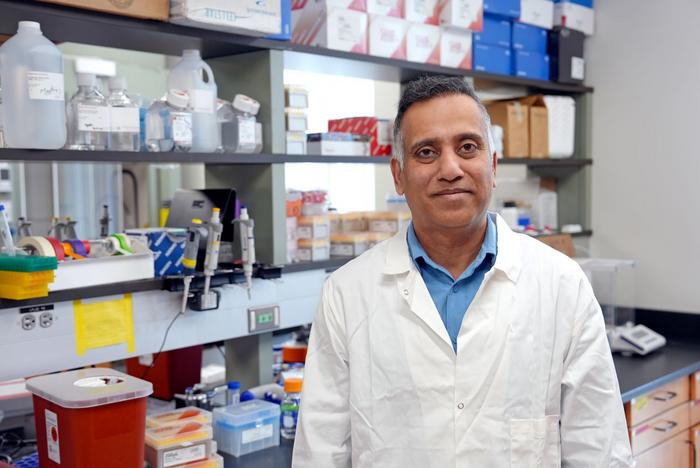
Clinton Mathias, associate professor of nutritional sciences in the College of Agriculture, Health and Natural Resources (CAHNR), has discovered a potential new treatment for allergic reactions.linton Mathias, associate professor of nutritional sciences in the College of Agriculture, Health and Natural Resources (CAHNR), has discovered a potential new treatment for allergic reactions.Daniel Kennedy, Mathias’ colleague at Western New England University where he worked before joining the UConn faculty in 2022, had been studying thiol isomerases in a mouse cancer model. At the same time, Mathias had been working with curcumin, the active ingredient in the curry spice turmeric and investigating its effects in mouse models of food allergies. These studies showed that curcumin had potent inhibitory effects on the development of food allergy. When mice were exposed to curcumin during an allergic reaction, they did not develop allergic symptoms.

Credit: (Jason Sheldon/UConn Photo)
Clinton Mathias, associate professor of nutritional sciences in the College of Agriculture, Health and Natural Resources (CAHNR), has discovered a potential new treatment for allergic reactions.linton Mathias, associate professor of nutritional sciences in the College of Agriculture, Health and Natural Resources (CAHNR), has discovered a potential new treatment for allergic reactions.Daniel Kennedy, Mathias’ colleague at Western New England University where he worked before joining the UConn faculty in 2022, had been studying thiol isomerases in a mouse cancer model. At the same time, Mathias had been working with curcumin, the active ingredient in the curry spice turmeric and investigating its effects in mouse models of food allergies. These studies showed that curcumin had potent inhibitory effects on the development of food allergy. When mice were exposed to curcumin during an allergic reaction, they did not develop allergic symptoms.
The team published their findings in Frontiers in Immunology in 2020.
These protective effects were exerted by directly targeting a major immune culprit during food allergy reactions, the mast cell, and suppressing its activity.
Thiol isomerases play critical roles in the functioning of cells and are important for their activity and survival. They play key roles in the folding of cellular proteins and are known to promote the activity of platelets and control blood clotting reactions.
Together, Mathias and Kennedy investigated whether curcumin may also block the function of thiol isomerases.
“We wondered whether curcumin might also potentially inhibit this particular enzyme,” Mathias says. “And we found that it did. It inhibited the enzyme’s catalytic activity. Furthermore, we found that mast cells can also express cell surface thiol isomerases, something that was previously shown only on a few cell types such as endothelial cells and hepatocytes.”
Immune cells such as mast cells produce many pro-allergic proteins during allergic reactions. Thiol isomerases may play a role in the folding and activity of these proteins. “Many of these are extremely important to drive the allergic response,” Mathias says. “So, if you block that, you’re blocking the allergic response.”
Mathias tested the efficacy of PACMA-31, a protein disulfide isomerase (PDI) inhibitor in mice. Mathias treated the mice with the inhibitor every day for the extent of their exposure to the allergen, a protein that is commonly present in egg whites. The use of this protein, ovalbumin, is widely accepted as a research model for food allergies.
“It’s a pretty good indicator that this would also work in other types of allergies, at least in mice,” Mathias says. “In humans, it remains to be tested.”
The inhibitor suppressed mast cell activation in the mice dramatically. The mice did not experience food allergy symptoms that were observed in the control group that did not receive the inhibitor.
The patent for this technology was granted earlier this year and Quercis Pharmaceuticals has obtained a license for this technology. Western New England University is the assignee for this patent.
The researchers still need to conduct additional studies to determine if the inhibitor just blocks allergic symptoms or if it can also prevent the development of sensitivity to the allergen.
“Our hypothesis is that it would,” Mathias says. “Because, when we treat cells with the PDI inhibitors before we’ve even activated them with the allergen, we find reduced activation. So, I think it’s possible that it actually prevents the development of food allergy and not just treats it.”
Other PDI inhibitors are already being tested in clinical trials as cancer drugs and a handful of other applications. But no one has yet tried to use them to treat food allergies.
Mathias says the next steps in this research are to learn more about how exactly PDI plays a role in allergic reactions by deleting its activity in immune cells.
“We’re interested in determining whether the enzyme assists with the folding of certain molecules produced by mast cells…and whether it can help stabilize them in the environment during allergic activation,” Mathias says. “Or, they may promote inflammation by enhancing the activity of antibodies that crosslink with the allergen which could then potentially increase the magnitude of the allergic response.”
Daniel Kennedy, Mathias’ colleague at Western New England University where he worked before joining the UConn faculty in 2022, had been studying thiol isomerases in a mouse cancer model. At the same time, Mathias had been working with curcumin, the active ingredient in the curry spice turmeric and investigating its effects in mouse models of food allergies. These studies showed that curcumin had potent inhibitory effects on the development of food allergy. When mice were exposed to curcumin during an allergic reaction, they did not develop allergic symptoms.
The team published their findings in Frontiers in Immunology in 2020.
These protective effects were exerted by directly targeting a major immune culprit during food allergy reactions, the mast cell, and suppressing its activity.
Thiol isomerases play critical roles in the functioning of cells and are important for their activity and survival. They play key roles in the folding of cellular proteins and are known to promote the activity of platelets and control blood clotting reactions.
Together, Mathias and Kennedy investigated whether curcumin may also block the function of thiol isomerases.
“We wondered whether curcumin might also potentially inhibit this particular enzyme,” Mathias says. “And we found that it did. It inhibited the enzyme’s catalytic activity. Furthermore, we found that mast cells can also express cell surface thiol isomerases, something that was previously shown only on a few cell types such as endothelial cells and hepatocytes.”
Immune cells such as mast cells produce many pro-allergic proteins during allergic reactions. Thiol isomerases may play a role in the folding and activity of these proteins. “Many of these are extremely important to drive the allergic response,” Mathias says. “So, if you block that, you’re blocking the allergic response.”
Mathias tested the efficacy of PACMA-31, a protein disulfide isomerase (PDI) inhibitor in mice. Mathias treated the mice with the inhibitor every day for the extent of their exposure to the allergen, a protein that is commonly present in egg whites. The use of this protein, ovalbumin, is widely accepted as a research model for food allergies.
“It’s a pretty good indicator that this would also work in other types of allergies, at least in mice,” Mathias says. “In humans, it remains to be tested.”
The inhibitor suppressed mast cell activation in the mice dramatically. The mice did not experience food allergy symptoms that were observed in the control group that did not receive the inhibitor.
The patent for this technology was granted earlier this year and Quercis Pharmaceuticals has obtained a license for this technology. Western New England University is the assignee for this patent.
The researchers still need to conduct additional studies to determine if the inhibitor just blocks allergic symptoms or if it can also prevent the development of sensitivity to the allergen.
“Our hypothesis is that it would,” Mathias says. “Because, when we treat cells with the PDI inhibitors before we’ve even activated them with the allergen, we find reduced activation. So, I think it’s possible that it actually prevents the development of food allergy and not just treats it.”
Other PDI inhibitors are already being tested in clinical trials as cancer drugs and a handful of other applications. But no one has yet tried to use them to treat food allergies.
Mathias says the next steps in this research are to learn more about how exactly PDI plays a role in allergic reactions by deleting its activity in immune cells.
“We’re interested in determining whether the enzyme assists with the folding of certain molecules produced by mast cells…and whether it can help stabilize them in the environment during allergic activation,” Mathias says. “Or, they may promote inflammation by enhancing the activity of antibodies that crosslink with the allergen which could then potentially increase the magnitude of the allergic response.”
Cite Scienmag News
Denise Maddox. (June 7, 2024). Patented technology uses curcumin for potent inhibitory effects on the development of food allergy. Scienmag. https://scienmag.com/patented-technology-uses-curcumin-for-potent-inhibitory-effects-on-the-development-of-food-allergy/
Denise Maddox. "Patented technology uses curcumin for potent inhibitory effects on the development of food allergy." Scienmag, 7 June 2024, https://scienmag.com/patented-technology-uses-curcumin-for-potent-inhibitory-effects-on-the-development-of-food-allergy/. Accessed 6 September 2026.
Denise Maddox. "Patented technology uses curcumin for potent inhibitory effects on the development of food allergy." Scienmag. June 7, 2024. https://scienmag.com/patented-technology-uses-curcumin-for-potent-inhibitory-effects-on-the-development-of-food-allergy/

