


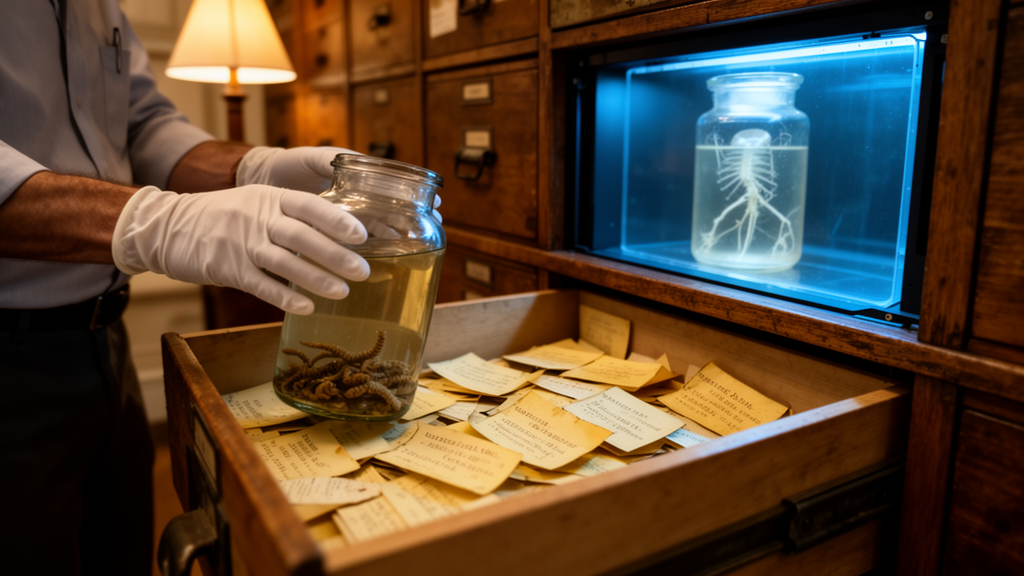
Deep inside the Phyletisches Museum in Jena, Germany, a handful of century-old pinned planthoppers have just rewritten what scientists know about one of the strangest groups of insects on Earth. Researchers screening the museum’s historical leafhopper and planthopper collection discovered specimens parasitized by twisted-wing parasites, tiny endoparasitic insects known as Strepsiptera, that had gone completely unnoticed for decades. Two of the finds represent the only evidence ever recorded of their species occurring in Germany, and one may even belong to a species new to science. The discovery, published in Natural History Collections and Museomics, shows how modern imaging technology can coax revolutionary secrets out of drawers that have sat untouched for a hundred years.
Strepsiptera, often called twisted-wing parasites, are among the most bizarre animals in the insect world. The order contains roughly 650 known species worldwide, and their life cycle reads like science fiction. The minute, free-living primary larvae hatch and seek out host insects, then burrow inside and transform into endoparasitic larvae that feed on the host from within. The adult females of most families never leave the host’s body at all, remaining inside as simplified, paedomorphic creatures that spend their entire lives wedged between the host’s abdominal segments, with only their cephalothorax protruding. The males, by contrast, live for just a few hours, long enough to find a mate and die. Because of this cryptic lifestyle, finding strepsipterans in the wild is notoriously difficult, which makes museum specimens that quietly preserved them all the more precious.
The team, working at the Phyletisches Museum Jena, systematically combed through more than 4,000 pinned specimens of Auchenorrhyncha, the group of sap-sucking insects that includes leafhoppers, planthoppers, and their relatives. The material came primarily from two historically important private collections. One belonged to Adolf Frank, a Thuringian collector active in the late nineteenth century whose carefully labeled insects, complete with handwritten notes on locality, host plant, and date, were purchased by the museum in 1930. The other was assembled by Ernst Wilhelm Schmidt, an Arnstadt naturalist whose well-documented collection entered the museum in 1966. Using nothing more than stereo microscopes at magnifications up to 40 times, the researchers counted and inspected every drawer, looking for the telltale protrusion of a parasite’s cephalothorax poking out from between a host’s abdominal plates.
What they found exceeded expectations. One female planthopper of the species Tettigometra impressopunctata, collected by Schmidt near Arnstadt in June 1936, turned out to harbor a female of Halictophagus tettigometrae, a strepsipteran species previously known only from Italy and Hungary. Four more specimens of the leafhopper Eupelix cuspidata, collected by Frank around Erfurt between 1891 and 1892, contained females of a second Halictophagus species whose exact identity remains tantalizingly open. Both discoveries constitute the first and only records of these parasites in Germany, suggesting that at least historically these species ranged far farther northwest than anyone had assumed. The host Tettigometra impressopunctata is itself classified as critically endangered on Germany’s Red List, adding a poignant layer to the find: the parasite may have vanished alongside its shrinking host.
The second species posed a genuine taxonomic puzzle. Its females and primary larvae display a unique combination of features that distinguishes them from the two Halictophagus species previously recorded in Germany, and its host, Eupelix cuspidata, has never been documented as a host for any other European Halictophagus. The trail leads back to a 1975 paper by the coleopterist Roy Crowson, who speculated that females he found inside the same host species in Great Britain might represent the previously unknown female of Halictophagus curtisii, the type species of the entire family Halictophagidae, described from a single male in 1832. The Jena specimens could be that missing female, or they could be something entirely new. Because the intraspecific variability of these features is poorly understood, and because confirming the identity would require matching males from the same locality, the researchers prudently refrained from naming a new species, leaving the question open for future work.
To document the fragile parasites without destroying them, the team deployed an impressive arsenal of imaging technology. The specimens, glued onto pieces of cardboard in the collectors’ original style, were carefully remounted on polymethyl methacrylate needles to avoid metal artifacts. One infected leafhopper was then transported to the German Electron Synchrotron, DESY, in Hamburg, where it was scanned at beamline P05 on the PETRA III storage ring using synchrotron-radiation-based micro-computed tomography. With an effective pixel size of 1.28 micrometers and 3,501 projections per scan, the technique produced stunning three-dimensional reconstructions revealing two female parasites curled inside the host’s abdomen, complete with their cephalothoraces and internal primary larvae, all without cutting into the century-old specimen. A second specimen was scanned at the Helmholtz-Zentrum Hereon with a laboratory CT system.
The non-invasive scans served a crucial practical purpose: they allowed the researchers to confirm that the endoparasitic females contained primary larvae before committing to dissection. Once confirmed, selected females and their cargo of larvae were carefully extracted, rehydrated, cleaned with Proteinase K and chloroform, and prepared for scanning electron microscopy. The SEM images revealed a world of detail invisible to the original collectors: cuticular pits on the clypeal lobes that may function as sensilla, vestigial antennae surrounded by incomplete toruli, mandibles armed with diagnostic teeth and bulges, and setae on the primary larvae that measure less than five micrometers in length. These microscopic features, particularly the shape of the birth opening and the pattern of setae on the larvae, are the key characters that separate Halictophagus species from one another.
The morphological documentation went further than any previous study of these insects. The researchers produced detailed descriptions of the previously unknown female and primary larva of the second Halictophagus species, revised the description of the H. tettigometrae female using SEM to reveal features that Silvestri’s original 1934 and 1941 descriptions could not capture, and even generated interactive 3D models published on Sketchfab, allowing anyone with an internet connection to rotate the parasitized hosts and inspect the hidden parasites themselves. The complete checklist of the museum’s Auchenorrhyncha main collection was also compiled, adding a further layer of documentation to a collection that spans specimens gathered from the Kerguelen Islands to Sri Lanka and China.
Beyond the immediate taxonomic payoff, the study is a showcase for what its authors call collectomics, the emerging discipline of extracting multidimensional, specimen-based data from natural history collections. Because pinned insects were never treated with formalin, their DNA escapes the chemical damage that plagues fluid-preserved specimens, meaning usable genetic material can be recovered even from insects that died more than a century ago. Combined with high-throughput CT digitization efforts such as the open-science initiative Antscan, the workflow demonstrated here, from screening to synchrotron scanning to SEM to molecular analysis, offers a template that could be applied to countless other collections and organisms. The researchers explicitly frame their approach as a good-practice example for the broader museomics movement now sweeping through natural history museums.
The broader message resonates far beyond entomology. At a time of dramatic global decline in biodiversity and insect biomass, historical collections have become irreplaceable baselines, recording where species lived before climate change, intensive agriculture, and habitat loss reshaped the landscape. The Jena discoveries prove that even collections thought to be thoroughly known can conceal species records that exist nowhere else on Earth, particularly for parasites so cryptic that chasing them in the field is nearly hopeless. Somewhere in the world’s museums, millions of pinned insects are waiting in their drawers, some harboring undiscovered parasites, some holding the only evidence of species now extinct in the wild. As the authors argue, preserving and thoroughly investigating these collections should be given the highest priority, because each unexamined drawer might hold the next surprise.
Subject of Research: From cabinets to collectomics: discovering females and primary larvae of Strepsiptera in a historical collection
Article Title: From cabinets to collectomics: discovering females and primary larvae of Strepsiptera in a historical collection
Article References: Tröger, D., Bock, B. L., Hammel, J. U., Grabe, V., Beutel, R. G., & Pohl, H. (2026). From cabinets to collectomics: discovering females and primary larvae of Strepsiptera in a historical collection. Natural History Collections and Museomics, 3, 1-31. https://doi.org/10.3897/nhcm.3.173071
Image Credits: AI Generated
Keywords: cabinets, collectomics, discovering, females, primary, larvae, Strepsiptera, historical, collection, scientific research
Cite Scienmag News
Gavin Prescott. (October 17, 2026). Parasites hiding for a century found in museum drawers with X-rays. Scienmag. https://scienmag.com/parasites-hiding-for-a-century-found-in-museum-drawers-with-x-rays/
Gavin Prescott. "Parasites hiding for a century found in museum drawers with X-rays." Scienmag, 17 October 2026, https://scienmag.com/parasites-hiding-for-a-century-found-in-museum-drawers-with-x-rays/. Accessed 17 October 2026.
Gavin Prescott. "Parasites hiding for a century found in museum drawers with X-rays." Scienmag. October 17, 2026. https://scienmag.com/parasites-hiding-for-a-century-found-in-museum-drawers-with-x-rays/


