


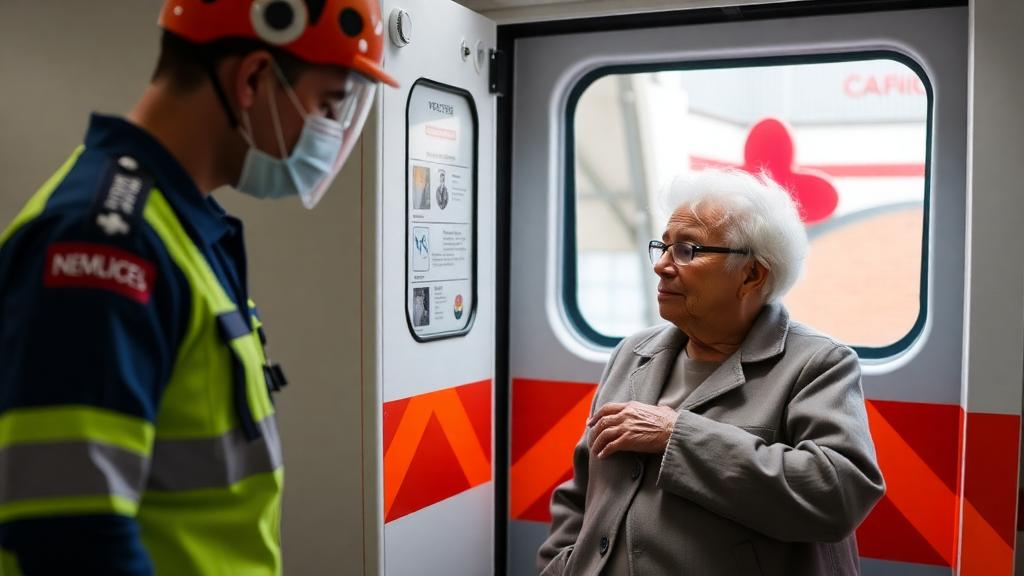
Community paramedicine has quietly become one of the most promising frontiers in preventive healthcare, and a new observational study suggests it could play a surprising role in the early detection of dementia. Researchers led by Gina Agarwal at McMaster University examined how two established community paramedicine programs in Canada, known as Community Paramedicine at Clinic (CP@clinic) and Community Paramedicine at Home (CP@home), could be used to assess the risk of potential dementia among older adults in community settings. Their findings, published in BMC Health Services Research, reveal that roughly one in five people screened through these programs showed signs of potential cognitive impairment, a rate the authors describe as high and clinically significant.
The study was designed as a cross-sectional analysis, drawing on data from 385 adults who participated in either the CP@clinic or CP@home programs. These programs bring paramedics out of the emergency response role and into a preventive one, offering regular check-ups to older adults and other vulnerable populations in the places where they live or gather. Instead of waiting for a crisis, community paramedics proactively monitor blood pressure, chronic disease status, mental health, and now, cognitive function. The researchers wanted to know whether embedding a brief dementia risk assessment into this existing infrastructure could identify people at elevated risk who might otherwise slip through the cracks of the healthcare system.
To measure dementia risk, the team used the Mini-Cog, a widely validated screening instrument that combines a short three-word memory task with the Clock Drawing Test. In the memory component, participants are asked to repeat and later recall three unrelated words, while the clock task requires them to draw a clock face with the hands set to a specific time. The test takes only a few minutes, making it well suited to the fast-paced, rapport-driven environment of a paramedic visit. A positive screen does not constitute a diagnosis, but it flags individuals who warrant more comprehensive evaluation by a physician, potentially opening the door to earlier interventions, better management of coexisting conditions, and advance planning while the patient can still participate fully in decisions about their care.
Of the 385 adults in the overall dataset, 151 participants from the CP@clinic program and 144 from CP@home completed the Mini-Cog assessment. The two groups differed in predictable and illuminating ways. CP@clinic attendees had a mean age of 74.2 years, whereas CP@home participants averaged 78.5 years. Nearly three-quarters of clinic attendees, 75.74 percent, lived alone, compared with 43.54 percent of those seen at home. The home-visit group also carried a heavier burden of chronic disease, averaging 2.42 chronic conditions against 1.60 in the clinic group. These contrasts reflect the different purposes of the two programs: CP@clinic operates as a drop-in style health hub in community settings such as subsidized housing, while CP@home reaches housebound or higher-acuity patients through scheduled home visits.
Given how different the two populations were, the researchers expected to see markedly different dementia risk rates between them. What they found instead was striking similarity. In the CP@clinic group, 18.54 percent of those screened were assessed as being at risk of cognitive impairment, while in the CP@home group the figure was 20.14 percent. The difference was not statistically significant, with a p-value of 0.84, meaning the rates were essentially indistinguishable. Both settings therefore appeared to identify potential dementia risk at a comparable and considerable rate, roughly one in every five individuals screened.
The authors offer a compelling explanation for this unexpected convergence: selective assessment practices by paramedics. Rather than administering the Mini-Cog universally, paramedics may have been prompted to offer the screen to individuals whose presentation, health history, or behavior during the visit raised concern. If paramedics exercised clinical judgment in deciding whom to assess, the screened samples in both programs would be enriched with higher-risk individuals, compressing the observed risk rates toward a similar, elevated level regardless of setting. This interpretation carries practical implications, suggesting that paramedic judgment can effectively triage who should receive cognitive screening, but it also underscores the need for clearer screening protocols to understand exactly how selection operates in the field.
Beyond the headline rate, the study explored the factors associated with potential cognitive impairment using a battery of statistical tools, including descriptive statistics, chi-squared tests, t-tests, and logistic regression. The researchers examined demographic variables, chronic disease history, and mental health measures. Participants in the programs were assessed for depression using the two-item Patient Health Questionnaire (PHQ-2) and for anxiety using the two-item Generalized Anxiety Disorder scale (GAD-2), while broader health risk profiles drew on instruments such as the Canadian Diabetes Risk Questionnaire (CANRISK) and body mass index measurements. Chronic conditions tracked in the analysis included common geriatric burdens such as chronic obstructive pulmonary disease, diabetes, and cardiovascular disease, alongside prior emergency department use, which is often a marker of fragile health in older adults.
The significance of this work lies less in any single number and more in the delivery model it validates. Dementia is notoriously underdiagnosed in primary care, and many older adults, particularly those who live alone, are socially isolated, or have mobility limitations, rarely present for routine cognitive assessment until symptoms have advanced. Community paramedicine programs sidestep several of these barriers at once. Paramedics are trusted figures who already visit or meet these populations regularly, the Mini-Cog adds only minutes to each encounter, and the existing program infrastructure for documentation and referral means that a positive screen can be routed to primary care providers for follow-up. In effect, the study demonstrates that the healthcare system can piggyback dementia surveillance onto services it is already delivering.
The programs studied operate across multiple regions of Ontario, Canada, with collaborating services including Niagara Emergency Medical Services, Rainy River District Paramedic Services, Region of Durham Paramedic Services, Guelph-Wellington Paramedic Services, Norfolk County Paramedic Services, Cochrane District Emergency Health Services, and Oxford County Paramedic Services, along with the Sunraysia Community Health Centre in Victoria, Australia. This geographic breadth matters because it suggests the model is not an artifact of a single well-resourced locality but a feasible approach across urban, rural, and remote settings. The research was supported by Health Canada’s Health Care and Strategies Program, and the study received ethics approval from the Hamilton Integrated Research Ethics Board, with written informed consent obtained from all participants.
For clinicians, policymakers, and families, the takeaway is that community paramedicine offers a scalable, low-cost channel for catching dementia risk years earlier than the current default of waiting for a crisis. Earlier identification does not yet mean a cure, but it means time: time to optimize vascular risk factors, review medications that can worsen cognition, connect patients and caregivers with support services, and involve patients in planning their own futures. As populations age and health systems strain under the growing prevalence of dementia, the idea that a paramedic with a three-word memory task and a clock-drawing exercise could flag one in five at-risk older adults is a powerful piece of the prevention puzzle, and a reminder that some of the most valuable diagnostic opportunities happen outside the clinic walls entirely.
Subject of Research: Dementia risk assessment through community paramedicine programs for older adults
Article Title: Use of dementia risk assessment in community paramedicine (CP) programming: an observational study of CP@clinic and CP@home
Article References: Use of dementia risk assessment in community paramedicine (CP) programming: an observational study of CP@clinic and CP@home. (n.d.). https://doi.org/10.1186/s12913-026-15680-y
Image Credits: AI Generated
DOI: 10.1186/s12913-026-15680-y
Keywords: community paramedicine, dementia, Mini-Cog, cognitive impairment, older adults, risk assessment, CP@clinic, CP@home, geriatrics, primary care, health services research, screening
Cite Scienmag News
Cassandra Pierce. (October 14, 2026). Paramedics May Flag Dementia Risk in One in Five Older Adults They Visit. Scienmag. https://scienmag.com/paramedics-may-flag-dementia-risk-in-one-in-five-older-adults-they-visit/
Cassandra Pierce. "Paramedics May Flag Dementia Risk in One in Five Older Adults They Visit." Scienmag, 14 October 2026, https://scienmag.com/paramedics-may-flag-dementia-risk-in-one-in-five-older-adults-they-visit/. Accessed 14 October 2026.
Cassandra Pierce. "Paramedics May Flag Dementia Risk in One in Five Older Adults They Visit." Scienmag. October 14, 2026. https://scienmag.com/paramedics-may-flag-dementia-risk-in-one-in-five-older-adults-they-visit/


