


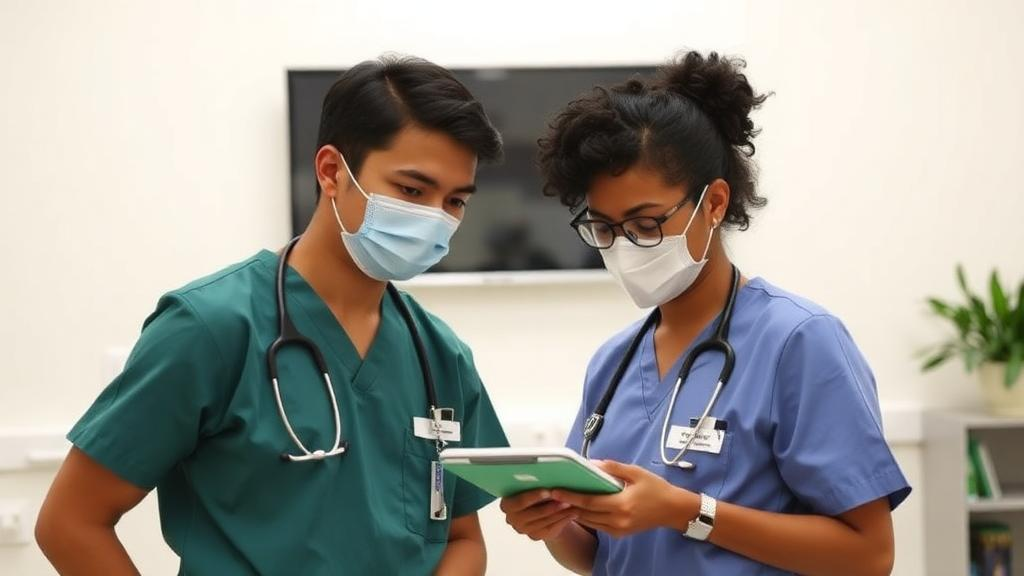
Medical training has long faced an awkward logistical problem: resident physicians and medical interns often rotate through the same hospital departments at the same time, yet they are taught as if they occupy separate educational worlds. A new randomized study from the Department of Gastroenterology at Henan Provincial People’s Hospital in Zhengzhou, China, suggests that merging those worlds through a structured pairing system can sharpen the skills of both groups simultaneously. The research, published in BMC Medical Education, describes and tests a so-called “1 + N” paired teaching mode, in which one resident physician is paired with a small group of two to three interns for joint instruction, rather than having the two trainee populations educated separately as is customary.
The premise behind the model is deceptively simple. Residents, who are several years further along in their clinical development, possess knowledge and practical skills that interns are actively trying to acquire. Interns, in turn, bring fresh theoretical grounding and an eagerness that can motivate residents to consolidate their own understanding. By formalizing this relationship into a teaching unit, the researchers hypothesized that residents would strengthen their teaching ability and clinical competence while interns would gain more individualized mentorship than a busy attending physician alone could provide. The approach also addresses a practical tension in teaching hospitals, where attending faculty must divide limited time between two overlapping cohorts of learners.
To test the idea rigorously, the team enrolled 72 resident physicians and 162 medical interns who were rotating through the gastroenterology department during the same period. Participants were randomly divided into two groups, each containing 36 residents and 81 interns, ensuring that both arms had an identical composition of trainees. In the paired group, each resident was matched with two to three interns and the pair-unit was taught together. In the unpaired control group, residents and interns received their instruction separately, following the conventional departmental teaching routine. This design allowed the investigators to isolate the effect of the pairing structure itself, rather than differences in curriculum, faculty, or patient exposure.
Evaluation relied on comprehensive assessments of clinical practice, spanning multiple measurable competencies. For interns, the researchers examined the quality of medical document writing, performance on the Subject-Objective-Assessment-Plan framework known as SOAP, clinical skill operations, doctor-patient communication, and clinical thinking ability. For residents, the evaluation covered cooperative consciousness, teaching ability, the quality of their modifications to medical documents, theoretical knowledge, clinical skill operations, and the same communication and clinical thinking measures. This dual-track assessment was essential because the paired model is intended to be mutually beneficial; a teaching innovation that improved intern performance at the expense of resident learning would represent a poor trade for training programs.
The results were striking across most domains. Interns in the paired group significantly outperformed their unpaired counterparts in medical document writing quality, with a t-statistic of 9.385 and a p-value below 0.001, indicating an extremely unlikely chance finding. Their SOAP documentation scores also rose markedly, as did their clinical skill operation performance. These gains are clinically meaningful: accurate documentation and structured clinical reasoning are foundational competencies, and deficiencies in medical record writing are among the most commonly cited weaknesses of early-career physicians worldwide.
The residents in the paired group benefited just as clearly, and in some ways more broadly. Compared with residents taught separately, those in the paired units showed significantly higher cooperative consciousness, stronger teaching ability, better quality in their modifications of medical documents, improved theoretical knowledge, and superior clinical skill operation scores, all with p-values below 0.001. The improvement in teaching ability is particularly noteworthy because teaching is a core professional responsibility of attending physicians, yet formal training in how to teach is often absent from residency curricula. By making residents responsible for guiding interns, the paired model appears to convert daily clinical work into deliberate practice for the very skill of instruction.
Not every measured competency improved, however, and the pattern of null results is as informative as the positive findings. Doctor-patient communication skills showed no statistically significant difference between the paired and unpaired groups, for either interns or residents. Clinical thinking ability likewise failed to reach significance in both cohorts. The researchers report t-statistics of 1.265 for interns and 1.030 for residents on communication, and 0.896 and 1.152 respectively on clinical thinking, none of which reached the threshold for statistical significance. This suggests that the benefits of pairing are concentrated in skills that can be transmitted through direct observation, correction, and repetition, such as documentation and procedural technique, while capacities like communication and clinical judgment may require different pedagogical tools, such as simulated patient encounters or dedicated case-based reasoning sessions.
The study carries practical implications for teaching hospitals far beyond gastroenterology. Departments in China and elsewhere routinely absorb large cohorts of interns and residents simultaneously, and the resulting competition for faculty attention can dilute the educational experience of both groups. A “1 + N” structure effectively multiplies teaching capacity without hiring additional faculty: each resident becomes a near-peer teacher, a role that educational research has long associated with deeper learning for the teacher through the protégé effect. The finding that residents’ theoretical knowledge also improved supports this mechanism, since preparing to explain concepts to juniors forces seniors to organize and consolidate their own understanding.
The study was conducted with appropriate ethical oversight, with approval from the Medical Ethics Committee of Henan Provincial People’s Hospital and informed consent from all participants, in accordance with the Declaration of Helsinki. The work was funded through several Chinese educational reform programs, including a Higher Educational Reform Research and Practice Project of Henan Province and postgraduate education research initiatives at Zhengzhou University, reflecting institutional interest in reforming how clinical trainees are taught. The research team, led by co-first authors Ling Lan, Wen-Jing Yuan, Peng-Fei Li, and Rui-Qi Liang, with corresponding authors Feng-Yu Cao, Xu-Dong Fu, and Yi-Bin Hao, positions the paired mode as a direct answer to the challenge of simultaneous resident and intern training rather than a general-purpose teaching gimmick.
Several caveats temper the enthusiasm that these results deserve. The study was conducted in a single gastroenterology department at one Chinese hospital, and specialty-specific factors, such as the volume of endoscopic procedures and the documentation intensity of gastrointestinal care, may have shaped the outcomes. The evaluation also occurred within a single rotation period, leaving open the question of whether the measured gains persist over months or years of training. And because communication skills and clinical thinking did not improve, programs adopting the model should treat it as a complement to, not a replacement for, teaching methods that target those competencies. Still, the randomized design, the balanced group composition, and the consistent statistical signals across documentation, procedural, and teaching outcomes make this one of the more convincing demonstrations that near-peer pairing can be engineered deliberately rather than left to chance. If replicated in other departments and institutions, the “1 + N” model could offer teaching hospitals a low-cost, structurally elegant way to raise the floor of clinical education for two generations of physicians at once.
Subject of Research: Evaluation of a paired near-peer teaching model for resident physicians and medical interns in clinical training
Article Title: Exploration and evaluation of “1 + N” paired teaching mode for resident physicians and medical interns
Article References: Lan, L., Yuan, W.-J., Li, P.-F., Liang, R.-Q., Zhang, H.-H., Fang, X.-H., Xie, J.-B., Lu, J., Zhang, L.-Q., Liu, B.-K., Shen, L.-X., Yuan, L.-N., Zhang, Y.-N., Zhang, B.-C., Zhang, Y., Cao, F.-Y., Fu, X.-D., & Hao, Y.-B. (2026). Exploration and evaluation of “1 + N” paired teaching mode for resident physicians and medical interns. BMC Medical Education. https://doi.org/10.1186/s12909-026-09105-x
Image Credits: AI Generated
DOI: 10.1186/s12909-026-09105-x
Keywords: medical education, resident training, medical internship, paired teaching, near-peer teaching, gastroenterology, clinical skills, SOAP documentation, teaching hospitals, randomized trial, clinical competence, China
Cite Scienmag News
Courtney Benton. (October 11, 2026). Paired Teaching Model Boosts Skills for Residents and Interns Alike. Scienmag. https://scienmag.com/paired-teaching-model-boosts-skills-for-residents-and-interns-alike/
Courtney Benton. "Paired Teaching Model Boosts Skills for Residents and Interns Alike." Scienmag, 11 October 2026, https://scienmag.com/paired-teaching-model-boosts-skills-for-residents-and-interns-alike/. Accessed 11 October 2026.
Courtney Benton. "Paired Teaching Model Boosts Skills for Residents and Interns Alike." Scienmag. October 11, 2026. https://scienmag.com/paired-teaching-model-boosts-skills-for-residents-and-interns-alike/


