


Black holes and neutron stars are among the densest known objects in the universe. Within and around these extreme astrophysical environments exist plasmas, the fourth fundamental state of matter alongside solids, liquids, and gases. Specifically, the plasmas at these extreme conditions are known as relativistic electron-positron pair plasmas because they comprise a collection of electrons and positrons—all flying around at nearly the speed of light.

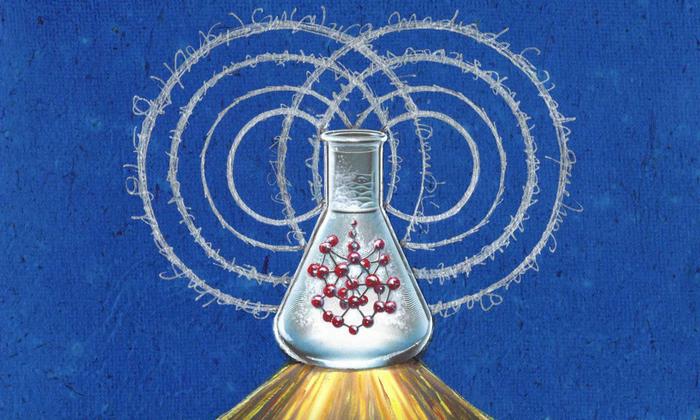
Credit: University of Rochester Laboratory for Laser Energetics illustration / Heather Palmer
Black holes and neutron stars are among the densest known objects in the universe. Within and around these extreme astrophysical environments exist plasmas, the fourth fundamental state of matter alongside solids, liquids, and gases. Specifically, the plasmas at these extreme conditions are known as relativistic electron-positron pair plasmas because they comprise a collection of electrons and positrons—all flying around at nearly the speed of light.
While such plasmas are ubiquitous in deep space conditions, producing them in a laboratory setting has proved challenging.
Now, for the first time, an international team of scientists, including researchers from the University of Rochester’s Laboratory for Laser Energetics (LLE), has experimentally generated high-density relativistic electron-positron pair-plasma beams by producing two to three orders of magnitude more pairs than previously reported. The team’s findings appear in Nature Communications.
The breakthrough opens the doors to follow-up experiments that could yield fundamental discoveries about how the universe works.
“The laboratory generation of plasma ‘fireballs’ composed of matter, antimatter, and photons is a research goal at the forefront of high-energy-density science,” says lead author Charles Arrowsmith, a physicist from the University of Oxford who is joining LLE in the fall. “But the experimental difficulty of producing electron-positron pairs in sufficiently high numbers has, to this point, limited our understanding to purely theoretical studies.”
Rochester researchers Dustin Froula, the division director for plasma and ultrafast laser science and engineering at LLE, and Daniel Haberberger, a staff scientist at LLE, collaborated with Arrowsmith and other scientists to design a novel experiment harnessing the HiRadMat facility at the Super Proton Synchrotron (SPS) accelerator at the European Organization for Nuclear Research (CERN) in Geneva, Switzerland.
That experiment generated extremely high yields of quasi-neutral electron-positron pair beams using more than 100 billion protons from the SPS accelerator. Each proton carries a kinetic energy that is 440 times larger than its resting energy. Because of such large momentum, when the proton smashes an atom, it has sufficient energy to release its internal constituents—quarks and gluons—which then immediately recombine to produce a shower that ultimately decays into electrons and positrons.
In other words, the beam they generated in the lab had enough particles to start behaving like a true astrophysical plasma.
“This opens up an entirely new frontier in laboratory astrophysics by making it possible to experimentally probe the microphysics of gamma-ray bursts or blazar jets,” Arrowsmith says.
The team has also developed techniques to modify the emittance of pair beams, making it possible to perform controlled studies of plasma interactions in scaled analogues of astrophysical systems.
“Satellite and ground telescopes are not able to see the smallest details of those distant objects and so far we could only rely on numerical simulations. Our laboratory work will enable us to test those predictions obtained from very sophisticated calculations and validate how cosmic fireballs are affected by the tenuous interstellar plasma,” says coauthor Gianluca Gregori, a professor of physics at the University of Oxford.
Moreover, he adds, “The achievement highlights the importance of exchange and collaboration between experimental facilities around the world, especially as they break new ground in accessing increasingly extreme physical regimes.”
In addition to LLE, University of Oxford, and CERN, collaborating institutions on this research include the Science and Technology Facilities Council Rutherford Appleton Laboratory (STFC RAL), the University of Strathclyde, the Atomic Weapons Establishment in the UK, the Lawrence Livermore National Laboratory, the Max Planck Institute for Nuclear Physics, the University of Iceland, and the Instituto Superior Técnico in Portugal.
The team’s findings come amid ongoing efforts to advance plasma science by colliding ultrahigh-intensity lasers, an avenue of research that will be explored using the NSF OPAL Facility.
Journal
Nature Communications
Method of Research
Experimental study
Subject of Research
Not applicable
Article Title
Laboratory realization of relativistic pair-plasma beams
Article Publication Date
12-Jun-2024
Cite Scienmag News
Grant Pearson. (June 13, 2024). Pair plasmas found in deep space can now be generated in the lab. Scienmag. https://scienmag.com/pair-plasmas-found-in-deep-space-can-now-be-generated-in-the-lab/
Grant Pearson. "Pair plasmas found in deep space can now be generated in the lab." Scienmag, 13 June 2024, https://scienmag.com/pair-plasmas-found-in-deep-space-can-now-be-generated-in-the-lab/. Accessed 7 September 2026.
Grant Pearson. "Pair plasmas found in deep space can now be generated in the lab." Scienmag. June 13, 2024. https://scienmag.com/pair-plasmas-found-in-deep-space-can-now-be-generated-in-the-lab/

