

Tuesday, July 14, 2026
Science
No Result
View All Result
  • Login
  • HOME
  • SCIENCE NEWS
  • CONTACT US
  • HOME
  • SCIENCE NEWS
  • CONTACT US
No Result
View All Result
Scienmag
No Result
View All Result
Home Science News Medicine

Paintable electrodes advance colorful, flexible wearable sensor technology

July 14, 2026
in Medicine
Reading Time: 2 mins read
0
Paintable electrodes advance colorful, flexible wearable sensor technology

Paintable electrodes advance colorful, flexible wearable sensor technology

65
SHARES
587
VIEWS
Share on FacebookShare on Twitter
ADVERTISEMENT

In a breakthrough merging art with cutting-edge biomedical engineering, researchers at Penn State have unveiled a revolutionary conductive ink that can be painted directly onto the skin, transforming wearable health monitoring into a customizable, artistic experience. This novel ink forms dry, paint-on electrodes capable of tracking heart, muscle, and brain electrical activity with unprecedented sensitivity and durability.

Conventional wearable sensors typically rely on rigid metal electrodes that often lose adhesion during physical movement, impairing signal accuracy. To overcome these limitations, the Penn State team developed a water-based polymer ink that dries rapidly—within ten minutes—and bonds intimately with the skin’s microtexture. This design drastically reduces the air gap found in commercial electrodes, enhancing electrical contact and measurement fidelity.

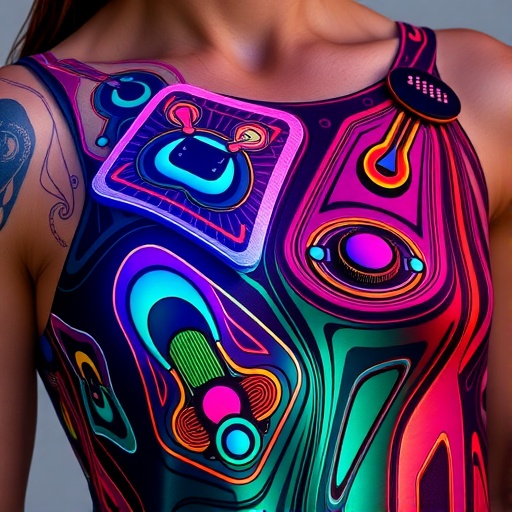
The ink formulation integrates multiple polymers and acidic additives to create a viscous yet paint-like consistency, easily pigmented with food dyes to allow users to decorate themselves with functional tattoos ranging from simple shapes to intricate cartoons. This personalization aspect not only enhances user engagement but also facilitates seamless integration into daily life.

Critically, the painted electrodes interface with a unique porous silver textile substrate. This flexible metal fabric enables the electrodes to stretch over 150% of their original size without fracturing, maintaining consistent electrical connectivity even during intense physical activity. The porous nature of the substrate also permits moisture and hair to pass through, preventing irritation and ensuring stable adhesion over extended periods.

In validation experiments, the painted electrodes successfully recorded precise electrocardiogram (ECG) signals continuously for 12 hours during routine activities and physical exercise. Furthermore, electromyography (EMG) signals captured from the forearm allowed direct wireless control of a robotic prosthetic hand, demonstrating the system’s potential for advanced human-machine interfacing.

This paintable electrode system is both washable and reapplicable, offering a disposable, cost-effective solution where a single bottle of ink can suffice for multiple applications over days or weeks. The modular design separates the reusable wireless data transmission unit from the disposable painted electrodes, optimizing practicality and hygiene.

Looking ahead, the researchers are exploring enhancements including chemical sensing capabilities to monitor biomarkers such as cortisol and glucose. Beyond human health, there are ambitions to pioneer “smart plants” that use similar bioelectronic interfaces to provide real-time insights into environmental chemical exposures and their impact on plant health.

This innovative approach opens new frontiers in biomedical electronics by fusing aesthetics with high-performance sensor technology, promising more comfortable, personalized, and accurate health monitoring solutions that could transform patient care, prosthetics, and even environmental science.

Subject of Research: Not applicable
Article Title: Paintable on-skin dry electrodes with robust skin and device connection for wireless sensing and human-machine interfaces
News Publication Date: 13-Jul-2026
Web References: DOI:10.1073/pnas.2615835123
Image Credits: Provided by Wanqing Zhang
Keywords: Wearable devices, Electronic devices, Bioelectronics, Electronics, Engineering, Robotics, Soft robotics, Health and medicine, Biomedical engineering, Physical exercise, Materials science, Human robot interaction

Tags: bioelectrode design integrating art and biomedical engineeringcustomizable artistic biomedical sensorsdurable dry paint electrodes for ECG and EMGflexible conductive ink for wearable deviceshigh-sensitivity dry electrodes for brain activity measurementinnovation in flexible skin-mounted sensor technologypaint-on skin electrodes for health monitoringpersonalized tattoo-like health monitoring devicesskin-microtexture bonding in wearable sensorsstretchable silver textile substrates for wearable electronicswater-based polymer inks for bioelectrode applicationswearable biomedical sensors
Share26Tweet16
Previous Post

Enhancing bacteria to accelerate environmental cleanup processes

Next Post

Atomic Structure in Metals Forms Corrosion Pathways in Nuclear Reactors

Related Posts

Night Owls Face Higher Risk of Metabolic Health Issues
Medicine

Night Owls Face Higher Risk of Metabolic Health Issues

July 14, 2026
New Study Links Muscle Health to Diabetes Risk
Medicine

New Study Links Muscle Health to Diabetes Risk

July 14, 2026
Half of New York Pedestrian Deaths Linked to Substance-Impaired Awareness
Medicine

Half of New York Pedestrian Deaths Linked to Substance-Impaired Awareness

July 14, 2026
Tumor Profiling Reveals Chemotherapy Effects and Personalized Treatments for Ovarian Cancer
Medicine

Tumor Profiling Reveals Chemotherapy Effects and Personalized Treatments for Ovarian Cancer

July 14, 2026
Advances and Challenges in Placenta Models for HIV-1, ART, and Nicotine Research
Medicine

Advances and Challenges in Placenta Models for HIV-1, ART, and Nicotine Research

July 14, 2026
Social Support and Participation Challenges in Disabled Brazilian Older Adults
Medicine

Social Support and Participation Challenges in Disabled Brazilian Older Adults

July 14, 2026
Next Post
Atomic Structure in Metals Forms Corrosion Pathways in Nuclear Reactors

Atomic Structure in Metals Forms Corrosion Pathways in Nuclear Reactors

  • Mothers who receive childcare support from maternal grandparents show more

    Mothers who receive childcare support from maternal grandparents show more parental warmth, finds NTU Singapore study

    27656 shares
    Share 11059 Tweet 6912
  • University of Seville Breaks 120-Year-Old Mystery, Revises a Key Einstein Concept

    1061 shares
    Share 424 Tweet 265
  • Bee body mass, pathogens and local climate influence heat tolerance

    682 shares
    Share 273 Tweet 171
  • Researchers record first-ever images and data of a shark experiencing a boat strike

    546 shares
    Share 218 Tweet 137
  • Groundbreaking Clinical Trial Reveals Lubiprostone Enhances Kidney Function

    531 shares
    Share 212 Tweet 133
Science

Embark on a thrilling journey of discovery with Scienmag.com—your ultimate source for cutting-edge breakthroughs. Immerse yourself in a world where curiosity knows no limits and tomorrow’s possibilities become today’s reality!

RECENT NEWS

  • Night Owls Face Higher Risk of Metabolic Health Issues
  • DRD1-MSNs Hyperactivity in Striatum Causes Repetitive Behaviors in Cry1Δ11 Mutation
  • Nasal Smell Stimulation Reduces Apnea in Premature Infants: Study
  • New 3D Thermal Cloak Conceals Objects from Heat in All Directions

Categories

  • Agriculture
  • Anthropology
  • Archaeology
  • Athmospheric
  • Biology
  • Biotechnology
  • Blog
  • Bussines
  • Cancer
  • Chemistry
  • Climate
  • Earth Science
  • Editorial Policy
  • Marine
  • Mathematics
  • Medicine
  • Pediatry
  • Policy
  • Psychology & Psychiatry
  • Science Education
  • Social Science
  • Space
  • Technology and Engineering

Subscribe to Blog via Email

Enter your email address to subscribe to this blog and receive notifications of new posts by email.

Join 5,146 other subscribers

© 2025 Scienmag - Science Magazine

Welcome Back!

Login to your account below

Forgotten Password?

Retrieve your password

Please enter your username or email address to reset your password.

Log In
No Result
View All Result
  • HOME
  • SCIENCE NEWS
  • CONTACT US

© 2025 Scienmag - Science Magazine

Discover more from Science

Subscribe now to keep reading and get access to the full archive.

Continue reading
