


In a landmark scientific advance, physicists from the University of Oxford have unveiled the first-ever real-time, three-dimensional simulations that probe the enigmatic interactions between light and what was once considered empty space. This technical tour de force utilizes cutting-edge computational methods to model how powerful laser beams influence the quantum vacuum—a realm where the void itself teems with ephemeral virtual particles, challenging classical notions of emptiness. This accomplishment signals the dawn of a new era in quantum electrodynamics and offers unprecedented opportunities to experimentally investigate phenomena that have long resided solely in theoretical realms.
The vacuum, traditionally depicted as complete emptiness, is now understood through the lens of quantum field theory as a seething backdrop of virtual electron-positron pairs spontaneously fluctuating into and out of existence. These virtual particles can, under extreme electromagnetic conditions, manifest tangible effects, such as polarizing the vacuum like a physical medium. The Oxford research team harnessed these subtle quantum mechanical predictions to simulate what happens when ultra-intense laser pulses interact with this dynamic substrate.
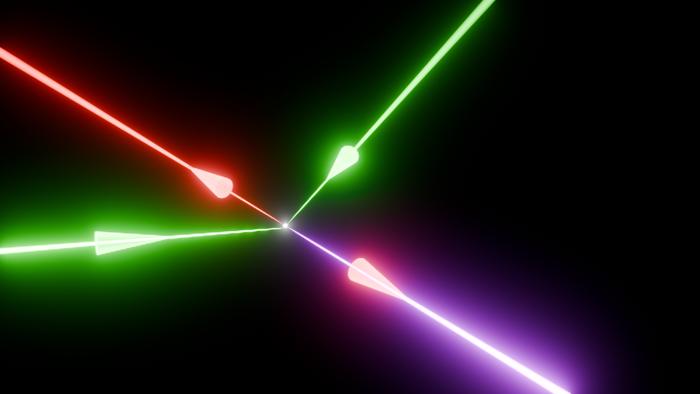
Central to their breakthrough is the recreation of a highly non-intuitive quantum process called vacuum four-wave mixing. The simulations reveal how three coherent laser beams, when intersected at precise focal points, induce a polarization of the quantum vacuum’s virtual pairs. This action effectively causes photons—the fundamental quanta of light—to scatter off each other, producing a fourth laser beam with a distinct color and trajectory. Such photon-photon scattering, commonly regarded as forbidden in classical electromagnetism, becomes possible because of the nonlinearities introduced by quantum vacuum polarization. These complex interactions mirror billiard balls colliding in a supernatural dance of light emerging from apparent darkness.
To achieve this, the researchers employed an enhanced version of the OSIRIS simulation framework—an advanced computational platform renowned for modeling plasma and laser-matter interactions. Leveraging massive parallel processing and sophisticated algorithms, the team computed the time evolution of the electromagnetic fields and the quantum vacuum perturbations in three spatial dimensions plus time. This real-time resolution exposed intricate dynamics hidden from static or lower-dimensional analyses, such as how small asymmetries in beam alignment subtly modulate scattering efficiencies and photon emission profiles.
Importantly, these comprehensive simulations do not merely satisfy theoretical curiosity. They directly inform the design and optimization of forthcoming experimental campaigns at next-generation high-power laser facilities worldwide. Institutions like the UK’s Vulcan 20-20, the European Extreme Light Infrastructure (ELI), and China’s Station for Extreme Light (SEL) and SHINE projects are rapidly advancing laser intensities into regimes where quantum vacuum nonlinearities become experimentally accessible. With simulation data underpinning their planning, experimentalists can finely tune laser pulse shapes, durations, and timings to maximize the likelihood of detecting elusive photon-photon scattering signals.
Lead researcher Zixin (Lily) Zhang, a doctoral physicist at Oxford, emphasized the transformative nature of this computational breakthrough. “Our simulations provide an unprecedented, time-resolved window into the quantum vacuum’s hidden dynamics under intense laser illumination,” she stated. "We have effectively unlocked access to a richly detailed four-dimensional landscape of quantum light-matter interactions that were previously inaccessible.” The team now aspires to extend their methods to explore more exotic laser configurations, including structured beams and ‘flying-focus’ pulses, potentially unveiling even more intricate quantum optical phenomena.
The implications stretch far beyond fundamental physics. Because vacuum polarization effects are sensitive to hypothetical particles such as axions or millicharged particles—both conjectured constituents of dark matter—this novel computational toolkit might also aid in the indirect search for physics beyond the Standard Model. Detecting minute deviations from predicted photon scattering rates or spectral features could hint at new forces or particles, providing a tantalizing avenue toward unraveling cosmic mysteries surrounding dark matter.
Professor Peter Norreys, co-author and established authority in quantum optics at Oxford, stressed that the journey from theory to experimental validation is now distinctly plausible. “These quantum vacuum effects no longer belong solely to mathematical constructs. With our sophisticated simulations and upcoming ultra-intense laser systems, we stand on the precipice of directly observing light-by-light scattering under laboratory conditions,” he explained. Such an achievement would not only confirm longstanding quantum electrodynamics predictions but also catalyze innovations in laser technology, high-field physics, and precision measurement.
The comprehensive simulation outputs shed light on how photon generation from vacuum fluctuations evolves temporally and spatially, detailing phase coherence, beam divergence, and polarization states of the emergent light. They delineate the critical interplay between laser intensities, focal geometries, and timing offsets—parameters whose meticulous control is essential to isolate genuine quantum signatures from background noise and competing effects.
Globally, the significance of this advance resonates within the context of complementary initiatives. For example, the University of Rochester’s OPAL laser facility in the United States has earmarked photon-photon scattering as a flagship experiment, poised to harness dual petawatt-class laser beams for experimental verification. Coordinated efforts among these leading centers, guided by rigorous simulation benchmarks like those developed at Oxford, promises to rapidly accelerate breakthroughs in understanding nonlinear quantum vacuum phenomena.
Beyond its immediate scientific ramifications, this work exemplifies the role of interdisciplinary collaboration and advanced computational science. Partnering closely with the Instituto Superior Técnico at the University of Lisbon, the Oxford team integrated expertise in quantum electrodynamics, laser physics, numerical modeling, and high-performance computing. This synergy enabled them to surmount the enormous complexity underlying semi-classical quantum vacuum interactions, crafting a versatile simulation platform with broad applicability.
As ultra-high-power laser facilities continue to come online globally, the frontier of quantum light-matter interaction research is set to expand dramatically. With the meticulous computational maps laid out by this study, researchers are now better equipped than ever to navigate and explore the quantum vacuum’s mysterious terrain, inching closer to unveiling the universe’s deepest inner workings at the intersection of light and emptiness.
News Publication Date: 5 June 2025
Web References:
https://www.nature.com/articles/s42005-025-02128-8
References:
DOI 10.1038/s42005-025-02128-8
Keywords
Physics, Quantum mechanics, Lasers, Light matter interactions, Vacuum
Cite Scienmag News
Katie Riggs. (June 5, 2025). Oxford Physicists Successfully Simulate Extreme Quantum Vacuum Phenomena. Scienmag. https://scienmag.com/oxford-physicists-successfully-simulate-extreme-quantum-vacuum-phenomena/
Katie Riggs. "Oxford Physicists Successfully Simulate Extreme Quantum Vacuum Phenomena." Scienmag, 5 June 2025, https://scienmag.com/oxford-physicists-successfully-simulate-extreme-quantum-vacuum-phenomena/. Accessed 5 September 2026.
Katie Riggs. "Oxford Physicists Successfully Simulate Extreme Quantum Vacuum Phenomena." Scienmag. June 5, 2025. https://scienmag.com/oxford-physicists-successfully-simulate-extreme-quantum-vacuum-phenomena/


