


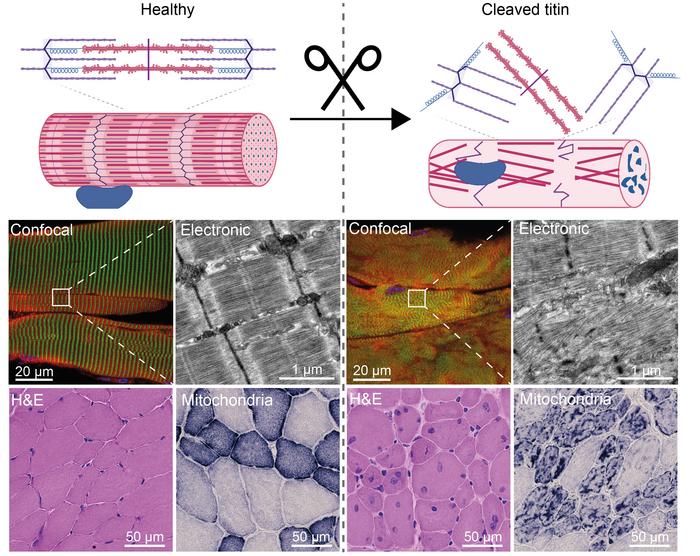
In a groundbreaking development poised to reshape our understanding of muscle biology and its related diseases, researchers at the Centro Nacional de Investigaciones Cardiovasculares (CNIC) in Madrid, Spain, have engineered a novel tool named TEVs-TTN that allows for the precise mechanical dissection of titin, the giant protein playing a pivotal role in muscle function. Headed by Jorge Alegre-Cebollada, this innovative method offers unprecedented control over the cleavage of titin in murine models, illuminating how mechanical disruption of this protein triggers the cascade of cellular dysfunction characteristic of muscular disease.
Titin, aptly named after mythological titans, is the largest known protein in the animal kingdom and serves as a molecular spring within the sarcomere—the fundamental contractile unit of muscle fibers. Comprising an intricate arrangement of folded domains, titin is essential for maintaining the structural integrity and elasticity of muscle during contraction and relaxation cycles. Mutations in the titin gene (TTN) rank among the most common genetic causes of congenital muscular dystrophies and cardiomyopathies worldwide.
Traditional models studying titin mutations have faced significant limitations due to the protein’s vast size and the complexity of its interactions, making it challenging to isolate mechanical effects from biochemical influences. Addressing this, the CNIC team’s TEVs-TTN approach enables controlled and site-specific cleavage of titin molecules within muscle cells, effectively “mechanically knocking out” the protein’s ability to sense and transmit force without completely abolishing its presence. This distinction allows for a more nuanced exploration of the protein’s mechanical contributions to muscle physiology.
Applying this novel method, the researchers observed that targeted cleavage of titin rapidly induced disassembly of sarcomeres. Confocal and electron microscopy revealed that within days, muscle fibers lost their highly ordered contractile structures, an outcome strikingly similar to those seen in patients harboring truncating TTN mutations. This sarcomeric breakdown was accompanied by hallmark pathological features such as myofibril atrophy, nuclear internalization, and mitochondrial aggregation, all indicators of deteriorating muscle health.
One of the most intriguing revelations of the study was that despite the profound structural collapse, muscle cells exhibited resilience, surviving even in the absence of intact sarcomeres. This finding challenges prior assumptions that sarcomere disintegration necessarily precipitates immediate cell death and illuminates potential compensatory mechanisms that cells might employ in response to mechanical failure. Such insights could have far-reaching implications, extending to conditions like muscle trauma, heart failure, and chemotherapy-induced cardiotoxicity, where mechanical integrity is compromised.
Dr. Roberto Silva-Rojas, the study’s first author, emphasized the translational potential of TEVs-TTN. “Our tool recapitulates the mechanical consequences of titin mutations with unprecedented fidelity, enabling a structured analysis of how impaired force transmission drives muscle disease. This platform opens avenues to test therapeutic interventions aimed at restoring sarcomere function,” he explained. Given the lack of suitable animal models that mirror the mechanical defects of TTN mutations, TEVs-TTN stands as a crucial advancement for preclinical research.
Beyond titin itself, this methodology sets a new paradigm for studying the mechanical roles of other critical proteins involved in muscle integrity and extracellular matrix interactions. Proteins such as dystrophin, integrins, and lamin A/C are all mechanically active and instrumental in maintaining muscle fiber stability and cellular communication; TEVs-TTN’s conceptual framework could be adapted to analyze the mechanical failure of these proteins in various pathologies.
The implications for muscular dystrophies, cardiomyopathies, and other force-related diseases are profound. With TEVs-TTN, researchers can disentangle the chain of biomechanical events that lead from protein dysfunction to tissue degeneration and clinical symptoms. This mechanistic clarity is essential for the rational design of treatments that go beyond symptom management, targeting the root causes of muscle degeneration.
Funded by prestigious bodies such as the European Research Council under the ProtMechanics-Life Consolidator Grant and supported by the European Molecular Biology Organization, the study showcases the critical intersection of mechanical biology, molecular genetics, and bioengineering. The multidisciplinary approach exemplified by the CNIC team highlights the growing potency of integrated methods to solve complex biological puzzles.
The publication of this research in Nature Biomedical Engineering solidifies TEVs-TTN’s role as both a scientific tool and a beacon for future innovation in muscle disease research. As the medical community presses forward to unlock the secrets of muscular disorders, this mechanical knockout strategy offers a powerful lens through which the dynamic interplay of force and form can be deciphered.
Finally, the CNIC, under the leadership of Dr. Valentín Fuster, continues to spearhead transformative cardiovascular and muscle research. Its unique public-private partnership funding model fosters cutting-edge science with real-world impact, positioning Spain at the forefront of biomedical innovation. The development of TEVs-TTN not only advances our grasp of muscle mechanics but also exemplifies how strategic investment in research infrastructure catalyzes discoveries with global relevance.
News Publication Date: 5-Jun-2025
Web References:
https://doi.org/10.1038/s41551-025-01403-x
Cite Scienmag News
Ophelia Keating. (June 5, 2025). Innovative Technique Unveils Role of Mechanical Proteins in Muscular Disorders. Scienmag. https://scienmag.com/innovative-technique-unveils-role-of-mechanical-proteins-in-muscular-disorders/
Ophelia Keating. "Innovative Technique Unveils Role of Mechanical Proteins in Muscular Disorders." Scienmag, 5 June 2025, https://scienmag.com/innovative-technique-unveils-role-of-mechanical-proteins-in-muscular-disorders/. Accessed 8 September 2026.
Ophelia Keating. "Innovative Technique Unveils Role of Mechanical Proteins in Muscular Disorders." Scienmag. June 5, 2025. https://scienmag.com/innovative-technique-unveils-role-of-mechanical-proteins-in-muscular-disorders/


