


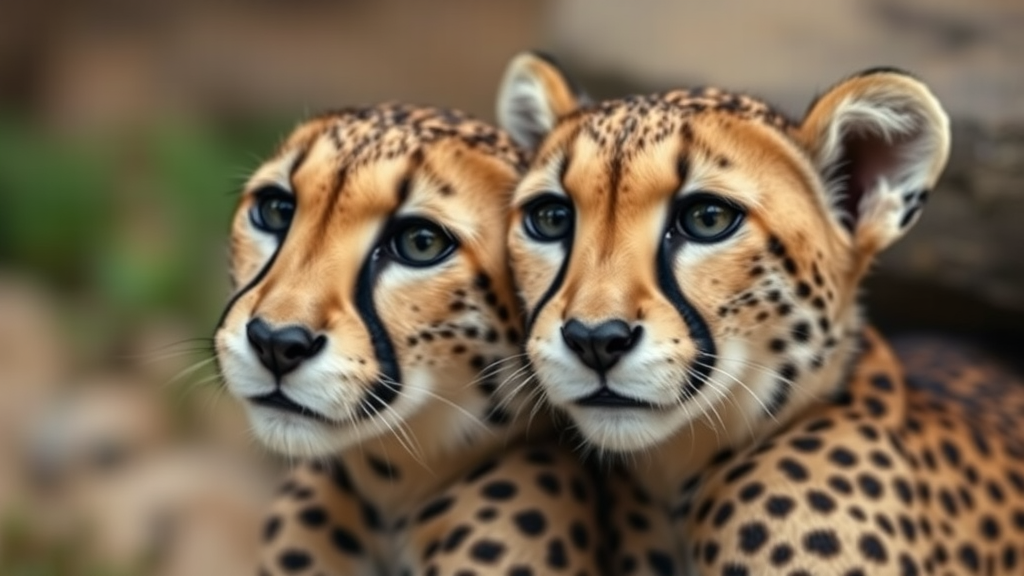
Cheetahs that lose their mothers in the first weeks of life and are then raised by human caretakers may carry a lasting acoustic imprint of that unusual upbringing into adulthood, according to a new playback study published in the journal Animal Cognition. The research, conducted on 25 captive adult cheetahs at the Cheetah Conservation Fund in Namibia, shows that the timing of maternal loss shapes how these big cats respond to voices years later, with early-orphaned animals reacting more strongly to unfamiliar human voices and showing markedly less interest in the calls of their own kind. The findings offer the first experimental evidence that early versus late orphancy produces long-lasting differences in acoustic perceptual development in a large carnivore, and they may help explain a persistent puzzle in cheetah conservation: the reduced reproductive success of hand-reared animals compared with mother-reared ones.
The study was motivated by a well-established principle in mammalian development. Early adult models, particularly the mother, play an essential role in tuning a youngster’s perception so that it can build a multimodal representation of species-specific social signals. When maternal care is disrupted, social integration often suffers. In cheetahs, orphaned cubs are frequently taken in by humans, and the degree of human rearing depends on how old the cub was when it lost its mother. The researchers hypothesized that the timing of maternal loss might therefore influence whether orphaned cheetahs could build normal species-specific vocal recognition, a question made especially interesting by the cheetah’s unusual two-stage developmental schedule.
During the first two months after birth, cheetah cubs are hidden in a den while their mother hunts alone, meaning direct contact between mother and cubs is limited in this early phase. Thereafter, the cubs begin following the mother and spend increasingly long periods in contact with her. This split creates a natural experiment: cubs orphaned before the two-month mark have experienced very little exposure to an adult cheetah, while cubs orphaned after that point have had substantially more maternal interaction. If acoustic recognition depends on experience during these windows, the two groups should differ, and that is precisely what the team set out to test.
To probe this, the researchers broadcast unfamiliar human voices and unfamiliar cheetah voices to the 25 captive adult cheetahs, all of which had been orphaned before the age of six months at one of the two developmental stages. Playback experiments of this kind are a standard tool in animal cognition research, allowing scientists to present controlled acoustic stimuli and measure attention, orientation, and behavioral changes without any direct interaction. The team recorded how quickly each animal responded, how long it paid attention to the loudspeaker, and how its activity changed in reaction to the sound.
The results revealed a striking pattern that differed by sex and by the timing of orphancy. Early-orphaned male cheetahs responded more quickly, paid attention for longer, and displayed more activity changes in response to the human voice than late-orphaned males did. In contrast, early-orphaned females showed less interest in the cheetah voice than their late-orphaned counterparts. Taken together across both sexes, early-orphaned cheetahs were 5.6 times more likely to respond to a human voice than late-orphaned cheetahs, a substantial difference that persisted into adulthood long after the period of human hand-rearing had ended.
These findings suggest that the perceptual tuning normally provided by the mother, and by exposure to conspecifics more broadly, was incomplete in the early-orphaned animals. Cubs that lost their mothers before the den-exit stage had little opportunity to learn what a cheetah sounds like, and their subsequent human rearing appears to have filled that perceptual gap with the wrong acoustic model. Late-orphaned cubs, having followed their mothers for weeks or months before losing them, retained enough species-specific exposure to maintain interest in cheetah vocalizations as adults. The study is the first to demonstrate such a long-lasting effect of early versus late orphancy on acoustic perceptual development, revealing an experience-dependent perceptual plasticity that shapes species-specific representation well into adulthood.
The sex differences add an intriguing layer to the story. Why early-orphaned males should orient more strongly toward human voices while early-orphaned females disengage from cheetah voices is not fully resolved, but the divergence hints that the developmental consequences of maternal loss and human rearing may not be uniform across the sexes. In a species where females disperse and males may form coalitions, different social ecologies could make each sex differently sensitive to the identity of the acoustic models available during early life. The authors suggest that these altered perceptual representations may underlie the reduced reproductive success previously observed in hand-reared versus mother-reared cheetahs, since recognizing and responding appropriately to conspecific signals is fundamental to courtship, mating, and social tolerance.
For conservation programs, the implications are practical as well as scientific. Cheetahs are difficult to breed reliably in captivity, and hand-rearing is sometimes unavoidable when mothers die or abandon cubs. The new results indicate that the developmental stage at which a cub is orphaned matters for its long-term social perception, not merely for its immediate survival. Facilities may therefore want to consider how orphaned cubs are reared and what acoustic and social environments they are exposed to, particularly for cubs taken in before two months of age. Enriching the early soundscape of such cubs with conspecific vocalizations, or pairing them with adult cheetah models, could potentially mitigate the perceptual deficits documented here, although testing such interventions would be a logical next step.
The work also contributes to a broader scientific conversation about how mammals build their understanding of species-specific communication. Across many mammalian species, early social experience tunes auditory perception, and cross-fostering or human-rearing studies in birds and primates have shown that the models available during sensitive periods can redirect preferences toward the wrong species or even toward humans. Demonstrating the same principle in a large, endangered carnivore, using a naturally occurring gradient of maternal exposure rather than experimental deprivation, strengthens the case that these mechanisms are widespread and consequential. It also underscores the ethical weight of hand-rearing decisions: what happens in the first weeks of a cheetah’s life can echo through years of its adult social and reproductive behavior.
Methodologically, the study stands out for its use of playback experiments with adult animals whose early histories were documented, allowing a direct test of timing effects that would be difficult to arrange experimentally. By comparing responses to human and cheetah voices within the same individuals, the researchers could dissociate general responsiveness from species-specific interest, and the divergent patterns they observed indicate that the two are shaped differently by early experience. As the first evidence that early versus late orphancy leaves a measurable, long-lasting signature on acoustic perception in cheetahs, the study opens a path toward better husbandry practices, improved breeding outcomes, and a deeper understanding of how the earliest social bonds sculpt the sensory world of growing animals.
Subject of Research: The effect of early versus late maternal loss and human hand-rearing on species-specific acoustic recognition in adult cheetahs.
Article Title: Not speaking my language: playback experiments reveal early-orphaned human-reared adult cheetahs lack interest in species-specific vocalizations
Article References: Hausberger, M., Collier, K., Glaziou, A., Schmidt-Küntzel, A., Marker, L., Johnston, B., Hetem, R. S., Azuh, I. E., & Lemasson, A. (2026). Not speaking my language: playback experiments reveal early-orphaned human-reared adult cheetahs lack interest in species-specific vocalizations. Animal Cognition. https://doi.org/10.1007/s10071-026-02106-9
Image Credits: AI Generated
DOI: 10.1007/s10071-026-02106-9
Keywords: cheetahs, animal cognition, playback experiments, maternal loss, hand rearing, acoustic perception, vocal communication, early experience, species recognition, conservation, Namibia, speaking
Cite Scienmag News
Drew Townsend. (September 20, 2026). Orphaned Cheetahs Raised by Humans Tune Out Their Own Species’ Calls. Scienmag. https://scienmag.com/orphaned-cheetahs-raised-by-humans-tune-out-their-own-species-calls/
Drew Townsend. "Orphaned Cheetahs Raised by Humans Tune Out Their Own Species’ Calls." Scienmag, 20 September 2026, https://scienmag.com/orphaned-cheetahs-raised-by-humans-tune-out-their-own-species-calls/. Accessed 4 October 2026.
Drew Townsend. "Orphaned Cheetahs Raised by Humans Tune Out Their Own Species’ Calls." Scienmag. September 20, 2026. https://scienmag.com/orphaned-cheetahs-raised-by-humans-tune-out-their-own-species-calls/


