


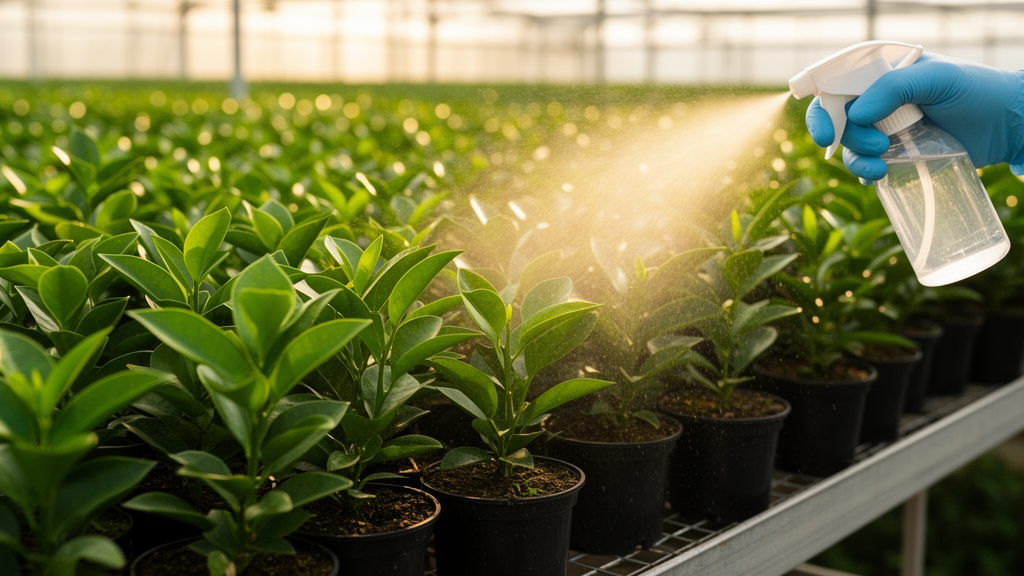
Huanglongbing, the devastating citrus disease also known as greening, may have gained a formidable new opponent. Researchers in Brazil have engineered a bio-based nanoemulsion loaded with oregano essential oil, hexyl gallate and eugenol that, when poured onto the roots of infected citrus seedlings, cut bacterial loads of Candidatus Liberibacter asiaticus by up to 2.46 log10 over 300 days. The work, published in Frontiers in Agronomy, offers a non-synthetic alternative to the broad-spectrum antibiotics that currently dominate efforts to manage a pathogen that has crippled citrus industries on several continents.
The bacterium behind huanglongbing is a notoriously difficult target. Candidatus Liberibacter asiaticus, or CLas, cannot be grown in laboratory culture and lives exclusively inside the phloem, the vascular tissue that transports sugars through the plant. This sequestered lifestyle means that any antimicrobial compound must navigate waxy cuticles, cell walls and apoplastic pathways before it can reach the pathogen. Conventional sprays of oxytetracycline and streptomycin often fail to penetrate deeply enough, while trunk injections are invasive and costly. The Brazilian team, led by researchers at São Paulo State University and the N&P Pharmaceutical Technology Laboratory, reasoned that a carefully designed colloidal delivery system could overcome these barriers from the opposite direction, entering through the roots and traveling with the transpiration stream toward the phloem.
Because CLas is unculturable, the scientists could not screen their formulations directly against it in a petri dish. Instead, they turned to two culturable relatives from the same bacterial order, Rhizobium tropici and Rhizobium phaseoli, as biological surrogates. Nine prototype formulations, built from cationic polymers, soy lecithin, surfactants, essential oils and other natural components, were tested using a resazurin microtitre assay that quantifies bacterial respiration through a color-changing dye. The standout, designated V13, inhibited 90 percent of R. tropici growth at just 0.14 percent by volume and killed the bacterium outright at 0.25 percent. Against R. phaseoli, the corresponding values were 0.28 and 0.5 percent. Formulations that showed strong inhibition but no killing, such as V12, were set aside as merely bacteriostatic.
Physicochemical characterization revealed a deliberately multimodal particle architecture. Dynamic light scattering showed that 98.5 percent of particles measured around 50 nanometers in the number-weighted distribution, with a polydispersity index of 0.31 and a zeta potential of minus 17.5 millivolts. Secondary populations between 280 and 440 nanometers, and a small micrometric fraction near 2.1 micrometers, were also present. Scanning electron microscopy confirmed both nanometric particles and microscopic aggregates, though the authors caution that the dehydration step required for SEM can induce coalescence that does not reflect the native suspension. The team interprets this size diversity as functional rather than accidental: the nanoscale fraction is well suited to diffusing through microscopic gaps in plant tissue and percolating through soil pores, while the larger particles may act as a localized reservoir in the soil matrix, improving retention and reducing leaching of the active ingredients.
Rheological testing added further confidence in the formulation’s practicality. V13 behaved as a near-Newtonian fluid, with a flow behavior index of 1.113, no yield stress, and a low, stable viscosity of roughly 1.4 millipascal-seconds at 20 degrees Celsius. A temperature sweep from 20 to 50 degrees Celsius showed an 83 percent viscosity recovery upon cooling with no thermal hysteresis, indicating that the emulsion resists heat-induced coalescence and should flow smoothly through standard agricultural spraying and drenching equipment. Despite a zeta potential magnitude that would normally signal weak electrostatic stability, the combination of soy lecithin and polysorbate provides steric and interfacial stabilization, and the formulation retained full bactericidal activity against both surrogates over a 120-day storage period across room temperature, refrigeration and greenhouse conditions, with pH holding steady near 5.
The decisive test came in the greenhouse. Valencia sweet orange seedlings grafted onto Swingle rootstocks were infected by caging five CLas-positive Asian citrus psyllids, Diaphorina citri, on young flush shoots for 72 hours. Once infection was confirmed by qPCR, seedlings received a shock-treatment schedule of root drenches: three applications in the first week, two more at weekly intervals, and two maintenance doses at fortnightly intervals, all at the minimum bactericidal concentration of 0.5 percent. Over 300 days of monitoring in two independent experiments, treated plants consistently maintained lower bacterial titers than untreated controls. In the first trial, begun in March 2025, the overall reduction reached 1.29 log10, with 70 percent of treated plants at or near the detection limit by the endpoint. The second trial, started under cooler winter conditions, delivered an even stronger 2.46 log10 reduction, with 90 percent of treated plants at or near the limit of detection and statistically significant differences at 180, 240 and 300 days.
Not every plant responded uniformly. The treated populations split into a highly responsive subset, seven of ten plants in the first trial and nine of ten in the second, that achieved a median log10 reduction of 3.44 relative to matched controls, while others showed more modest declines. The authors attribute this heterogeneity to differences in individual root architecture, the density of vascular colonization established before treatment began, and micro-variations in absorption efficiency. Seasonal factors likely played a role as well, since respiration rates and photoassimilate flow differ between the summer and winter trials, and the treatment effect alone reached statistical significance only in the winter experiment. These patterns underscore a recognized challenge in systemic treatments evaluated over long greenhouse trials and point toward uptake consistency as a priority for future formulation refinement.
Safety data provided an encouraging counterpoint to the efficacy results. In ecotoxicological assays, mealworm larvae, Tenebrio molitor, exposed topically to the formulation at the field dose and at ten times that concentration showed no acute toxicity over 72 hours, with mortality below 1 percent at the high dose, while a commercial insecticide positive control killed 60 percent of larvae. Survival analysis of the stingless bee Melipona scutellaris, a native Brazilian pollinator, revealed no significant differences among untreated, vehicle, 0.5 percent and 5 percent treatment groups, with median survival times ranging from 16.5 to 19 days across groups. No visible phytotoxicity, such as leaf necrosis, wilting or growth arrest, appeared in treated seedlings at any point during the 300-day monitoring period, although quantitative endpoints like root biomass and chlorophyll content were not measured in this proof-of-concept study.
The mechanism behind the formulation’s success likely involves more than simple antibacterial killing. Eugenol and carvacrol, key molecules in oregano essential oil, are classified as permeation enhancers that transiently disrupt plant cell membranes by intercalating with lipid bilayers. This membrane depolarization can trigger calcium leakage, oxidative bursts and the activation of salicylic and jasmonic acid signaling pathways, potentially priming the plant’s own immune defenses. Recent work in grapevines showed that oregano essential oil vapor primes immunity against downy mildew, and the authors hypothesize a similar effect may contribute to the CLas reductions observed here. Meanwhile, hexyl gallate disrupts bacterial membranes and interferes with cell division, and the multi-ingredient design may help slow the emergence of resistance compared with single-antibiotic approaches.
Significant hurdles remain before V13 can reach commercial orchards. The study was conducted under controlled greenhouse conditions, and field validation across variable environments, formulation scale-up, economic feasibility and the fate of the nanoparticles in complex field soils all await investigation. The ecotoxicological assessment covered only mortality and survival in two indicator species, leaving sublethal effects, pollinator exposure through contaminated nectar or pollen, and impacts on rhizosphere microbial communities unexplored. Still, the demonstration that a root drench of plant-derived nanocarriers can push CLas populations toward the detection limit in living trees, without antibiotics and without harming beneficial insects in initial tests, marks a meaningful advance. As greening incidence in Brazil’s citrus belt reached 47.63 percent of orange trees in 2025, corresponding to nearly 100 million infected trees, the need for such tools has never been more urgent.
Subject of Research: Bio-based nanoemulsion delivery of essential oil compounds to reduce Candidatus Liberibacter asiaticus titers in citrus seedlings via root drenching
Article Title: Reduction of Candidatus Liberibacter asiaticus titres in citrus seedlings via root-drenching application of bio-based nanoemulsions
Article References: Bergamo, V. R., Marin, V. R., Zamunér, C. F. C., Miotelo, L., Petrônio, M. S., & Ferreira, H. (2026). Reduction of Candidatus Liberibacter asiaticus titres in citrus seedlings via root-drenching application of bio-based nanoemulsions. Frontiers in Agronomy, 8, Article 1965184. https://doi.org/10.3389/fagro.2026.1965184
Image Credits: AI Generated
DOI: 10.3389/fagro.2026.1965184
Keywords: Huanglongbing, Candidatus Liberibacter asiaticus, citrus, nanoemulsion, oregano essential oil, hexyl gallate, eugenol, root drenching, phloem-restricted pathogen, Diaphorina citri, ecotoxicology, plant disease management
Cite Scienmag News
Kristina Jarvis. (October 15, 2026). Oregano Oil Nanoemulsion Slashes Citrus Greening Bacteria in Seedlings. Scienmag. https://scienmag.com/oregano-oil-nanoemulsion-slashes-citrus-greening-bacteria-in-seedlings/
Kristina Jarvis. "Oregano Oil Nanoemulsion Slashes Citrus Greening Bacteria in Seedlings." Scienmag, 15 October 2026, https://scienmag.com/oregano-oil-nanoemulsion-slashes-citrus-greening-bacteria-in-seedlings/. Accessed 15 October 2026.
Kristina Jarvis. "Oregano Oil Nanoemulsion Slashes Citrus Greening Bacteria in Seedlings." Scienmag. October 15, 2026. https://scienmag.com/oregano-oil-nanoemulsion-slashes-citrus-greening-bacteria-in-seedlings/


