


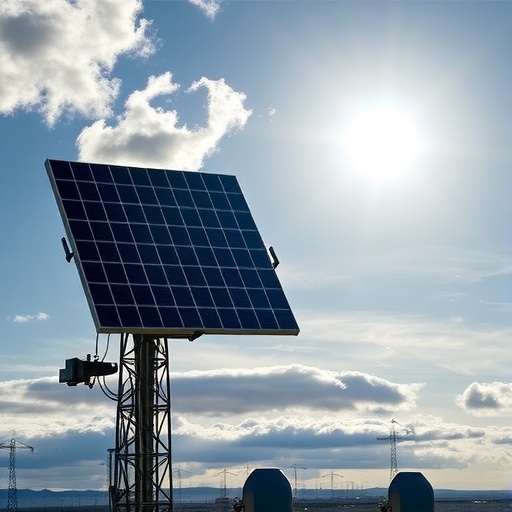
Solar energy, a cornerstone of the global shift toward clean and sustainable power, faces a critical challenge due to the inherent variability of sunlight. Fluctuations caused by weather phenomena such as clouds and atmospheric disturbances complicate the reliable operation of photovoltaic (PV) systems. Precisely forecasting solar radiation in the short term is therefore essential to optimize the efficiency and stability of solar power output. Yet, current forecasting models struggle with clarity and accuracy as the prediction timeframe lengthens, often generating images that fade into blur and lose key details, limiting the usefulness of these forecasts for real-world applications.
Researchers from the Nanjing University of Information Science and Technology, in collaboration with other institutions, have pioneered an innovative approach leveraging artificial intelligence to overcome these limitations. Their newly developed model, dubbed GAN-Solar, employs Generative Adversarial Networks (GANs) to enhance the quality of solar radiation forecasting significantly. GANs consist of two competing neural networks—the generator and the discriminator—that operate in a dynamic adversarial relationship to iteratively improve output quality, a mechanism borrowed from advanced machine learning techniques originally designed for image synthesis and enhancement.
In this analogy, the generator acts as a “master painter,” tasked with creating detailed and realistic future maps of solar radiation based on past satellite data. Simultaneously, the discriminator serves as a “keen art critic,” evaluating these synthetic forecasts against actual satellite imagery to distinguish between authentic and generated content. Through ongoing training cycles, this adversarial contest sharpens the generator’s ability to render projections, effectively enhancing its capacity to generate high-definition, accurate representations of solar irradiance dynamics that traditional models fail to resolve with sufficient fidelity.
Lead author Chao Chen describes this process as equipping solar forecasting systems with “high-precision glasses,” enabling them not just to observe the broad patterns of solar radiation distribution but to capture the minute details critical for operational decision-making. Unlike conventional forecasts, which tend to grow fuzzier and less reliable with increased forecast horizons, GAN-Solar maintains sharpness and structural integrity in its predictions. This capability allows grid managers and energy dispatchers to anticipate fluctuations and plan accordingly, reducing volatility and improving the integration of solar power into energy markets.
Quantitative validation of GAN-Solar’s performance demonstrates a marked improvement over state-of-the-art forecasting techniques. The model achieved an increase in the Structural Similarity Index (SSIM) score—from 0.84 to 0.87—a key metric that quantifies the visual and structural quality of forecast images relative to real measurements. This gain reflects the model’s enhanced ability to replicate the complex textures and spatial patterns of solar radiation accurately, representing a significant breakthrough in predictive modeling for renewable energy applications.
Beyond the fundamental improvements in forecast clarity, GAN-Solar’s implications extend to the broader domain of satellite communication networks, where precise solar radiation data is critical for maintaining signal integrity and system reliability. Fluctuations in solar exposure impact not only power generation but can also influence atmospheric conditions and radio wave propagation, making enhanced forecast precision an asset across multiple sectors reliant on atmospheric data.
Moreover, GAN-Solar exemplifies how machine learning algorithms can be rigorously applied to environmental and energy challenges, opening new frontiers for AI-driven optimization in climate-sensitive technologies. By continuously refining its outputs through adversarial learning, GAN-Solar embodies a self-improving system that can adapt to evolving climatic patterns and datasets, suggesting a scalable approach to forecasting in other domains where spatiotemporal precision is paramount.
This research signals a transformative moment for renewable energy management, where AI not only supplements but fundamentally redefines the tools available for anticipating and mitigating the variability inherent in natural energy sources. As solar power grows to represent an increasingly significant share of the global energy mix, innovations such as GAN-Solar will be instrumental in ensuring grid stability, reducing operational costs, and enhancing the overall sustainability of energy infrastructure.
Looking ahead, the integration of GAN-based forecasting models with real-time satellite observations and energy grid monitoring systems offers a promising avenue for further research and practical deployment. Such integration could yield continuous, adaptive forecasts that dynamically respond to sudden meteorological changes, empowering operators with actionable intelligence for immediate decision-making. This could mitigate the risks associated with solar intermittency and enable smoother transitions between different power generation modes.
Furthermore, the researchers highlight the potential to extend the application domain of GAN-Solar by incorporating diverse datasets, including atmospheric chemistry, aerosol concentrations, and temperature gradients, to enrich the contextual understanding of solar radiation dynamics. Such multidimensional inputs could enable forecasts that factor in complex environmental interactions, thereby improving prediction robustness under extreme or unusual weather phenomena.
The development of GAN-Solar also underscores the critical role of interdisciplinary collaboration that bridges meteorology, computer science, and renewable energy engineering. By bringing together expertise from these varied fields, the research team has demonstrated how cutting-edge AI methods can be tailored and optimized for the nuanced needs of energy meteorology, potentially setting a benchmark for future advances in renewable energy forecasting technologies.
In conclusion, the advent of GAN-Solar reveals a sophisticated leap forward in solar radiation forecasting, harnessing adversarial neural networks to generate high-definition, reliable predictions that stand to significantly enhance the operational efficacy and resilience of solar power systems worldwide. By addressing the critical challenge posed by the intermittent nature of solar irradiance through superior computational modeling, this innovation paves the way for more stable, efficient, and sustainable integration of solar energy into complex infrastructure networks.
Web References: http://dx.doi.org/10.1016/j.ijin.2025.07.004
Cite Scienmag News
Faith Mcneil. (October 15, 2025). Optimizing Solar Radiation Forecasts for Satellite Communication Networks Using GAN Technology. Scienmag. https://scienmag.com/optimizing-solar-radiation-forecasts-for-satellite-communication-networks-using-gan-technology/
Faith Mcneil. "Optimizing Solar Radiation Forecasts for Satellite Communication Networks Using GAN Technology." Scienmag, 15 October 2025, https://scienmag.com/optimizing-solar-radiation-forecasts-for-satellite-communication-networks-using-gan-technology/. Accessed 5 September 2026.
Faith Mcneil. "Optimizing Solar Radiation Forecasts for Satellite Communication Networks Using GAN Technology." Scienmag. October 15, 2025. https://scienmag.com/optimizing-solar-radiation-forecasts-for-satellite-communication-networks-using-gan-technology/


