


In an age where sustainable food production is no longer a mere choice but an imperative, a pioneering study from the forefront of food science has unveiled groundbreaking advancements in meat analog technology. Researchers Kim YJ, Choi YJ, Kim JH, and colleagues have propelled the field forward by developing a novel emulsion-type meat analog that integrates mealworms and textured vegetable protein (TVP) with a strategic addition of mushrooms. Published in Food Science & Biotechnology in 2025, their work heralds a new era in the textural and functional enhancement of plant-based meat alternatives by harnessing unusual yet promising sources of protein and bioactive components.
Meat analogs have skyrocketed in popularity as a sustainable alternative to animal protein, responding to the urgent environmental concerns linked to livestock farming. However, replicating the intricate sensory and functional characteristics of real meat remains a formidable challenge. This study focuses on the technofunctional properties — critical parameters reflecting how well these analogs mimic meat’s structure, texture, and cooking behavior — by leveraging an emulsion system as its core structural model. Emulsions, where fat droplets are finely dispersed in a protein matrix, offer a versatile platform for mimicking the juiciness and mouthfeel of animal meat.
The researchers began their exploration by integrating mealworm protein, an insect-based ingredient renowned for its high protein content, balanced amino acid profile, and remarkable sustainability credentials. Mealworms mature quickly on low-resource substrates, produce minimal greenhouse gases, and provide a nutritional richness that traditional plant proteins often lack. Combining mealworm protein with textured vegetable protein (TVP), derived predominantly from soy, created a complementary protein blend designed to optimize both nutritive value and functional performance.
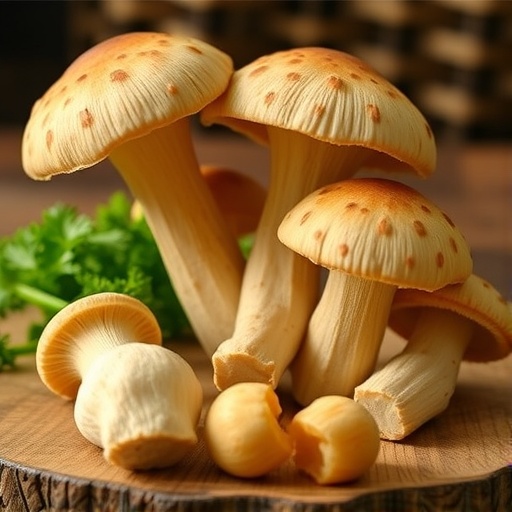
Central to the innovation was the incorporation of mushrooms, a natural ingredient whose umami-rich profile and fibrous structure have long been recognized in culinary circles for enhancing meat flavor and texture. The team meticulously evaluated different concentrations of mushrooms in their emulsion blends to pinpoint the “optimal concentration” that amplifies the mucilaginous properties and water-holding capacity without sacrificing firmness. These factors critically influence the juiciness, tenderness, and overall palatability of meat substitutes, often the Achilles’ heel of plant-based options.
Methodological rigor was evident in the study’s multi-pronged approach: rheological measurements traced the viscoelasticity of emulsions to assess their resistance to deformation, while differential scanning calorimetry gauged thermal stability — crucial for cooking applications. Texture profile analysis simulated biting and chewing to directly model consumer eating experiences. These technical metrics converged to map how mealworm and mushroom interactions modulate structural dynamics within the protein-fat-water matrix.
One of the most striking findings was how mushroom incorporation at a finely tuned ratio elevated the emulsification efficiency and microstructure uniformity of the meat analog. Scanning electron microscopy revealed a densely packed network of protein fibers intertwined with mushroom-derived polysaccharides, which collectively enhanced cohesion and reduced phase separation during cooking. This microstructural synergy translated into substantial improvements in cooking yield and moisture retention, both parameters that dictate consumer satisfaction in real-world use.
Beyond textural properties, the study illuminated the nutritional upgrading conferred by the mealworm-mushroom amalgam. The presence of bioactive compounds native to mushrooms—including β-glucans and antioxidants—coupled with the high-quality protein from mealworms, tapped into a functional food paradigm. This meat analog offers not just a sensory experience comparable to conventional meat but also potential health benefits associated with immune modulation and oxidative stress reduction.
Another critical dimension was the environmental footprint analysis. Although not the primary focus, the authors contextualized their product within the broader sustainability discourse. Producing a meat analog anchored in entomophagy (insect eating) and fungal ingredients exemplifies circular bioeconomy principles; it requires fewer natural resources and emits fewer greenhouse gases compared to traditional meat production. This positions the formulation as a blueprint for future food systems that align planetary health with consumer demand.
The broader implications of this research ripple across diverse sectors, from food technology startups ambitiously seeking the “holy grail” of meat mimicry to policymakers crafting frameworks that incentivize sustainable protein innovation. The study’s detailed emphasis on emulsion engineering fosters new frontiers for ingredient synergy, enabling the next generation of hybrid meat substitutes that are textured, flavorful, and environmentally responsible.
Taking a step back, this work underscores a crucial scientific principle — the value of interdisciplinary approaches. By bridging entomology, mycology, food chemistry, and materials science, the research team has fundamentally expanded the toolkit available to food engineers. Such integrated methodologies are vital to overcoming entrenched challenges that single-source proteins or ingredients alone have struggled to surmount.
Moreover, this study invites curiosity into the sensory acceptability from a consumer standpoint, an area ripe for future exploration. While the technofunctional properties have been advanced significantly, real-world market success depends on consumer perception, cultural openness to insect-derived ingredients, and culinary versatility. Addressing these human factors will be pivotal in translating laboratory breakthroughs into everyday dining experiences.
Importantly, the research also hints at scalability potential. Emulsion-type meat analogs lend themselves well to industrial production methods, including high-shear mixing and extrusion, suggesting that moving from pilot-scale studies to commercial manufacture is plausible without prohibitive cost or complexity. This scalability prospect bodes well for democratizing access to high-quality meat alternatives worldwide.
In sum, the paper authored by Kim and colleagues represents a landmark contribution to sustainable food science, showcasing how strategic ingredient incorporation at molecular levels can unlock superior properties in meat analogs. By combining the environmental virtues of insects and mushrooms with cutting-edge emulsion technology, the study not only addresses pressing sustainability and nutritional imperatives but also lays the foundation for a new generation of protein innovations that do not compromise on taste, texture, or ethical considerations.
As the global population continues to rise and climate challenges mount, the advent of such sophisticated meat alternatives provides an encouraging harbinger of how science can reshape our foodscape. With continued interdisciplinary collaboration, iterative product development, and consumer engagement, the tantalizing prospect of truly delicious and planet-friendly meat substitutes might soon shift from niche novelty to mainstream staple, transforming diets and ecosystems alike.
Cite Scienmag News
Drew Townsend. (October 3, 2025). Optimizing Mushrooms Boost Meatless Mealworm-TVP Emulsions. Scienmag. https://scienmag.com/optimizing-mushrooms-boost-meatless-mealworm-tvp-emulsions/
Drew Townsend. "Optimizing Mushrooms Boost Meatless Mealworm-TVP Emulsions." Scienmag, 3 October 2025, https://scienmag.com/optimizing-mushrooms-boost-meatless-mealworm-tvp-emulsions/. Accessed 4 September 2026.
Drew Townsend. "Optimizing Mushrooms Boost Meatless Mealworm-TVP Emulsions." Scienmag. October 3, 2025. https://scienmag.com/optimizing-mushrooms-boost-meatless-mealworm-tvp-emulsions/


