

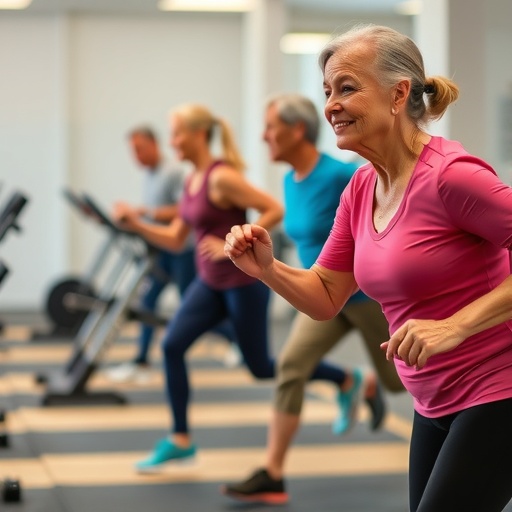
In the evolving landscape of geriatric health research, a groundbreaking randomized controlled trial set to be published in 2026 promises to redefine how we approach physical performance, cognitive function, and mental health in elderly individuals experiencing possible sarcopenia. Spearheaded by researchers Li, Ossowski, Pasek, and colleagues, this study meticulously examines the interplay between exercise frequency and volume to establish optimal intervention protocols that could dramatically improve quality of life for this vulnerable population.
Sarcopenia, the age-related loss of muscle mass and strength, represents a growing public health challenge as it undermines older adults’ physical independence and predisposes them to a cascade of debilitating consequences. Addressing sarcopenia’s multifactorial impacts requires interventions that go beyond simplistic exercise prescriptions. The study protocol under discussion aims to clarify the nuanced effects of training frequency and volume on multiple outcome domains, notably physical capabilities, cognitive faculties, and mental health status.
This ambitious inquiry utilizes a rigorously designed randomized controlled trial methodology, the gold standard in clinical research, to ensure that findings will be robust, reproducible, and clinically relevant. Participants diagnosed with or suspected of having sarcopenia will be allocated into different intervention arms, each receiving a tailored combination of exercise doses, carefully manipulating frequency (how often exercises are performed) and volume (the total work done per session and per week). Such precision is invaluable because previous research has often relied on inconsistent or poorly defined exercise regimens.
The investigative team draws on a sophisticated understanding of exercise physiology and geriatric medicine to hypothesize that certain combinations of frequency and volume may synergistically yield more pronounced benefits than when these variables are considered in isolation. They seek to determine whether more frequent, lower-volume exercise, or alternatively, less frequent, higher-volume sessions prove superior in eliciting improvements across physical, cognitive, and psychological dimensions.
Integral to the study design is the comprehensive assessment strategy. Physical performance will likely be quantified using standardized instruments such as gait speed tests, muscle strength dynamometry, and validated functional scales, while cognitive function will be measured through neuropsychological batteries aimed at capturing memory, attention, and executive function changes. Mental health parameters, including measures of mood, anxiety, and overall psychological well-being, are expected to be evaluated using validated self-report questionnaires and potentially clinician-administered interviews.
The implications of this research are far-reaching. If the optimal exercise prescription identified in the trial can be widely adopted, it would offer a cost-effective, non-pharmacological strategy to mitigate the progression of sarcopenia. This is particularly critical given the challenges associated with drug development for age-related muscle loss and its complications. Moreover, improving cognitive function and mental health alongside physical gains would illuminate the holistic benefits of tailored physical activity regimens in aging populations.
Experts outside the research team have expressed excitement about the potential translational impact of these findings. The ability to fine-tune exercise prescriptions to individual needs and healthcare settings has long been an unmet goal in geriatric care. Additionally, the integration of mental and cognitive health outcomes aligns with contemporary paradigms emphasizing biopsychosocial models of aging, breaking away from reductionist approaches that assess these domains in isolation.
Beyond clinical settings, the study’s evidence could revolutionize public health recommendations, guiding community programs and even policy initiatives geared towards older adults. Tailored interventions that maximize adherence and outcomes could stem the tide of disability and healthcare costs associated with sarcopenia and related conditions, ultimately enhancing population health and aging well-being.
From a mechanistic perspective, the trial may also shed light on how different exercise regimens influence muscle plasticity, neurotrophic factor release, and inflammatory pathways implicated in aging processes. The interplay of these biological mechanisms offers a plausible explanation for the cognitive and emotional improvements observed in physically active older individuals, framing exercise as a potent modulator of systemic aging.
The researchers also acknowledge significant methodological challenges inherent to studies involving older adults, including variability in baseline fitness, comorbidities, and potential adherence issues. Their protocol addresses these concerns through stringent inclusion criteria, detailed monitoring protocols, and the use of intention-to-treat analyses to minimize bias and attrition effects.
As the study progresses, it may also pave the way for future investigations incorporating precision medicine approaches, such as genetic profiling or biomarker analyses, to further customize interventions. The integration of wearable technology for real-time monitoring and feedback could enhance engagement and provide granular data on exercise patterns and physiological responses.
In the broader scientific community, this protocol has already sparked discussions about redefining exercise guidelines for older populations globally, highlighting the importance of not just exercising but exercising ‘smartly.’ The trial’s findings could potentially challenge existing consensus statements and inspire new models of care emphasizing individualized, evidence-based exercise prescriptions.
Furthermore, the emphasis on mental health alongside physical and cognitive domains underscores a holistic recognition that quality aging transcends mere physical maintenance. It encompasses preserving emotional resilience, cognitive agility, and social participation—domains intricately linked and mutually reinforcing.
In summary, the forthcoming trial led by Li et al. represents a pivotal step towards unraveling the complex interactions between exercise dose parameters and multifaceted health outcomes in elderly individuals with possible sarcopenia. Its comprehensive approach, scientific rigor, and translational potential position it as a landmark study that may soon shift paradigms in geriatric health management, offering renewed hope to an aging population eager to maintain independence and well-being.
As the global demographic landscape continues shifting towards an older profile, innovative interventions like those being tested are more than timely—they are essential. The results of this trial will not only contribute valuable knowledge but could also usher in a new era of proactive, precision exercise medicine aimed at combating the silent but pervasive threat of sarcopenia and enhancing the lived experience of older adults worldwide.
Stay tuned as the scientific community eagerly awaits the publication of results from this innovative trial, which could redefine aging and physical activity’s intertwined narratives for decades to come.
Subject of Research: Optimal combinations of exercise frequency and volume to improve physical performance, cognitive function, and mental health in elderly individuals with possible sarcopenia.
Article Title: The optimal combinations of frequency and volume for improving physical performance, cognitive function and mental health in old individuals with possible sarcopenia: study protocol of a randomized controlled trial.
Article References:
Li, X., Ossowski, Z., Pasek, M. et al. The optimal combinations of frequency and volume for improving physical performance, cognitive function and mental health in old individuals with possible sarcopenia: study protocol of a randomized controlled trial. BMC Geriatr (2026). https://doi.org/10.1186/s12877-026-07225-z
Image Credits: AI Generated


