


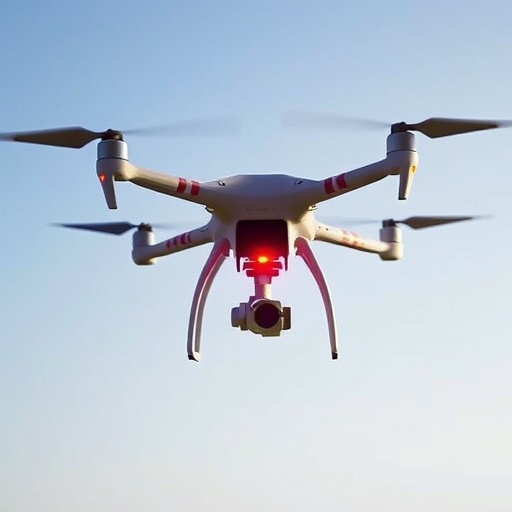
In a world increasingly reliant on autonomous technologies, the integration of communication systems among unmanned aerial vehicles (UAVs) has emerged as a critical area of research and practical application. A recent study by Bonilla Licea et al. has delved into revolutionary methods of optical communication-based identification specifically tailored for multi-UAV systems. With the rapid advancements in UAV technology, this research provides vital insights that could reshape the landscape of drone operation, enhancing both security and efficiency.
The study introduces optical communication as a pivotal means for UAV systems to communicate with one another and to identify themselves reliably. Traditional methods for drone identification often rely on radio frequencies, which can be susceptible to interference and hacking. By utilizing light-based communication methods, the researchers propose a solution that could mitigate these risks, paving the way for a safer operational environment.
One of the most significant implications of using optical communication lies in its bandwidth advantages. Optical systems can transmit far more data at much higher speeds compared to their radio-frequency counterparts. This allows for real-time data sharing among UAVs, enabling them to perform complex tasks such as cooperative navigation, monitoring, and surveillance. In scenarios where UAVs are deployed for emergency response, this instantaneous communication can be the difference between success and failure.
The researchers outlined a comprehensive theoretical framework that supports this optical identification system, underlining how light can be modulated and structured to facilitate the decoding of signals among UAVs. They explored various modulation techniques that can convert data into light signals, which can then be transmitted over distances without the degradation often found in traditional communication methods.
In practice, multi-UAV systems equipped with this technology could execute intricate maneuvers together while dynamically exchanging identification and operational status. This would not only improve collaborative efforts among drones but also enhance their ability to adapt to changing environments in real time. In military applications, for instance, the capacity for drones to identify their allies instantaneously could mitigate the risks of friendly fire while ensuring efficient mission execution.
However, implementing optical communication in UAV systems is not without its challenges. The authors emphasize the need for line-of-sight between communicating UAVs, which can be problematic in dynamic and cluttered environments. Additionally, variations in environmental conditions such as fog, rain, or dust could impede light transmission, necessitating sophisticated algorithms for maintaining communication integrity.
Despite these challenges, the potential benefits of this technology are vast. Enhanced identification protocols could facilitate the regulation of airspace, ensuring that UAVs do not interfere with manned aircraft operations. Moreover, the capability to accurately identify each drone functioning within a specific airspace creates new opportunities for research into traffic management, where various drones could operate simultaneously without risk of collision.
To aid the understanding and implementation of their findings, Bonilla Licea et al. detailed experimental setups that have successfully tested the principles of their optical identification methods. These experiments have confirmed the feasibility of the proposed concepts in real-world scenarios, demonstrating robust performance in terms of both range and reliability. As a result, the study not only highlights the theoretical foundation but also presents tangible applications that can be adopted in current UAV technologies.
The research holds promise for numerous industries beyond military uses. In agriculture, for instance, multiple drones could work collaboratively, identifying crop health through shared visual data. Emergency services could deploy fleets of UAVs that communicate efficiently while conducting search and rescue missions or assessing natural disaster impacts.
As this exciting area of research continues to evolve, the implications of enhanced communication protocols among UAVs are profound. The transition from traditional RF communications to optical systems represents a leap forward in drone technology, potentially revolutionizing how these machines are utilized in environmental monitoring, logistics, and urban management.
Future studies will undoubtedly build upon the findings of Bonilla Licea and colleagues, exploring how improvements in light modulation techniques and data processing could further enhance the capacity and reliability of UAV communications. With the growing significance of aerial robotics in various sectors, the integration of optical identification systems may soon become a critical component of UAV operations.
As the technologically advanced world of drones develops, the collaboration between researchers and industry will play a key role in shaping the future of UAV communication systems. The work of Bonilla Licea et al. sets a solid foundation for ongoing exploration, prompting other innovators to seek out new methodologies that could help refine and implement these technologies on a broader scale.
In conclusion, the optical communication-based identification study represents a paradigm shift for multi-UAV systems, combining theoretical insight with practical applications to forge a safer and more efficient future for drone operations. Researchers and engineers alike are now faced with the exciting challenge of harnessing these advances to bring forth the next generation of autonomous aerial technologies.
Cite Scienmag News
Denise Maddox. (January 26, 2026). Optical ID Systems Revolutionizing Multi-UAV Communication. Scienmag. https://scienmag.com/optical-id-systems-revolutionizing-multi-uav-communication/
Denise Maddox. "Optical ID Systems Revolutionizing Multi-UAV Communication." Scienmag, 26 January 2026, https://scienmag.com/optical-id-systems-revolutionizing-multi-uav-communication/. Accessed 5 September 2026.
Denise Maddox. "Optical ID Systems Revolutionizing Multi-UAV Communication." Scienmag. January 26, 2026. https://scienmag.com/optical-id-systems-revolutionizing-multi-uav-communication/


