


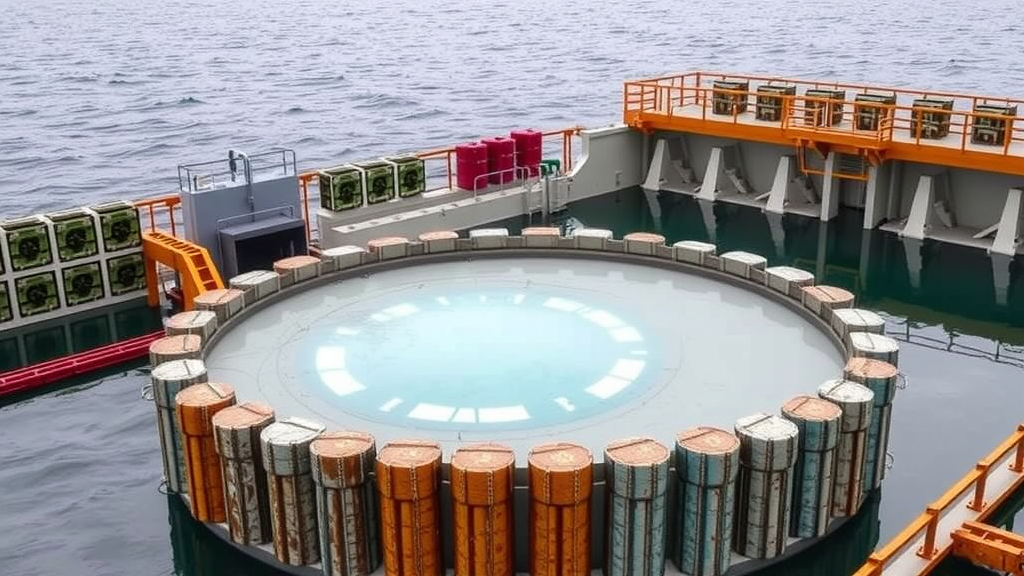
Seawater is the most abundant water resource on the planet, and for the hydrogen economy it represents a tantalizing feedstock. Electrolysis of purified water is well established, but the energy and financial costs of desalinating seawater before it reaches an electrolyzer, together with community concerns about drawing down scarce fresh water supplies, have long limited the appeal of coastal hydrogen plants. A new development reported in Nature Energy now changes the calculus: researchers have coupled alkaline water electrolysis and vacuum distillation into a single unified process that uses waste heat from the electrolysis stack itself to treat seawater, demonstrating efficient co-production of hydrogen and fresh water at the 250 kilowatt scale.
The significance of the demonstration lies in its scale and integration. Laboratory reports of seawater electrolysis appear regularly, but few technologies have graduated beyond the bench. A 250 kW system is a meaningful industrial pilot size, large enough to expose engineering realities such as heat management, brine handling, corrosion and long-term stability that small laboratory cells simply never encounter. By designing the distillation and electrolysis stages as one thermally and hydraulically linked unit rather than two separately optimized plants, the researchers eliminated much of the parasitic energy burden and capital cost that normally separate seawater from the ultrapure water that conventional electrolyzers demand.
The underlying problem is well known to electrochemists. Alkaline water electrolyzers, among the most mature and durable electrolysis technologies, circulate a concentrated potassium hydroxide electrolyte and split water at nickel-based electrodes. They are robust against many impurities, yet the magnesium, sulfate and, above all, chloride ions in seawater wreak havoc. Chloride ions that reach the anode can participate in chlorine and hypochlorite evolution reactions that compete with oxygen evolution, corroding electrodes and membranes and contaminating the product gas. Precipitates of magnesium hydroxide and calcium carbonate can clog porous transport layers and poison catalyst surfaces. This is why virtually every commercial electrolysis installation relies on deionized water, often to resistivity specifications measured in megohm-centimeters.
Previous attempts to sidestep this requirement have taken two broad routes. One is direct seawater electrolysis, in which specially designed catalysts and membranes resist chloride chemistry; a prominent 2023 Nature Energy study demonstrated a self-driven system that suppressed chloride corrosion through in situ generated protective layers, and a 2026 follow-up by Jiang and colleagues advanced that line of work. The other route is upstream desalination, in which seawater is purified by reverse osmosis, membrane distillation or thermal processes before entering a standard electrolyzer. Each route carries penalties: direct seawater electrolysis remains constrained by catalyst durability and selectivity at industrially relevant current densities, while standalone desalination adds cost, complexity and energy demand that hydrogen producers have been reluctant to absorb.
The unified system described in the new report belongs to the second family but reframes its economics entirely. Vacuum distillation lowers the boiling point of water by reducing pressure, allowing evaporation at temperatures far below 100 degrees Celsius. Alkaline electrolysis stacks operate with substantial inefficiency: a portion of the electrical input inevitably degrades into heat at operating temperatures typically between 60 and 90 degrees Celsius. In conventional plants this heat is a nuisance, requiring cooling water and radiating away as waste. In the unified design, that same low-grade waste heat becomes the driving force for vacuum distillation of seawater. The electrolyzer effectively pre-heats and purifies its own feedwater, closing the loop between the two processes.
This thermal coupling yields several compounding benefits. The distillation step produces water of a purity suitable for direct injection into the alkaline electrolyte circulation loop, so the plant draws seawater rather than municipal fresh water, neutralizing objections from communities and regulators in water-stressed coastal regions. The concentrated brine byproduct can be managed as a manageable waste stream, and in principle carries value as a feedstock for salt and mineral recovery. Because no external steam boiler or electrically driven desalination train is required, the overall energy efficiency of hydrogen production improves relative to a conventional arrangement of separate desalination and electrolysis plants, and the system’s footprint shrinks accordingly.
The 250 kW demonstration matters because it interrogates the integration at a scale where heat balances become genuine engineering constraints rather than laboratory conveniences. At this size, the researchers could quantify how much of the stack’s waste heat is recoverable, how the vacuum distillation unit responds to the transient thermal profile of a real electrolyzer under variable renewable power, and how water quality, brine concentration and hydrogen output behave over sustained operation. Co-producing fresh water alongside hydrogen also opens a second revenue stream: a coastal hydrogen plant can double as a small desalination facility, supplying potable or industrial water to its host community and improving the project’s overall economics in ways that hydrogen sales alone cannot.
Analysts following the hydrogen sector have repeatedly emphasized that water availability is an underappreciated constraint on global electrolyzer deployment. The International Energy Agency’s Global Hydrogen Review has documented the rapid growth of announced electrolyzer capacity, much of it concentrated in coastal and arid regions such as Australia, the Middle East, Chile and North Africa, precisely where solar and wind resources are strongest and fresh water is scarcest. Policy frameworks, including those developed by Australian state agencies to manage water resources during extreme events, increasingly scrutinize industrial water withdrawals. A technology that converts seawater into both a clean fuel and fresh water directly addresses the resource conflict at the heart of the green hydrogen build-out.
Challenges remain before such unified plants can be considered commodity technology. Long-term materials compatibility is paramount: vacuum distillation vessels, heat exchangers and condensers must resist corrosion and scaling over thousands of hours, and the electrolyzer stack must tolerate the trace impurities that survive even high-quality distillation. Maintaining vacuum conditions adds mechanical complexity and pumping loads that must be optimized against the heat available from the stack. The economics will also hinge on the value assigned to the co-produced fresh water, which varies enormously by geography. Nevertheless, the demonstration that waste heat from alkaline electrolysis can drive vacuum distillation of seawater at the quarter-megawatt scale offers a credible, thermodynamically elegant answer to one of the hydrogen economy’s most persistent bottlenecks, and points the way toward hydrogen production that quenches water scarcity rather than deepening it.
Subject of Research: A unified system coupling alkaline water electrolysis with vacuum distillation to co-produce hydrogen and fresh water from seawater
Article Title: A unified distillation and electrolysis system
Article References: Love, J. G. (2026). A unified distillation and electrolysis system. Nature Energy. https://doi.org/10.1038/s41560-026-02136-0
Image Credits: AI Generated
DOI: 10.1038/s41560-026-02136-0
Keywords: green hydrogen, seawater electrolysis, vacuum distillation, alkaline water electrolysis, desalination, waste heat recovery, hydrogen economy, water scarcity, electrocatalysis, renewable energy, Nature Energy, co-production
Cite Scienmag News
Denise Maddox. (September 20, 2026). One System Turns Seawater into Hydrogen and Fresh Water at Scale. Scienmag. https://scienmag.com/one-system-turns-seawater-into-hydrogen-and-fresh-water-at-scale/
Denise Maddox. "One System Turns Seawater into Hydrogen and Fresh Water at Scale." Scienmag, 20 September 2026, https://scienmag.com/one-system-turns-seawater-into-hydrogen-and-fresh-water-at-scale/. Accessed 5 October 2026.
Denise Maddox. "One System Turns Seawater into Hydrogen and Fresh Water at Scale." Scienmag. September 20, 2026. https://scienmag.com/one-system-turns-seawater-into-hydrogen-and-fresh-water-at-scale/


