


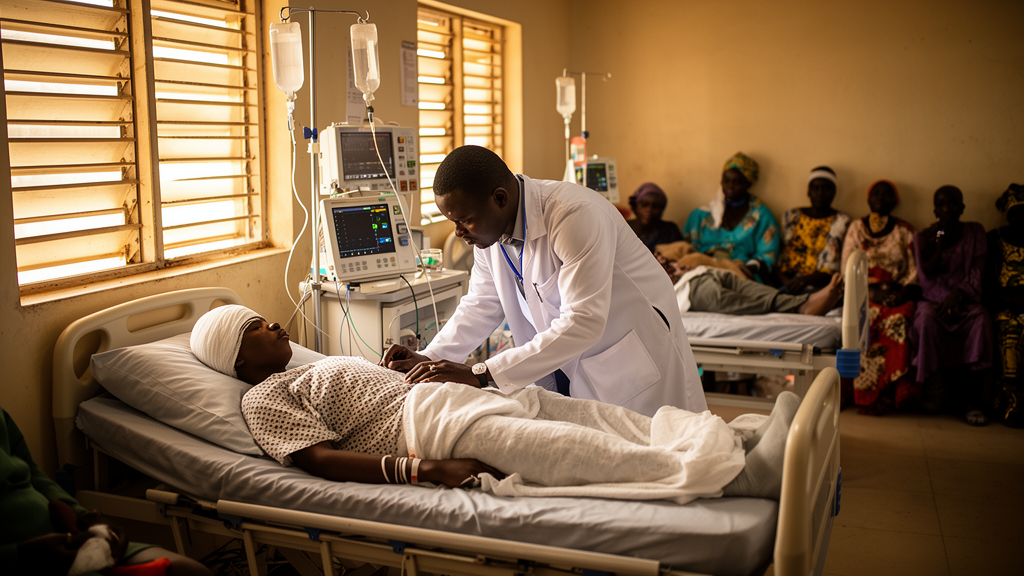
Traumatic brain injury claimed the lives of one in five patients admitted to Nigeria's foremost university teaching hospital over a 13-year span, according to a prospective cohort study conducted at the University College Hospital in Ibadan. The findings come from a dedicated TBI registry maintained by the hospital's academic neurosurgery division and cover 1,440 patients whose injuries involved definite perturbation of brain function, a stricter definition than the loosely framed head injury categories used in most previous reports from Africa and other low- and middle-income countries. The Glasgow Coma Scale quantified clinical severity, the Abbreviated Injury Scale-Head and the Injury Severity Score measured anatomical injury burden, the Rotterdam CT scoring system graded brain imaging, and the Glasgow Outcome Scale, dichotomized for analysis, captured in-hospital outcome.
The authors note that most previous reports from Africa and other low- and middle-income countries have lacked deployment of such standardized scoring systems, addressing head injury more loosely rather than traumatic brain injury specifically. The demographic profile of the cohort shows how heavily traumatic brain injury strikes the young. Patients averaged 32.2 years of age, with a standard deviation of 19 years, and males made up 77.1% of the group, at 1,110 of the 1,440 cases.
Road trauma dominated the causation, accounting for 1,173 cases, or 82% of the entire series, and it remained the leading mechanism even among the elderly. Two- and three-wheeled vehicles were responsible for 57% of the road injuries. Falls contributed 136 cases, or 9.4%, occurring mainly in childhood.
The clinical picture on presentation was marked by frequent disturbance of consciousness. Loss of consciousness occurred in 89% of patients, with a median duration of 11.0 hours and an interquartile range of 2 to 48 hours. Vomiting was recorded in 25% of cases, seizures in 16%, and anisocoria in 27%.
The anatomical severity of the injuries was substantial. In 86% of cases the Abbreviated Injury Scale-Head score exceeded 2, and 47.0% of patients presented with moderate-to-severe injury, defined as a Glasgow Coma Scale score between 3 and 12. Yet access to diagnostics and operative treatment lagged behind the clinical need.
Computed tomography of the brain was obtained in 1,046 of the 1,440 patients, or 72.6%, leaving more than a quarter of the confirmed TBI cohort without brain imaging. Acute operative treatment was delivered to just 13% of the cohort. Most patients, 76%, arrived as referrals from outlying health facilities, with a median duration of 13 hours between injury and presentation at the teaching hospital, and an interquartile range stretching from 5 to 48 hours.
Outcomes split along severity lines. In-hospital mortality reached 21%, concentrated among the young and the severely injured, while 75% of patients achieved a good outcome, defined on the Glasgow Outcome Scale as either good recovery or moderate deficit. The investigators found that outcomes were significantly associated with TBI severity as measured by the Glasgow Coma Scale and with brain CT severity as graded by the Rotterdam system.
The authors conclude that the clinical epidemiology of TBI from this single-institution series differs substantially from that of high-income countries. A 21% mortality rate predominantly affecting economically productive young adults, they write, represents a serious public health burden for the region. Substantial gaps persist across many aspects of the TBI-management continuum, the investigators state, presenting clear opportunities to improve the currently sub-optimal outcome metrics in sub-Saharan Africa.
For a developing country in the CT-scan era, the study offers a benchmark: standardized scoring, prospective enrollment, and registry-based follow-up proved feasible at a single academic center, producing severity-stratified data that earlier African reports, which lacked standardized scoring, could not supply. The figures also quantify the distance that remains, with delayed referral for three-quarters of patients, CT coverage below three-quarters of the cohort, and operative treatment for roughly one in eight patients in this 13-year Nigerian series.
Subject of Research: Prospective clinical epidemiology and in-hospital outcomes of traumatic brain injury in a Nigerian academic neurosurgery cohort
Article Title: Traumatic brain injury from a developing country in the CT-scan era: a 13-year prospective in-hospital cohort study
Article References: Adeleye, A. O., Agboola, O. O., Oyemolade, T. A., Malomo, T. A., Azeez, A. L., Rabiu, T. B., & Ukachukwu, A. K. (2026). Traumatic brain injury from a developing country in the CT-scan era: a 13-year prospective in-hospital cohort study. Frontiers in Neurology, 17, Article 1889484. https://doi.org/10.3389/fneur.2026.1889484
Image Credits: AI Generated
DOI: 10.3389/fneur.2026.1889484
Keywords: traumatic brain injury, Nigeria, neurotrauma, Glasgow Coma Scale, CT imaging, low- and middle-income countries, road traffic injuries, in-hospital mortality, prospective cohort, sub-Saharan Africa, Traumatic, brain
Cite Scienmag News
Cassandra Pierce. (October 26, 2026). One in Five Died: Nigerian Cohort Tracks 13 Years of Traumatic Brain Injury. Scienmag. https://scienmag.com/one-in-five-died-nigerian-cohort-tracks-13-years-of-traumatic-brain-injury/
Cassandra Pierce. "One in Five Died: Nigerian Cohort Tracks 13 Years of Traumatic Brain Injury." Scienmag, 26 October 2026, https://scienmag.com/one-in-five-died-nigerian-cohort-tracks-13-years-of-traumatic-brain-injury/. Accessed 26 October 2026.
Cassandra Pierce. "One in Five Died: Nigerian Cohort Tracks 13 Years of Traumatic Brain Injury." Scienmag. October 26, 2026. https://scienmag.com/one-in-five-died-nigerian-cohort-tracks-13-years-of-traumatic-brain-injury/


