


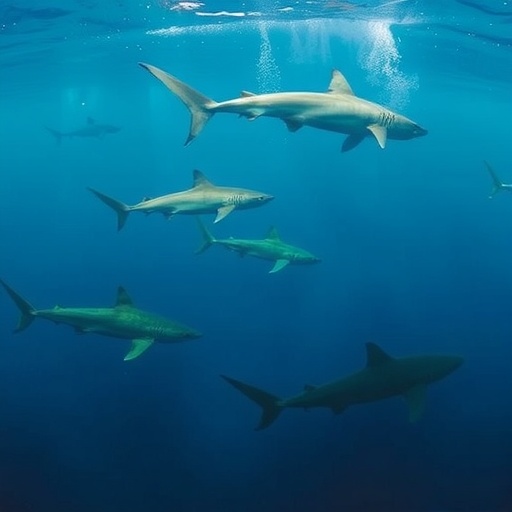
(Santa Barbara, Calif.) — For millions of years, sharks left behind a remarkably detailed record of their presence—not in bones or teeth, but in something resembling microscopic dandruff. Researchers from the University of California, Santa Barbara, and the Smithsonian Tropical Research Institute in Panama have used fossilized shark scales embedded in ancient reef sediments to reconstruct how many sharks once inhabited two coastlines separated by only about 100 kilometers. Their results reveal an unexpected ecological divide: before intensive human fishing, reefs along Panama’s Pacific coast supported approximately 20 times more sharks than reefs on the Caribbean side. The discovery offers one of the clearest estimates yet of historical shark abundance while warning that conservation targets based on the wrong ecological baseline could be dramatically misleading.
The material at the center of the study is known technically as a dermal denticle. These tiny, tooth-like structures cover a shark’s body, reducing drag as the animal moves through water and helping protect its skin. Unlike the scales of most bony fish, shark denticles are composed largely of dentine and enamel-like tissue, making them exceptionally resistant to decay. Sharks continuously shed and replace them throughout their lives. Once released, the denticles settle onto the seafloor and can become trapped in layers of reef sediment, where they may survive for thousands or even millions of years. Because denticle shape varies according to its location on the body and its functional role, researchers can often identify the type of shark that produced a fossil scale, even when no skeleton remains.
By counting these preserved denticles in carefully dated sediment samples, scientists can estimate the relative abundance of sharks that once swam above a reef. The method does not count individual animals directly; instead, it measures the rate at which shark remains accumulated in the sediment. When combined with information about sediment deposition, reef area and the age of each layer, denticle concentrations become a powerful proxy for historical shark populations. The approach effectively transforms the seafloor into an ecological archive. It can reveal not only whether shark numbers declined, but also whether the original ecosystem was naturally characterized by a small, moderate or exceptionally large predator population—information that modern surveys alone cannot provide.
The researchers compared sediment deposited between approximately 7,000 and 3,000 years ago with material accumulated during the past century. The older layers predated the era of industrial fishing and therefore provided a window into reef ecosystems before humans began removing large numbers of marine predators. Across 157 samples, the team collected 3,497 shark denticles. The contrast between Panama’s two coasts appeared almost immediately. In Bocas del Toro on the Caribbean coast, researchers recovered roughly 50 denticles from 10 kilograms of reef sediment. On the Pacific coast, their first small sample produced about 200 denticles from only 1 kilogram. As the dataset expanded and statistical models accounted for differences in sampling effort, sediment age and accumulation rates, the pattern remained strikingly consistent.
The fossil record showed that reefs in the Gulf of Panama once supported shark populations roughly 20 times denser than those on the Caribbean coast. The finding is surprising because the two regions are geographically close and share many of the same shark species. Their modern environments, however, function very differently. The Gulf of Panama experiences seasonal upwelling, a process in which winds push surface water away from the coast and draw cold, nutrient-rich water upward from the deep ocean. Those nutrients stimulate phytoplankton growth, which supports zooplankton, fish and increasingly large predators. In effect, the Pacific coast receives a seasonal pulse of energy capable of sustaining a high biomass of sharks. The Caribbean coast is comparatively nutrient-poor, with clearer, more glass-like water but less energy circulating through the food web. Its reefs naturally supported fewer sharks, leaving their populations more vulnerable to additional disturbance.
The modern comparison adds another layer to the story. Since intensive human activity began, shark denticle accumulation on the Caribbean coast has fallen by approximately 75 percent. On the Pacific coast, denticle accumulation during the last century is statistically similar to the prehistoric baseline, despite the fact that more than 98 percent of Panama’s fishing activity occurs on that side of the country. At first glance, the result appears to contradict expectations: the more heavily fished coast seems to have retained more of its historical shark signal. The researchers argue that environmental productivity helps explain the apparent paradox. A highly productive ecosystem may be capable of supporting larger shark populations and may also possess greater capacity for recovery after losses. A naturally low-productivity ecosystem, by contrast, may suffer severe ecological damage even when fishing pressure is lower, because its predator populations begin from a much smaller starting point.
The authors caution that the Pacific coast should not be declared safe. A sediment layer representing the average of the past 100 years may conceal recent and rapid declines. Targeted shark fishing in the Gulf of Panama intensified during the 1980s, meaning that the latest losses could be diluted when combined with earlier decades of higher abundance. Independent research has already documented pressure on Pacific shark populations, and the region may be approaching a critical threshold. The Gulf’s natural resilience is also being challenged by climate change. The seasonal upwelling that supplies the ecosystem with cold, nutrient-rich water failed for the first time on record in 2021, raising concerns that changes in ocean temperature, wind patterns and productivity could weaken the food base supporting large predators.
The study has immediate implications for marine conservation because managers often use the healthiest nearby reef as a reference for restoration. That strategy assumes neighboring ecosystems once supported comparable numbers of sharks and experienced similar degrees of human impact. Panama’s fossil record shows why that assumption can fail. If the Pacific coast were used as the benchmark for Caribbean reefs, managers could set recovery goals an order of magnitude—or more—above what the Caribbean environment can naturally sustain. Conversely, treating the Caribbean’s depleted modern abundance as a realistic target for the Pacific could normalize a profound loss. The researchers say conservation plans must incorporate ocean productivity, habitat quality and historical ecological differences alongside fishing history. A reef’s appropriate shark target cannot be calculated from geography alone.
The broader significance of the work extends beyond Panama. Shark populations have declined worldwide, yet scientists have struggled to determine what “healthy” abundance looked like before commercial fishing, habitat destruction and climate change transformed marine ecosystems. Conventional surveys are too recent to capture long-term variability, while historical records are often incomplete or biased toward areas where people were already fishing. Fossil denticles provide an independent archive that can reach back thousands of years and distinguish broad changes in both shark abundance and community composition. By combining paleontology with ecology and conservation science, the research offers a new way to define realistic recovery goals. It also delivers a vivid warning: the number of sharks an ocean should contain depends not only on how much exploitation it has endured, but on how much energy the ecosystem can supply. In a changing climate, even regions that once supported abundant sharks may be pushed toward ecological conditions unseen for millennia.
Web References: University of California, Santa Barbara reference; Science article
References: Science, DOI: 10.1126/science.aec2144
Keywords
Sharks, shark denticles, fossil scales, coral reefs, marine ecosystems, ocean productivity, upwelling, shark conservation, paleoecology, population ecology, Panama, climate change
Cite Scienmag News
Margaret Porter. (August 13, 2026). One Country, Two Oceans, Twenty Times More Sharks. Scienmag. https://scienmag.com/one-country-two-oceans-twenty-times-more-sharks/
Margaret Porter. "One Country, Two Oceans, Twenty Times More Sharks." Scienmag, 13 August 2026, https://scienmag.com/one-country-two-oceans-twenty-times-more-sharks/. Accessed 4 September 2026.
Margaret Porter. "One Country, Two Oceans, Twenty Times More Sharks." Scienmag. August 13, 2026. https://scienmag.com/one-country-two-oceans-twenty-times-more-sharks/


