


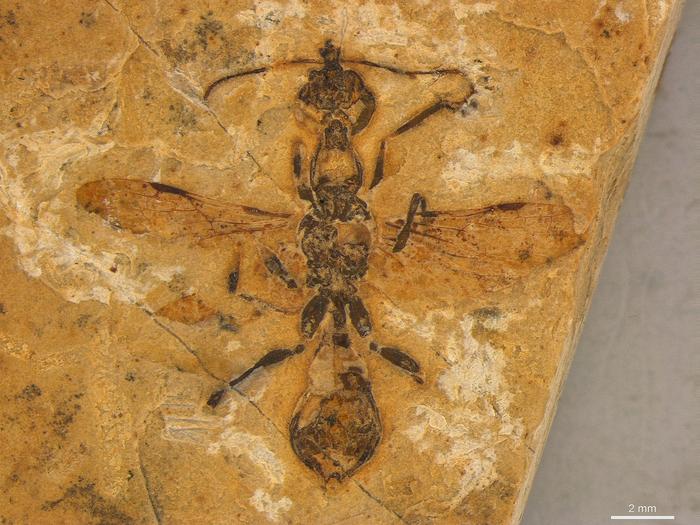
In a groundbreaking discovery that promises to redefine our understanding of ant evolution, a team of researchers has unveiled the oldest known ant fossil, dating back an astonishing 113 million years. This remarkable specimen, unearthed in northeastern Brazil, belongs to the enigmatic and extinct subfamily Haidomyrmecinae, colloquially known as "hell ants." These ancient insects showcase highly specialized anatomical adaptations that offer a rare glimpse into the evolutionary innovations that occurred during the Cretaceous period.
The fossil, preserved with exquisite detail in limestone from the Crato Formation, stands out not only for its age but for the complexity of its morphology. Unlike typical ant mandibles that operate laterally, this hell ant exhibits forward-facing, scythe-like jaws that are arranged parallel to its head. Such a design evokes a predatory style vastly different from modern ants, suggesting sophisticated hunting strategies that evolved much earlier in ant evolutionary history than previously assumed.
According to lead author Anderson Lepeco from the Museu de Zoologia da Universidade de São Paulo, this discovery represents the earliest undisputed geological record of ants worldwide. The implications of this are profound, as it pushes back the timeline of ant diversification and dispersal across ancient landmasses. Prior to this, some of the oldest ants were found in French and Burmese amber deposits, but none were known from rock fossils of this antiquity—until now.
The exceptional preservation of this hell ant allowed the researchers to employ micro-computed tomography (micro-CT), a state-of-the-art imaging technique that generates three-dimensional internal views of the fossil without damaging the delicate specimen. This non-destructive method provided unprecedented insight into the anatomical features of the hell ant, including structures hidden beneath the exoskeleton. Micro-CT imaging confirmed the close phylogenetic relationship between this specimen and hell ants previously only known from Burmese amber.
Geologically, the Crato Formation is renowned for its remarkable fossil conservation, offering a window into the diverse Cretaceous ecosystems of South America. The presence of hell ants in this formation broadens the known geographical distribution of these insects, indicating that they were widely dispersed across the globe much earlier than documented. This widespread biogeographical distribution challenges existing models of ant migration and adaptation during the mid-Cretaceous.
What astonished scientists most were the hell ant’s extraordinary predatory appendages. Unlike extant ants whose mandibles move sideways for grasping and manipulating objects, the Cretaceous hell ant boasted mandibles that projected forward and worked in tandem with a unique facial horn located anterior to the eyes. Such morphological specializations hint at a predation method that might have involved impaling or trapping prey with a coordinated jaw and horn mechanism, a trait unseen in living ant species.
The anatomical complexity observed in this ancient fossil reveals that ants had already evolved highly specialized behaviors and structural adaptations by the Early Cretaceous, a time when ecosystems were undergoing dramatic global changes. This predatory sophistication suggests that evolutionary pressures fostered diverse hunting strategies early in the history of Formicidae, contributing to the ecological success ants enjoy today.
This discovery further underscores the importance of systematic study and reexamination of existing fossil collections residing in museums. The research team’s meticulous approach to analyzing the Crato Formation insect repository highlights how much paleontological treasures may still lie hidden within accumulated collections, awaiting modern technologies for rediscovery and interpretation.
Moreover, the finding brings attention to Brazilian paleontology and its rich yet underexplored fossil record. It underscores the value of preserving and funding local scientific infrastructure, enabling researchers to make world-class contributions and insights into prehistoric biodiversity. The fossil’s intact condition owes much to the Crato Formation’s unique sedimentology, which has preserved delicate biological materials that usually degrade rapidly over millions of years.
Beyond expanding the fossil record, this hell ant exemplifies how evolutionary biology intertwines with technological innovation. The successful application of micro-CT imaging in paleontology is revolutionizing the field, allowing scientists to peer inside fossils with high-resolution detail without physical intervention. This frontier of non-invasive imaging heralds a new age of paleontological research where even the smallest anatomical nuances can be elucidated.
Finally, the discovery invites broader contemplation on evolutionary dynamics—how certain lineages develop complex adaptations swiftly, while others follow different trajectories. The hell ant’s peculiar mandible morphology hints at a lineage-specific ecological niche, possibly specializing in predation techniques not observed in modern ants. Such findings stimulate further inquiries into the selective pressures and environmental contexts shaping ant diversification in prehistoric eras.
Taken together, the unveiling of this 113-million-year-old hell ant fossil marks a monumental stride in understanding the origin and evolution of ants. It reshapes timelines, reveals intricate morphological innovation, and showcases the power of advanced imaging technologies in illuminating the deep past. As researchers delve further into fossil collections with renewed vigor and tools, additional revelations about the ancient world of insects are sure to emerge, continuing the long saga of evolutionary discovery.
News Publication Date: 24-Apr-2025
References: Lepeco et al., “A hell ant from the Lower Cretaceous of Brazil,” Current Biology, DOI: 10.1016/j.cub.2025.03.023
Cite Scienmag News
Gavin Prescott. (April 24, 2025). Oldest Known Ant Fossil Unearthed in Brazil. Scienmag. https://scienmag.com/oldest-known-ant-fossil-unearthed-in-brazil/
Gavin Prescott. "Oldest Known Ant Fossil Unearthed in Brazil." Scienmag, 24 April 2025, https://scienmag.com/oldest-known-ant-fossil-unearthed-in-brazil/. Accessed 3 September 2026.
Gavin Prescott. "Oldest Known Ant Fossil Unearthed in Brazil." Scienmag. April 24, 2025. https://scienmag.com/oldest-known-ant-fossil-unearthed-in-brazil/


