

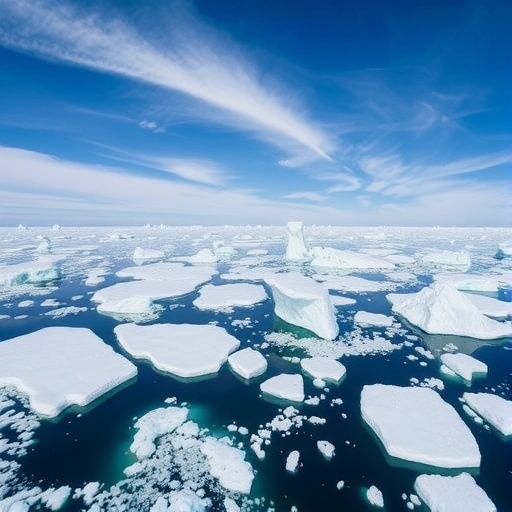
For decades, the sprawling sea ice surrounding Antarctica presented an enigmatic contrast to the rapidly dwindling ice of the Arctic. Unlike the Arctic’s steady, decades-long decline, the Antarctic sea ice expanded gradually until an unprecedented plummet occurred in late 2015, followed by marked fluctuations year after year. This puzzling shift has long captivated climate scientists, who recognize Antarctic sea ice as a critical moderator of global climate systems, the Southern Ocean ecosystem, and atmospheric temperature regulation. Recent research spearheaded by the University of Gothenburg now offers compelling insights, pinpointing the dynamic interplay of oceanic layers and powerful Southern Hemisphere storms as the driving mechanism behind the dramatic ice loss.
Antarctic sea ice plays a multifaceted role in Earth’s climate machinery. Its high albedo effect—the ability to reflect incoming solar radiation—significantly dampens heat absorption, stabilizing temperature gradients critical for atmospheric circulation patterns. Furthermore, sea ice acts as a thermal barrier limiting heat flux between the ocean and atmosphere, shaping weather systems far beyond polar latitudes. Given the intricate feedback loops involved, understanding the precise controls over sea ice extent is paramount to refining climate models and enhancing prognostic capabilities under anthropogenic warming scenarios.
Historically, Antarctic sea ice presented a slow yet steady expansion over several decades, a trend markedly divergent from the Arctic experience. However, this growth was abruptly interrupted in 2015 by a rapid and persistent decline, signaling a radical shift in underlying oceanographic and atmospheric processes. Subsequent large interannual fluctuations further underscore the complexity of mechanisms modulating Antarctic sea ice dynamics, inviting a deeper inquiry into subsurface ocean properties and their interaction with atmospheric forcings.
Central to this newfound understanding is the concept of wintertime stratification in the Southern Ocean, specifically the delineation of distinct water masses by variations in temperature and salinity. These gradients hinder vertical mixing, enabling the formation of a cold, relatively fresh Winter Water layer just below the sea ice. This stratified layer functions as a thermal “shield,” effectively insulating the ice from the warmer, saltier deep waters beneath. This vertical partitioning is critical in preserving the integrity of the sea ice, preventing basal melting from below.
Yet, this protective Winter Water layer has been gradually thinning over recent decades, a critical precursor that set the stage for the sea ice collapse. Persistent warming of the deep ocean water masses has incrementally eroded the thickness and stability of this cold-water layer, diminishing its insulating effect. Researchers have observed that as this layer diminishes, warmer waters encroach upward, escalating basal melt rates and weakening the structural resilience of Antarctic sea ice formations.
In 2015, the situation was further exacerbated by an episode of extraordinarily intense storms sweeping across the Southern Ocean. These storms significantly disrupted the stratification, mechanically mixing the water column and entraining warmer deep waters into layers closer to the surface. The breakdown of this stratification removed the thermal buffer that had long safeguarded the ice, catalyzing a rapid and unprecedented melting event. The resulting sea ice loss unfolded at record speeds, a stark testament to the ocean-atmosphere coupling dynamics at play.
This breakthrough revelation underscores how episodic meteorological phenomena, when interacting with long-term oceanographic trends, can precipitate abrupt climatic transitions. It also highlights the limitations of existing climate models that may underestimate or omit such vertical ocean stratification processes and their susceptibility to storm-driven mixing. Accurately incorporating these interactions is vital to predicting future trajectories of Antarctic ice and the consequent global climate implications.
A remarkable aspect of this study lies in the innovative methodology employed to obtain in situ oceanographic data in the notoriously remote and harsh Southern Ocean environment. Researchers harnessed the natural behavior of Southern Elephant seals, attaching sophisticated conductivity-temperature-depth satellite relay data loggers (CTD-SRDLs) to these animals. As the seals dived deep into the ocean during their natural foraging expeditions, they provided invaluable temperature and salinity profiles across regions otherwise challenging to sample.
This biologging approach not only augmented autonomous marine robotics deployments but also yielded unprecedented spatial and temporal resolution of water column stratification beneath the sea ice. The data sets captured subtle gradients and variabilities instrumental in characterizing the thinning Winter Water layer and its seasonal dynamics. This synergy of cutting-edge technology and animal behavior exemplifies the creative strategies essential for advancing polar oceanography in inaccessible domains.
The findings elucidate the critical role of the Winter Water as a “gatekeeper” regulating heat exchange between the abyssal ocean and the ocean-atmosphere interface. Its diminishing thickness directly correlates with increased vulnerability of sea ice to subsurface melting, while its disruption by storm-induced mixing underscores the sensitivity of Antarctic sea ice extent to both oceanic warming and atmospheric variability. This nuanced understanding advances the overarching narrative of polar climate change, emphasizing the interconnectedness of ocean stratification processes and transient meteorological events.
In light of accelerated global warming and the intensification of Southern Hemisphere storm systems projected by climate models, the implications of this study resonate beyond Antarctica. Similar stratification-dependent feedbacks may manifest in other polar or subpolar marine systems, potentially triggering abrupt shifts in sea ice dynamics or related ecosystems. Therefore, comprehensive monitoring and refined modeling of oceanic stratification will be indispensable in anticipating global climate tipping points and devising informed mitigation strategies.
This pioneering research published in Nature Climate Change represents a significant leap forward in unraveling the complexities of Antarctic sea ice variability. By integrating long-term observational data, novel tagging technologies, and detailed oceanographic analysis, scientists have decoded a vital piece of the polar climate puzzle. The convergence of ocean warming, episodic storms, and weakening stratification collectively orchestrated the historic 2015 sea ice decline, reshaping our understanding of how Antarctic ice responds to a changing world.
As investigators continue to monitor ongoing trends, the role of continuous, high-resolution observations via biologging and autonomous platforms will be paramount. This study not only imparts critical insights for climate science but also showcases the ingenuity required to probe Earth’s most extreme environments. Ultimately, deciphering these dynamics is essential for projecting future Antarctic ice behavior and its profound influence on global climate systems.
Subject of Research: Antarctic sea ice decline mechanisms involving ocean stratification and storm-induced mixing
Article Title: Wind-triggered Antarctic sea ice decline preconditioned by thinning Winter Water
News Publication Date: 18-Mar-2026
Web References: https://doi.org/10.1038/s41558-026-02601-4
Image Credits: Photo by Dan Costa (UCSC), showing a Southern Elephant seal equipped with a CTD-SRDL tag
Keywords: Antarctic sea ice, Winter Water layer, ocean stratification, Southern Ocean storms, basal melting, climate model, Southern Elephant seals, biologging, ocean-atmosphere interaction


