


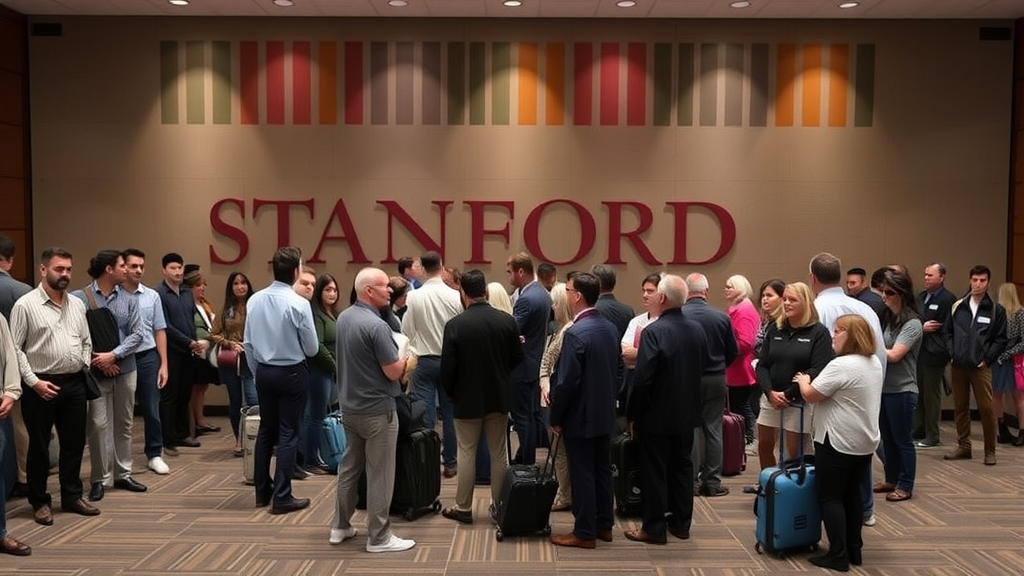
The 15th International Workshop on Modeling the Ocean, known as IWMO-2025, convened at Stanford University in California from June 30th to July 1st, 2025, bringing together ocean modelers from around the world at a moment when international scientific exchange faced unusual strain. The meeting took place against a backdrop of federal budget cuts to universities and research institutions in the United States, which restricted the travel of many American scientists, while strict border regulations prevented some international researchers from obtaining visas to enter the country. Organizers expressed deep appreciation for those who persevered to attend despite these obstacles. Because attendance was somewhat smaller than at past meetings, the workshop ran for two days rather than the typical three and a half days, yet the scientific program remained dense and wide-ranging, reflecting the vitality of a community that has been meeting regularly since 2009.
The IWMO workshops are managed by an international steering committee of scientists drawn from ten different countries, with local volunteers from the hosting institute handling organization and support. A defining tradition of the series is the publication of a special issue, or Topical Collection, of peer-reviewed papers in the journal Ocean Dynamics after each meeting. More than 200 papers have now appeared in these collections, making the workshop series one of the most consistently productive venues for ocean modeling research. To promote international collaboration and diverse participation, organizers deliberately rotate the meeting across continents: IWMO-2023 was held in Hamburg, Germany, and IWMO-2024 took place in Sapporo, Japan. Since the organization’s inauguration in Taiwan in 2009, six meetings have been held in Asia, four in Europe, four in North America, one in South America and one in Australia. Only two previous meetings were held in the United States, in Virginia in 2010 and in Ann Arbor, Michigan in 2022. Following the Stanford meeting, IWMO-2026 was held in Palma de Mallorca, Spain, and IWMO-2027 is planned for June 2027 in Hangzhou, China.
The scientific program at Stanford featured 32 oral presentations, including four keynote invited presentations by prominent scientists, along with 10 posters. Sessions spanned the breadth of modern ocean modeling: internal and surface waves, coupled physical-biological interactions, global and basin-scale circulation, mixing and sub-mesoscale processes, coastal and estuarine modeling, and numerical methods. Continuing the IWMO tradition of encouraging early-career participation, 13 graduate students and postdoctoral researchers presented their work as part of the Outstanding Young Scientist Award competition, with the top winners hailing from the United States, Japan and Germany. The accompanying Topical Collection in Ocean Dynamics includes eight peer-reviewed papers from workshop participants, each subjected to rigorous review by IWMO members and external experts under the stewardship of a team of guest editors. Together the papers showcase a variety of numerical ocean and wave models, diverse analysis methods, and study sites ranging from the German Bight and the coasts of the United States and Canada to seas along the Asian Pacific coasts.
Among the collection’s contributions, Zhang and colleagues developed an idealized coupled Computational Fluid Dynamics and Discrete Element Method model, known as CFD-DEM, to study how cross-flow velocities affect particle transport near a subsea pipeline. The simulations identified distinct critical velocity thresholds for different particle sizes, offering a practical engineering tool for subsea pipeline design and backfilling projects, where the loss of backfill material is a persistent operational concern. The work illustrates how idealized numerical experiments can distill complex sediment-structure interactions into design guidance that engineers can apply directly to offshore infrastructure.
Wave dynamics featured prominently in the collection as well. Imamura and Yoshikawa tackled the long-standing challenge of parameterizing surface-wave breaking in wave-resolving simulations using a nonhydrostatic numerical model. Rather than relying on the empirical criteria that many existing models employ, they introduced a fourth-order diffusivity into the surface elevation equation to explicitly represent wave breaking. The approach was validated successfully against laboratory experiments and theory, demonstrating a physically grounded alternative to heuristic breaking schemes. In a related vein of coastal prediction, Ezer used the Princeton Ocean Model to explore how high-frequency oscillations in the Gulf Stream, with periods ranging from one week to two months, can induce coastal sea level variability. Comparisons with observations revealed a statistically significant anticorrelation between Gulf Stream strength and coastal sea level, but the relationship depends nonlinearly on location along the coast and on the frequency of the current’s variability, complicating the prediction of coastal flooding.
Nature-based coastal protection emerged as another theme. Jacob, Pein and Staneva used the unstructured-grid SCHISM hydrodynamic model, extended with sediment dynamics and vegetation, to evaluate seagrass as a nature-based solution for coastal protection in the German Wadden Sea. Their simulations, which incorporated end-of-the-century sea level rise projections, showed that despite rising seas, seagrass meadows retain their damping capacity and can reduce wave heights by as much as 30 percent in shallow areas. This finding carries significant implications for coastal management, suggesting that restored ecosystems could complement or even substitute for hard engineering defenses in some settings. In the Pacific Northwest, Khangaonkar and colleagues tested a sigma-coordinates formulation with shaved cells in the SCHISM model to simulate the Salish Sea, a fjord-like deep estuary. The refined grid and higher resolution compared with a past FVCOM configuration of the region eliminated the need for bathymetric smoothing and improved predictions of currents and temperatures, resolving near-shore intertidal and deep estuarine circulation simultaneously.
Aquaculture’s footprint on coastal hydrodynamics was examined by Fu and colleagues, who applied the FVCOM numerical model with an enhanced dual-drag parameterization to simulate the impact of large-scale floating-raft aquaculture structures in the open waters near Zhangzi Island in the northern Yellow Sea of China. The simulations showed that floating rafts can significantly reduce tidal current velocities, especially near the surface, with consequences for regional circulation and the transport of material. On the neighboring Pacific coast of North America, Lin and Dunphy deployed the NEMO model with AGRIF two-way nesting to resolve a fjord tidal jet in Quatsino Sound, British Columbia, Canada. The nested model reproduced tidal mixing in good agreement with observations and generated internal waves during each flood phase, with barotropic-to-baroclinic energy conversion for the M2 tide identified along the tidal-jet slope and in shallow waters.
Artificial intelligence also made its mark on the collection. Hu and colleagues proposed a geospatially encoded dual-channel network with attention mechanisms and physics constraints for reconstructing complex seafloor topography. Bathymetric prediction based on gravity anomalies remains the dominant approach for mapping the seafloor, but the new study integrates traditional physical models with neural networks to enhance the model’s fitting capacity, pointing toward a hybrid future in which machine learning and process-based oceanography reinforce one another rather than compete.
Taken together, the IWMO-2025 proceedings capture a field in vigorous transition, one in which classical process models such as the Princeton Ocean Model and FVCOM share the stage with next-generation frameworks like SCHISM and NEMO, and in which data-driven methods are beginning to reshape how the seafloor and the flows above it are mapped. The breadth of applications, from pipeline engineering and aquaculture siting to flood prediction and ecosystem-based coastal defense, underscores why ocean modeling has become indispensable infrastructure for climate adaptation worldwide. The organizers extended thanks to the local organizing committee at Stanford and to all participants for sustaining the collaborative spirit of the IWMO tradition, and the community now looks ahead to Palma de Mallorca and Hangzhou, where the next chapters of this sixteen-year-old scientific conversation will unfold.
Subject of Research: The 15th International Workshop on Modeling the Ocean (IWMO-2025) and its associated peer-reviewed papers on numerical ocean modeling
Article Title: The 15th international workshop on modeling the ocean (IWMO-2025) in Stanford, California, USA, June 30th – July 1st, 2025
Article References: Fringer, O., de Camargo, R., Chang, Y.-L., Xue, H., & Ezer, T. (2026). The 15th international workshop on modeling the ocean (IWMO-2025) in Stanford, California, USA, June 30th – July 1st, 2025. Ocean Dynamics, 76(9), Article 95. https://doi.org/10.1007/s10236-026-01853-0
Image Credits: AI Generated
DOI: 10.1007/s10236-026-01853-0
Keywords: IWMO-2025, ocean modeling, Ocean Dynamics, Stanford University, coastal sea level, seagrass coastal protection, SCHISM, NEMO, FVCOM, Gulf Stream, wave breaking parameterization, seafloor topography reconstruction
Cite Scienmag News
Violet Maxwell. (September 12, 2026). Ocean Modelers Gather at Stanford for IWMO-2025 Amid Travel Barriers. Scienmag. https://scienmag.com/ocean-modelers-gather-at-stanford-for-iwmo-2025-amid-travel-barriers/
Violet Maxwell. "Ocean Modelers Gather at Stanford for IWMO-2025 Amid Travel Barriers." Scienmag, 12 September 2026, https://scienmag.com/ocean-modelers-gather-at-stanford-for-iwmo-2025-amid-travel-barriers/. Accessed 5 October 2026.
Violet Maxwell. "Ocean Modelers Gather at Stanford for IWMO-2025 Amid Travel Barriers." Scienmag. September 12, 2026. https://scienmag.com/ocean-modelers-gather-at-stanford-for-iwmo-2025-amid-travel-barriers/


