


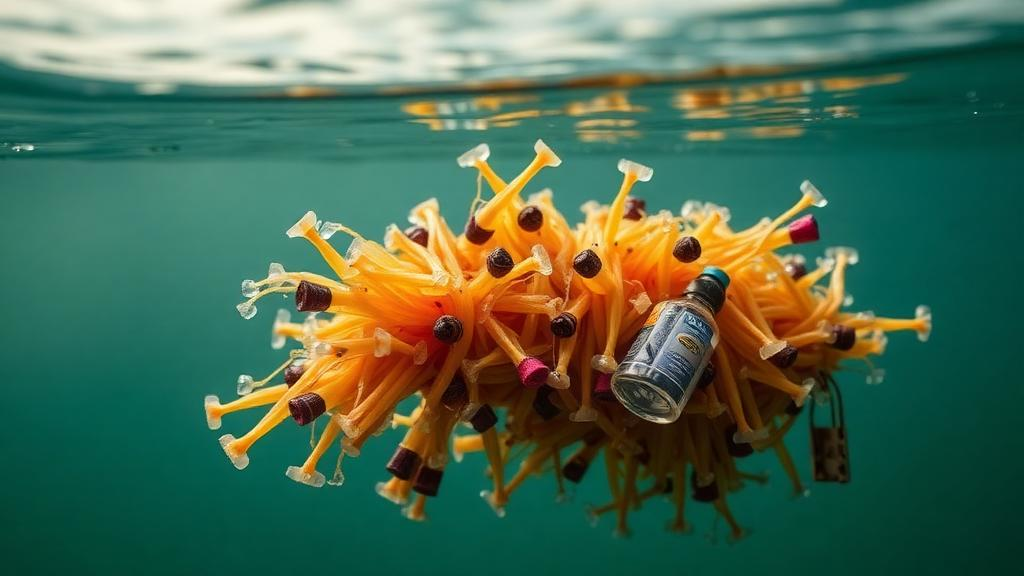
Deep in the ocean, a group of bacteria famous for devouring oil spills is quietly revealing a second talent: helping to break down and recycle plastics. A comprehensive review published in the journal Blue Biotechnology by Chunming Dong, Zhaoshou Wang and Zongze Shao of the Third Institute of Oceanography and Xiamen University brings together decades of research on the bacterial genus Alcanivorax, tracing its journey from celebrated hydrocarbon degrader to a promising candidate in the emerging marine blue circular economy. The picture that emerges is of a remarkably versatile microbe whose enzymes could one day help close the loop on plastic waste, particularly the bio-based polyester plastics that are rapidly replacing conventional materials.
Alcanivorax bacteria belong to the order Oceanospirillales within the Gammaproteobacteria and were first described in 1998 with the type species Alcanivorax borkumensis SK2, isolated from coastal seawater. Since then, the group has grown considerably. In 2023, a phylogenomic reanalysis split the original genus into three: the emended Alcanivorax, along with two new genera, Alloalcanivorax and Isoalcanivorax. Today the group comprises three genera and nineteen formally described species, and the review’s authors report that comparative genomic analysis of their own global strain collection suggests at least nineteen more potential novel species await description. Most species have been isolated from marine habitats ranging from coastal seawater and sediments to deep-sea water, hydrothermal vents and cold seeps, and more than half were recovered from hydrocarbon-enriched cultures, underscoring the group’s intimate link with hydrocarbon metabolism.
The ecological reach of these bacteria is extraordinary. They have been detected in crude oil-contaminated seawater and beaches, but also in pristine surface waters, mesopelagic and deep seawater, hydrothermal plumes of the South Pacific, Antarctic surface waters, the Haima cold seep in the South China Sea, corals, sponges and even dinoflagellate cultures. Their ubiquity stems from their role in what scientists call the cryptic hydrocarbon cycle. Cyanobacteria alone are estimated to produce between 308 and 771 million tons of hydrocarbons per year in the global ocean, roughly 100 to 500 times the amount of petroleum hydrocarbons discharged by human activities, which stands at 0.47 to 8.3 million tons annually. Because no significant hydrocarbon accumulation occurs in seawater, microbes that consume these compounds must be constantly at work, and Alcanivorax is among the most abundant and widespread of them.
The mechanism by which Alcanivorax degrades alkanes is now relatively well understood. The key initiating step is terminal or subterminal oxidation, in which alkane hydroxylases of several protein families, including AlkB, AlmA, LadA and cytochrome P450 enzymes, convert alkanes into primary or secondary alcohols. These are further oxidised to aldehydes or ketones, converted into fatty acids, and finally mineralised to carbon dioxide through beta-oxidation. Recent work has added remarkable detail. Cryo-electron microscopy structures of AlkB published in 2023 revealed an unexpected diiron center at the catalytic site, in which one iron atom interacts with oxygen to generate a highly oxidising Fe(V) oxo complex that performs the initial hydroxylation. Other studies have mapped hundreds of small regulatory RNAs involved in alkane adaptation in Alcanivorax dieselolei B-5, and microfluidic experiments showed that A. borkumensis SK2 forms dendritic biofilms that physically reshape oil droplets, accelerating hydrocarbon consumption through interfacial tubulation.
It is this hydrocarbon machinery that now draws attention to plastics. Fossil-based plastics such as polyethylene and polypropylene share a carbon-carbon backbone with alkanes, differing mainly in their far greater degree of polymerisation. Global plastic production climbed from 275 million tons in 2010 to 400.3 million tons in 2022, and an estimated 4.8 to 12.7 million tons entered the ocean in 2010 alone. The United Nations Environment Programme projects that 23 to 37 million tons of plastic waste will flow into the sea each year by 2040. As plastics fragment under ultraviolet light, mechanical stress and biological attack, they generate microplastics smaller than five millimetres and nanoplastics smaller than one micrometre. Only about one percent of marine plastic floats; the rest sinks into the water column and sediments, where biodegradation, however slow, may be the only practical removal pathway.
Within this context, Alcanivorax has emerged as a consistent presence in the plastisphere, the microbial community that colonises plastic debris. An integrated analysis of 2229 marine and terrestrial sampling sites found that hydrocarbon-degrading bacteria, including Alcanivorax, are consistently and significantly more abundant on plastic surfaces than on non-plastic controls. The review distinguishes between in situ plastispheres, which form naturally on plastics in the ocean, and ex situ plastispheres, generated in the laboratory when environmental samples are enriched with plastics as the sole carbon source. Alcanivorax abundance is significantly lower in natural plastispheres, typically around one percent or less, than in laboratory enrichments, likely because of differences in nutrient supply. In enriched cultures the numbers can be striking: Alcanivorax reached 60 percent of communities enriched with low-density polyethylene from Mediterranean plastics, 51 percent in PET-degrading consortia from eastern Pacific deep-sea sediments, and 55 percent in polyethylene plastisphere experiments examining metal ion effects.
Whether these bacteria truly degrade the toughest fossil-based plastics remains contested. Several studies report measurable polyethylene degradation, including weight losses of 3.5 percent over 80 days for an A. borkumensis strain on LDPE film, and 0.9 percent over 34 days for Alcanivorax sp. 24, a Chilean isolate whose proteomics suggested degradation proceeds through extracellular reactive oxygen species that oxidise the polymer surface. A cold-tolerant strain, Alcanivorax sp. N3-2A, degraded LDPE at temperatures as low as 4 degrees Celsius. Yet a rigorous gas chromatography study measuring carbon dioxide release concluded that A. borkumensis SK2 does not degrade LDPE when it is the sole carbon source, and researchers have called for isotopic labelling and other robust methods to settle the question. For polypropylene, the most produced plastic of 2022, a Japanese strain closely matching A. borkumensis degraded liquid low-molecular-weight PP oligomers in the presence of co-substrates such as hexadecane, releasing detectable intermediates and suggesting that monooxygenases like AlkB and P450 could attack polyolefin fragments. Deep-sea isolates have also shown activity against PET, polystyrene and polycaprolactone, although one study warned that bacterial degradation of polystyrene released 1.3 percent of the film as micro- and nanoplastics while mineralising only 4.5 percent, a sobering reminder that biodegradation can create secondary pollution.
Where Alcanivorax truly shines is in the enzymatic recycling of bio-based polyester plastics. Polylactic acid, or PLA, is widely used in disposable cutlery and straws, and the carboxylesterase ABO_2449 from A. borkumensis SK2 can hydrolyse 40 percent of solid PLA within one hour, releasing lactic acid monomers, dimers and oligomers. Related enzymes ABO_1197 and ABO_1251, identified from marine metagenomic libraries, remain active at room temperature and even at 5 degrees Celsius, and degrade polycaprolactone and polybutylene succinate adipate alongside PLA. A metagenomic enzyme called GEN0105, related to Alcanivorax esterases, hydrolyses 70 percent of solid PLA within 18 hours, with lactate monomers making up roughly half the product. For polyhydroxybutyrate and its copolymer PHBV, the esterase ALC24_4107 from Alcanivorax sp. 24 was confirmed as the enzyme responsible for hydrolysing PHB, PHBV, PBS, polyethersulfone and PCL. Phylogenetic analyses reveal that PLA-active alpha/beta hydrolase fold esterases are widely distributed across the Alcanivorax group, while PHB depolymerase family esterases cluster specifically within the genus Alloalcanivorax, hinting at a rich, largely unexplored enzymatic repertoire. Four SK2 esterases also show activity against 3PET, a model PET substrate, suggesting that direct PET-hydrolysing enzymes may await discovery in these genomes.
The authors argue that significant work remains before commercial deployment. Priorities include mining Alcanivorax genomes for novel esterases with artificial intelligence, decoding catalytic mechanisms, engineering enzymes for higher thermal stability, since plastics near their glass transition temperatures are more susceptible to enzymatic attack, and constructing heat-resistant engineered strains by transferring these hydrolases into marine thermophiles. More robust assessment methods, such as isotopic labelling, are also needed to verify genuine degradation claims. Until then, the review concludes, the most important goal remains controlling total plastic production itself. Still, the prospect that oil-eating ocean bacteria, already guardians of a hidden hydrocarbon cycle, could become workhorses of polyester plastic recycling offers a genuinely hopeful chapter in the effort to protect the sea from its most persistent pollutant.
Subject of Research: Marine Alcanivorax bacteria in hydrocarbon and synthetic plastic degradation and their enzymatic potential for plastic recycling
Article Title: Degradation from hydrocarbons to synthetic plastics: the roles and biotechnological potential of the versatile Alcanivorax in the marine blue circular economy
Article References: Dong, C., Wang, Z., & Shao, Z. (2024). Degradation from hydrocarbons to synthetic plastics: the roles and biotechnological potential of the versatile Alcanivorax in the marine blue circular economy. Blue Biotechnology, 1(1), Article 14. https://doi.org/10.1186/s44315-024-00017-3
Image Credits: AI Generated
DOI: 10.1186/s44315-024-00017-3
Keywords: Alcanivorax, marine bacteria, plastic degradation, hydrocarbon cycle, plastisphere, esterases, PLA, PHB, biodegradation, plastic recycling, blue circular economy, biotechnology
Cite Scienmag News
Violet Maxwell. (October 4, 2026). Ocean Bacteria That Eat Oil May Also Help Recycle the World’s Plastics. Scienmag. https://scienmag.com/ocean-bacteria-that-eat-oil-may-also-help-recycle-the-worlds-plastics/
Violet Maxwell. "Ocean Bacteria That Eat Oil May Also Help Recycle the World’s Plastics." Scienmag, 4 October 2026, https://scienmag.com/ocean-bacteria-that-eat-oil-may-also-help-recycle-the-worlds-plastics/. Accessed 17 October 2026.
Violet Maxwell. "Ocean Bacteria That Eat Oil May Also Help Recycle the World’s Plastics." Scienmag. October 4, 2026. https://scienmag.com/ocean-bacteria-that-eat-oil-may-also-help-recycle-the-worlds-plastics/


