


Researchers predict that 12.7% of marine teleost fish species are at risk of extinction, up fivefold from the International Union for Conservation of Nature’s prior estimate of 2.5%. Nicolas Loiseau and Nicolas Mouquet from the MARBEC Unit (the Marine Biodiversity, Exploitation and Conservation Unit) in Montpellier, France, and colleagues report these findings in a study published August 29th in the open-access journal PLOS Biology. Their report includes nearly 5,000 species that did not receive an IUCN conservation status due to insufficient data.

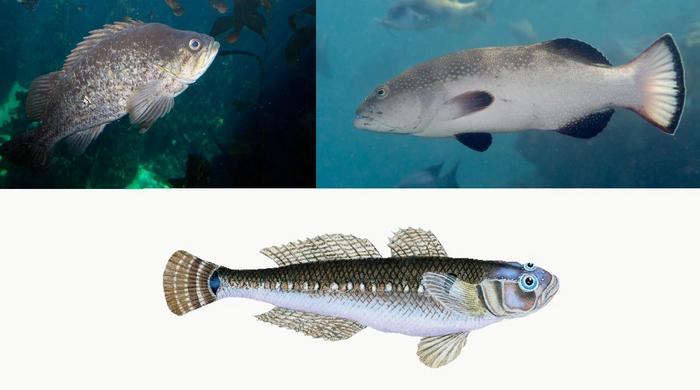
Credit: Collage of images of the fish (clockwise) from Brian Gratwicke, Richard Zerpe, and Edward Donovan (CC BY 4.0,
Researchers predict that 12.7% of marine teleost fish species are at risk of extinction, up fivefold from the International Union for Conservation of Nature’s prior estimate of 2.5%. Nicolas Loiseau and Nicolas Mouquet from the MARBEC Unit (the Marine Biodiversity, Exploitation and Conservation Unit) in Montpellier, France, and colleagues report these findings in a study published August 29th in the open-access journal PLOS Biology. Their report includes nearly 5,000 species that did not receive an IUCN conservation status due to insufficient data.
The IUCN’s Red List of Threatened Species tracks more than 150,000 species to guide global conservation efforts on behalf of the most threatened. However, 38% of marine fish species (or 4,992 species at the time of this research) are considered Data-Deficient and do not receive an official conservation status or the associated protections.
To better direct conservation efforts toward the species that need them, Loiseau and colleagues combined a machine learning model with an artificial neural network to predict the extinction risks of Data-Deficient species. The models were trained on occurrence data, biological traits, taxonomy and human uses from 13,195 species.
They categorized 78.5% of the 4,992 species as Non-Threatened or Threatened (which includes Critically Endangered, Endangered and Vulnerable IUCN categories). Predicted Threatened species increased fivefold (from 334 to 1,671) and predicted Non-Threatened species increased by a third (from 7,869 to 10,451).
Predicted Threatened species tended to have a small geographic range, large body size and low growth rate. The extinction risk was also correlated with shallow habitats. The South China Sea, the Philippine and Celebes Seas and the west coasts of Australia and North America emerged as hotspots for predicted Threatened species. The researchers recommend increased research and conservation efforts in these areas.
The researchers observed “a marked change in conservation priority ranking after species IUCN predictions,” recommending that the Pacific Islands and Southern Hemisphere’s polar and subpolar regions be prioritized to account for emerging at-risk species. Many species that remained Data-Deficient occur in the Coral Triangle, indicating that additional research is needed there.
The researchers note that models cannot replace direct evaluations of at-risk species but AI offers a unique opportunity to provide a rapid, extensive and cost-effective evaluation of extinction risk of species.
Loiseau adds, “Artificial Intelligence (AI) enables the reliable assessment of extinction risks for species that have not yet been evaluated by the International Union for Conservation of Nature (IUCN). Our analysis of 13,195 marine fish species reveals that the extinction risk is significantly higher than the IUCN’s initial estimates, rising from 2.5% to 12.7%. We propose to incorporate recent advancements in forecasting species extinction risks into a new synthetic index called ‘predicted IUCN status.’ This index can serve as a valuable complement to the current ‘measured IUCN status.’”
#####
In your coverage, please use this URL to provide access to the freely available paper in PLOS Biology:
Citation: Loiseau N, Mouillot D, Velez L, Seguin R, Casajus N, Coux C, et al. (2024) Inferring the extinction risk of marine fish to inform global conservation priorities. PLoS Biol 22(8): e3002773.
Author Countries: France, Switzerland
Funding: NL is supported by the Fondation pour la Recherche sur la Biodiversité (FRB) and La region Occitanie (BiodivOc) in the context of the CESAB project ‘Creating a global database of fish functional traits: integrating physiology and ecology across aquatic ecosystems’ (PHENOFISH). DM was partly funded through the 2017–2018 Belmont Forum and BiodivERsA REEF-FUTURES project under the BiodivScen ERA-Net COFUND programme and with funding from ANR, DFG, NSF, Royal Society, ERC and NSERC. The funders had no role in study design, data collection and analysis, decision to publish, or preparation of the manuscript.
Journal
PLoS Biology
Method of Research
Computational simulation/modeling
Subject of Research
Not applicable
COI Statement
Competing interests: The authors have declared that no competing interests exist.
Cite Scienmag News
Drew Townsend. (August 29, 2024). Number of fish species at risk of extinction fivefold higher than previous estimates according to a new prediction. Scienmag. https://scienmag.com/number-of-fish-species-at-risk-of-extinction-fivefold-higher-than-previous-estimates-according-to-a-new-prediction/
Drew Townsend. "Number of fish species at risk of extinction fivefold higher than previous estimates according to a new prediction." Scienmag, 29 August 2024, https://scienmag.com/number-of-fish-species-at-risk-of-extinction-fivefold-higher-than-previous-estimates-according-to-a-new-prediction/. Accessed 4 September 2026.
Drew Townsend. "Number of fish species at risk of extinction fivefold higher than previous estimates according to a new prediction." Scienmag. August 29, 2024. https://scienmag.com/number-of-fish-species-at-risk-of-extinction-fivefold-higher-than-previous-estimates-according-to-a-new-prediction/

