


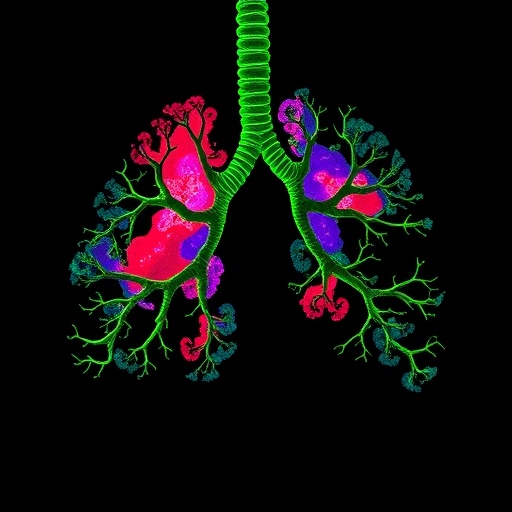
In a groundbreaking study poised to redefine our understanding of cancer therapy resistance, researchers have uncovered a sophisticated molecular mechanism that endows non-small cell lung cancer (NSCLC) cells with enhanced radioresistance. The team, led by Zha, Huang, Liu, and colleagues, discovered that the nuclear receptor interacting protein 1 (NRIP1) acts as a critical co-activator for the transcription factor FOXO3 once it has translocated to the nucleus. This co-activation leads to the upregulation of mitochondrial transcription factor A (TFAM), ultimately fortifying cancer cells against the damaging effects of radiation therapy.
The fight against NSCLC, the most common type of lung cancer, is often hampered by the tumor’s ability to resist conventional radiation treatments. Radiation therapy primarily works by damaging the DNA of rapidly dividing cells, inducing apoptosis or programmed cell death. However, many tumors develop mechanisms to evade these lethal effects, presenting an urgent need for deeper insights into the underlying biology of radioresistance.
At the heart of this novel research lies FOXO3, a transcription factor well known for its roles in regulating cellular stress responses, apoptosis, and metabolism. Previous studies have implicated FOXO3 in tumor suppression, but its role in cancer cell survival under radiation pressure remained unclear. Zha and colleagues reveal that in NSCLC cells exposed to radiation, FOXO3 translocates into the nucleus, a critical step that shifts its function from cytoplasmic inactivity to potent transcriptional regulation.
NRIP1 unexpectedly emerges as a pivotal player in this neuronal-turned-oncogenic context. Classically known for interacting with nuclear receptors and modulating gene expression, NRIP1 was found to partner specifically with nuclear-localized FOXO3. This partnership is far from merely additive; NRIP1 effectively amplifies FOXO3’s transcriptional activity, enabling it to drive expression of a select set of genes essential for mitochondrial integrity and function.
Among those genes, TFAM stands out for its crucial role in mitochondrial DNA transcription and replication. Enhanced TFAM expression translates into robust mitochondrial biogenesis and function, equipping the cancer cells with the metabolic and bioenergetic capacity to survive otherwise lethal radiation-induced stress. This new axis linking NRIP1, FOXO3, and TFAM represents an elegant example of how cancer cells repurpose normal cellular machinery to escape therapeutic interventions.
The implications of this mechanism are profound. Mitochondria are not only powerhouses of the cell but also arbiters of apoptosis. By bolstering mitochondrial health, NSCLC cells effectively raise the threshold for radiation-induced cell death. The upregulated TFAM ensures that mitochondrial DNA damage is quickly repaired and mitochondrial function restored, thus maintaining the metabolic flexibility essential for survival under oxidative stress.
Methodologically, the research team leveraged a combination of molecular biology techniques, including chromatin immunoprecipitation assays to confirm direct binding of FOXO3 and NRIP1 to the TFAM promoter region. In parallel, they employed knockdown experiments via siRNA to demonstrate that disruption of either NRIP1 or FOXO3 significantly diminishes TFAM expression and sensitizes cells to radiation, underscoring the therapeutic potential of targeting this pathway.
In vivo studies further corroborated these findings. Mouse models bearing NSCLC tumors with silenced NRIP1 expression exhibited markedly improved responses to radiation therapy, with decreased tumor growth and increased apoptotic markers. These results not only validate NRIP1’s role in promoting radioresistance but also position it as a viable molecular target to enhance the efficacy of existing treatments.
This discovery opens up exciting new avenues for cancer therapy. By developing small molecules or biologics that can disrupt the interaction between NRIP1 and FOXO3, clinicians might sensitize resistant tumors to radiation, improving patient outcomes significantly. Moreover, given the ubiquitous nature of FOXO transcription factors in various cancers, this mechanism might transcend NSCLC, providing a broader therapeutic scope.
The study also challenges some pre-existing paradigms in cancer biology. FOXO3 has traditionally been classified as a tumor suppressor, largely due to its roles in promoting cell cycle arrest and apoptosis. Here, its activity, when modulated by NRIP1, flips the script to promote survival under therapeutic stress, highlighting the nuanced and context-dependent roles transcription factors can play in cancer.
Further investigation will be essential to unravel the complete spectrum of genes regulated by the NRIP1-FOXO3 complex and to understand the conditions under which this partnership is favored. Whether other co-factors or post-translational modifications influence this interaction remains to be elucidated.
Moreover, the mitochondrial focus of this resistance mechanism points to the broader relevance of metabolic reprogramming in cancer. The ability of tumors to adapt their energy production and resist apoptosis is increasingly recognized as a hallmark of aggressive cancers. This research contributes a crucial molecular link, connecting nuclear transcriptional events to mitochondrial dynamics in the context of therapy resistance.
Importantly, the translational potential of these findings is immense. Biomarkers based on NRIP1 or TFAM expression could inform clinical decision-making by identifying patients likely to benefit from radiation sensitization strategies. Personalized medicine approaches could integrate such markers to tailor interventions that disrupt the resistive machinery intrinsic to tumor cells.
The precise molecular dynamics of NRIP1 binding to FOXO3 and the structural basis of this interaction offer another promising research frontier. Structural biology and drug design strategies can exploit this knowledge to develop selective inhibitors, with minimal off-target effects, an essential consideration for preserving normal tissue function during cancer treatment.
In addition, understanding how radiation itself influences NRIP1 and FOXO3 expression and localization will be critical. The adaptive response of cancer cells to radiation involves a cascade of signaling pathways, and integrating these findings with broader cellular stress responses could identify combinational therapeutic strategies enhancing radiosensitivity.
As radiation therapy remains a cornerstone in treating a variety of cancers, overcoming radioresistance represents a formidable challenge. This study by Zha et al. achieves a milestone in delineating a novel nuclear-mitochondrial axis that specifies survival advantage following radiation insult, heralding new hope for improving lung cancer treatment outcomes.
The convergence of nuclear receptor co-activators, transcription factors, and mitochondrial regulators in cancer’s resilience underscores the sophistication of tumoral biology and the complexity of therapeutic intervention. But with each new discovery, the path toward precise and effective cancer therapies becomes clearer. This research not only enriches our fundamental understanding but also lights the way for future translational innovation.
Cite Scienmag News
Nathaniel Bowman. (March 27, 2026). NRIP1 Boosts FOXO3, Enhances Lung Cancer Radioresistance. Scienmag. https://scienmag.com/nrip1-boosts-foxo3-enhances-lung-cancer-radioresistance/
Nathaniel Bowman. "NRIP1 Boosts FOXO3, Enhances Lung Cancer Radioresistance." Scienmag, 27 March 2026, https://scienmag.com/nrip1-boosts-foxo3-enhances-lung-cancer-radioresistance/. Accessed 4 September 2026.
Nathaniel Bowman. "NRIP1 Boosts FOXO3, Enhances Lung Cancer Radioresistance." Scienmag. March 27, 2026. https://scienmag.com/nrip1-boosts-foxo3-enhances-lung-cancer-radioresistance/


