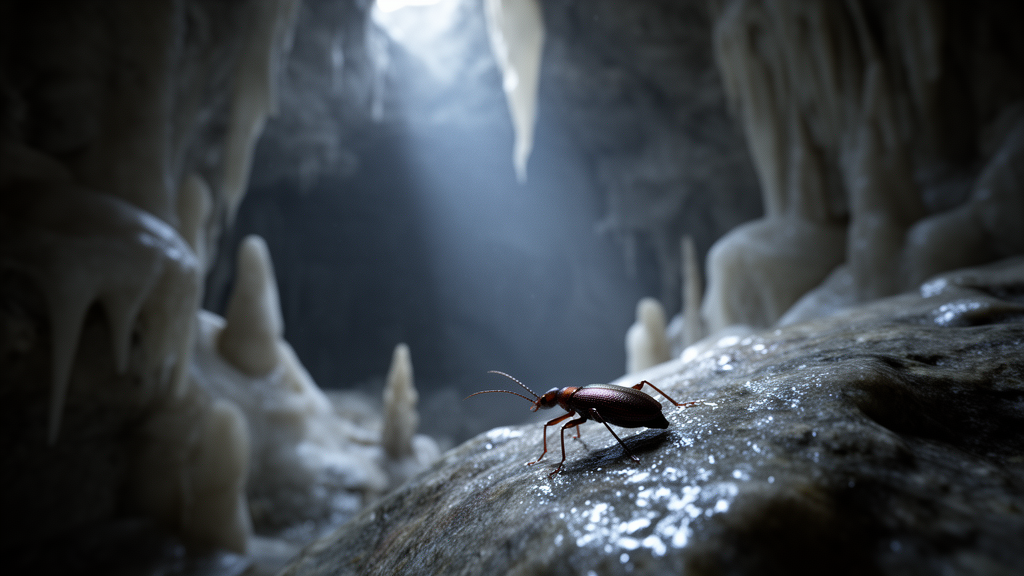
Deep beneath the karst towers of southwest China lives a blind, flightless rove beetle so rare that scientists have verified it from only eleven places on Earth. The genus Zopherobatrus, described barely a decade ago, spends its entire life in permanent darkness, wingless and eyeless, confined to the dissolution-formed voids of limestone caves. Now, a new study published in Subterranean Biology has quantified, for the first time, just how precarious that existence is. Using an Ensemble of Small Models framework, researchers projected that between 24 and 48 percent of the beetle’s climatically suitable habitat could vanish by the 2070s under different emissions scenarios, while a systematic gap analysis revealed that only 2.6 percent of its current habitat falls within any protected area and not a single known locality is formally safeguarded.
The findings expose what the authors call a double jeopardy for subterranean biodiversity: simultaneous erosion of suitable habitat driven by climate change combined with a near-total absence of legal protection. For cave-obligate organisms like Zopherobatrus, which cannot cross non-karstic barriers and depend entirely on geologically isolated subterranean habitats, this combination transforms projected range shifts into what the study describes as a substantial extinction debt. The genus is the only known lineage of true troglobitic Pselaphinae in China, making its vulnerability representative of an entire poorly known segment of the country’s cave fauna.
Subterranean ecosystems have long been treated as thermally buffered refugia, insulated from surface climate change by the thermal inertia of deep rock. That assumption is increasingly challenged. Mean annual cave temperatures track surface trends, albeit with dampened amplitudes and temporal lags, meaning persistent surface warming is expected to equilibrate underground over decadal scales. For obligate cave dwellers that evolved within narrow thermal envelopes, even modest warming poses an existential threat. Their capacity for compensatory range shifts is further constrained by the discontinuous, island-like distribution of suitable subterranean habitats within highly fragmented karst landscapes, where each cave system functions as an evolutionary island separated by inhospitable surface terrain.
The modelling challenge was formidable. With only eleven spatially unique occurrence records spanning Guizhou, Yunnan, Guangxi, Chongqing, and Hunan provinces, conventional species distribution models would have been statistically unstable, since recommended minimum thresholds for critical SDM algorithms typically range from 14 to 25 records. The researchers overcame this paradox using an Ensemble of Small Models approach, which decomposes the modelling problem into multiple bivariate sub-models, each fitted with only two predictor variables, then combines them into a Boyce-weighted ensemble. This strategy restricts model complexity at the sub-model level while capturing multi-dimensional environmental relationships through aggregation, mitigating the overfitting that plagues small-sample applications.
Four environmental variables were selected a priori for their hypothesized ecological relevance to subterranean organisms. Annual mean temperature served as a direct proxy for the thermal niche of cave-dwelling ectotherms, because deep cave temperature approximates local annual mean surface temperature due to thermal equilibrium between epigean and hypogean environments. Precipitation seasonality reflected temporal consistency in groundwater recharge, a critical physiological stressor for stenohygrobic fauna whose survival depends on uninterrupted drip-water supply. Mean NDVI, averaged over five years of MODIS satellite data, proxied aboveground primary productivity, since subterranean ecosystems are allochthonous and rely on surface-derived organic matter percolating into cave habitats. Distance to the nearest karst outcrop represented a hard geological constraint, because non-karst lithologies lack the dissolution-formed voids required for subterranean colonization.
Background data were generated using a target-group background strategy, employing georeferenced records of other cavernicolous Pselaphinae as pseudo-absences. This approach accounts for spatial bias in sampling effort, as background points inherently reflect the geographic distribution of entomological collecting activity rather than random environmental sampling. The study area was delimited to approximate the species’ accessible area, spanning the broader East Asian karst belt, thereby reducing the influence of distal environments the genus has never encountered. Model performance was assessed using the continuous Boyce index, which avoids the inflated performance estimates associated with AUC in presence-only SDMs, and a null-model significance test based on 999 permutations confirmed the empirical performance was significantly better than expected by chance.
Under current conditions, the ensemble predicted 226,475 square kilometres of climatically suitable habitat, concentrated across the karst regions of southwest China with the highest suitability clustered along the deeply incised montane regions of the Guizhou-Hunan-Chongqing border area. Future projections revealed substantial contraction under all four scenarios examined, spanning two time periods and two Shared Socioeconomic Pathways. Under the optimistic low-emissions pathway, suitable habitat declined by roughly 36 to 39 percent, with a counterintuitive partial recovery by the 2070s reflecting emission stabilization inherent to that scenario. Under the high-emissions fossil-fuelled pathway, contractions reached 50 percent by the 2050s and 63.1 percent by the 2070s, while the projected range centroid shifted northwestward by up to 141 kilometres toward higher elevations.
Crucially, the study argues that the conventional net area change metric masks functional habitat loss for this dispersal-limited group. Although newly suitable areas were projected to appear along the northern periphery of the current distribution, these climatically gained areas are probably ecologically irrelevant because Zopherobatrus comprises obligate cave-dwelling organisms with negligible dispersal capacity and strict dependence on karst substrates. Colonization of disjunct newly suitable areas is functionally impossible. Consequently, the more biologically meaningful retained habitat ratio, representing the proportion of currently suitable habitat that remains suitable under future conditions, ranged from as low as 24 percent under the high-emissions 2070s scenario to 48.2 percent under the low-emissions 2070s scenario, indicating that over half to three-quarters of current suitable habitat will be lost without compensatory range expansion.
The gap analysis revealed a pronounced mismatch between the distribution of suitable habitat and the coverage of existing protected areas. Of the 226,475 square kilometres of currently suitable habitat, only 5,841 square kilometres fell within the boundaries of national or provincial nature reserves. More critically, none of the eleven known occurrence localities was located within any protected area. The researchers identified 49,299 square kilometres of climate refugia, defined as areas predicted to remain suitable under all four future scenarios, concentrated in the deeply incised karst valleys of the Guizhou-Hunan-Chongqing border region and parts of northern Guangxi. However, 95.9 percent of these refugia lie outside any existing protected area, and within these unprotected refugia, 12,611 square kilometres of high-suitability habitat was flagged as critical conservation gaps. Among the eleven known localities, only one was situated within a climate refugium.
The study recommends three actionable conservation measures. First, the establishment of targeted micro-reserves centred on identified climate refugia, particularly in the deeply incised karst valleys of the Guizhou-Hunan-Chongqing border region. Unlike conventional large-scale protected areas, micro-reserves are small, precisely delineated conservation units designed to protect specific habitats of narrow-range endemics. For cave-dwelling taxa, such reserves would need to include not only cave entrances but also the surrounding surface catchment area, given the dependence of subterranean ecosystems on surface-derived energy and hydrological inputs, a vertical conservation unit approach integrating above- and belowground biodiversity protection. Second, the inclusion of Zopherobatrus in China’s List of Key Protected Wild Animals, since none of the known species currently holds any formal conservation status. Third, the systematic integration of subterranean fauna into regional conservation prioritization frameworks, by overlaying suitability maps for multiple cave-obligate taxa to delineate subterranean biodiversity hotspots. The researchers also caution that even within existing protected areas, the legal framework governing subterranean resource use in China remains ambiguous, meaning surface-level nature reserve designations do not necessarily confer explicit protection against subsurface mining, quarrying, or groundwater extraction, potentially rendering the 2.6 percent coverage estimate an overestimate of effective protection.
Subject of Research: Climate vulnerability and conservation gaps of the rare troglobitic beetle genus Zopherobatrus in southwest China
Article Title: Nowhere to hide: Ensemble of Small Models exposes climate vulnerability and conservation gaps for an extremely rare troglobitic beetle genus
Article References: Yin, Z.-W. (2026). Nowhere to hide: Ensemble of Small Models exposes climate vulnerability and conservation gaps for an extremely rare troglobitic beetle genus. Subterranean Biology, 56, 51-83. https://doi.org/10.3897/subtbiol.56.190752
Image Credits: AI Generated
DOI: 10.3897/subtbiol.56.190752
Keywords: troglobitic beetles, Zopherobatrus, Ensemble of Small Models, species distribution models, karst ecosystems, climate refugia, conservation gap analysis, subterranean biodiversity, southwest China, protected areas, Pselaphinae, habitat loss
Cite Scienmag News
Margaret Porter. (October 17, 2026). Nowhere to hide: climate models expose conservation gaps for an extremely rare cave beetle. Scienmag. https://scienmag.com/nowhere-to-hide-climate-models-expose-conservation-gaps-for-an-extremely-rare-cave-beetle/
Margaret Porter. "Nowhere to hide: climate models expose conservation gaps for an extremely rare cave beetle." Scienmag, 17 October 2026, https://scienmag.com/nowhere-to-hide-climate-models-expose-conservation-gaps-for-an-extremely-rare-cave-beetle/. Accessed 17 October 2026.
Margaret Porter. "Nowhere to hide: climate models expose conservation gaps for an extremely rare cave beetle." Scienmag. October 17, 2026. https://scienmag.com/nowhere-to-hide-climate-models-expose-conservation-gaps-for-an-extremely-rare-cave-beetle/