


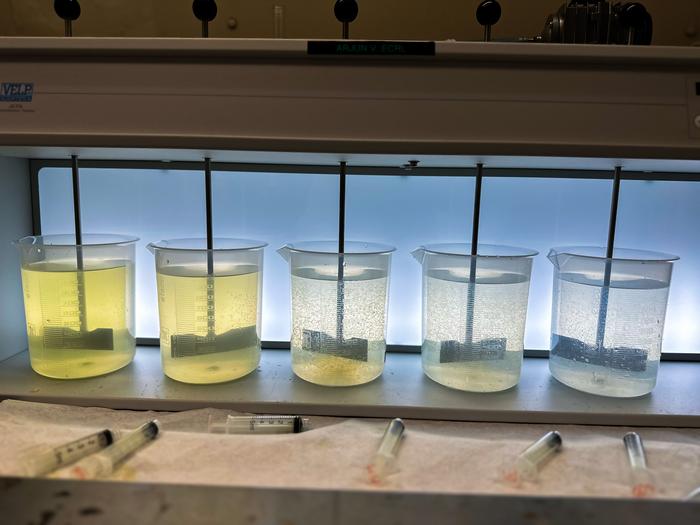
In a groundbreaking effort to tackle the pervasive issue of PFAS contamination in drinking water, a research team at New Jersey Institute of Technology has received funding from the Bureau of Reclamation’s Desalination and Water Purification Research program.

Credit: Emerging Contaminants Research Lab @ NJIT
In a groundbreaking effort to tackle the pervasive issue of PFAS contamination in drinking water, a research team at New Jersey Institute of Technology has received funding from the Bureau of Reclamation’s Desalination and Water Purification Research program.
This highly competitive grant, awarded to only eight projects out of over eighty applicants, supports their innovative project titled “Enhanced Coagulation for the Removal of Per- and Polyfluoroalkyl Substances using Hydrophobic Ion Pairing Approach Project.”
Arjun Venkatesan, associate professor in NJIT’s Civil and Environmental Engineering Department and the principal investigator of this work, is also leading a pilot study from the same program for the project “Enhancing the Removal of Hydrophilic Per- and Polyfluoroalkyl Substances by Granular Activated Carbon using Hydrophobic Ion-pairing as Pre-treatment” that utilizes a similar approach to tackle PFAS contamination.
Addressing the Challenges of PFAS Removal
Per- and polyfluoroalkyl substances (PFAS), often termed “forever chemicals,” pose a significant challenge for conventional water treatment methods. The carbon-fluorine bonds in PFAS are among the strongest in chemistry, making these substances extremely resistant to natural degradation processes.
This persistence means PFAS remain in the environment indefinitely, accumulating over time and posing long-term health risks. Traditional treatment methods, such as granular activated carbon (GAC) filtration, struggle to effectively remove certain types of PFAS, particularly the hydrophilic (short-chain) variants.
“GAC is the go-to technology for PFAS treatment,” said Venkatesan, who is also the director of NJIT’s Emerging Contaminants Research Laboratory (ECRL). “However, it doesn’t work for all PFAS chemicals. Long-chain PFAS are removed efficiently, but short-chain PFAS, which are also toxic and regulated, are not.”
The primary mechanism of PFAS removal by GAC relies on hydrophobic interactions, which are ineffective for the water-soluble short-chain PFAS. This gap in treatment capabilities necessitates innovative solutions to improve water safety and meet regulatory standards set by the US Environmental Protection Agency (EPA).
Innovative Solutions and Collaboration
The team’s novel approach involves a pre-treatment process that significantly enhances the performance of existing GAC systems. By adding a chemical to the influent water that forms hydrophobic complexes with PFAS molecules, both short-chain and long-chain PFAS can be more effectively adsorbed onto the GAC surfaces. This process not only improves removal efficiency but also offers a cost-effective solution that can be readily implemented in existing water treatment facilities.
The Suffolk County Water Authority (SCWA) has played a crucial role in this project by providing access to a contaminated groundwater site for pilot testing. SCWA also offered in-kind support for the construction of the pilot filtration columns and additional water testing to complement the PFAS study, exemplifying the practical, community-focused nature of the research.
Promising Preliminary Results
While the pilot testing has just begun, laboratory tests have shown promising results. The pre-treatment approach has demonstrated a significant improvement in the time to breakthrough for PFAS removal. For instance, the time to 50% breakthrough for PFBS, a regulated short-chain PFAS, was improved by approximately 170%.
These preliminary findings suggest that the novel pre-treatment process could lead to substantial improvements in GAC performance, ultimately enhancing water quality and safety.
Real-World Impact and Future Research
With the new award, the team now is ready to demonstrate the novel pre-treatment approach for another commonly employed water treatment process called coagulation and flocculation. The simplicity and cost-effectiveness of this approach make it a viable option for widespread adoption.
“Our approach can be easily implemented in existing conventional water treatment systems with minimal modifications,” said William Pennock, assistant professor in NJIT’s Civil and Environmental Engineering Department and collaborator on the coagulation and flocculation treatment research. “All we need is a chemical dosing pump to inject the HIP chemical into the untreated water.”
This straightforward integration could result in significant operational cost savings for water treatment facilities, potentially reducing the frequency of GAC replacement by about 50%.
Looking ahead, the research team is also exploring the potential of the hydrophobic-ion pairing approach for other ionic organic contaminants, indicating a broad applicability of this technology. Future research will focus on testing biodegradable and environmentally friendly alternatives to the HIP chemical, ensuring the process does not introduce secondary contaminants.
This research aligns closely with the latest EPA regulations on PFAS in drinking water. By improving GAC filter performance and reducing operational costs, the proposed pre-treatment process addresses a critical national need. The successful implementation of this technology promises immediate and cost-effective enhancements to existing water treatment systems, benefiting communities and advancing public health protections.
This innovative research represents a significant step forward in the fight against PFAS contamination. By enhancing existing water treatment processes, the team is not only addressing a pressing environmental challenge but also providing practical, scalable solutions that can be adopted nationwide.
Cite Scienmag News
Courtney Benton. (July 10, 2024). Novel pre-treatment process enhances PFAs removal from drinking water. Scienmag. https://scienmag.com/novel-pre-treatment-process-enhances-pfas-removal-from-drinking-water/
Courtney Benton. "Novel pre-treatment process enhances PFAs removal from drinking water." Scienmag, 10 July 2024, https://scienmag.com/novel-pre-treatment-process-enhances-pfas-removal-from-drinking-water/. Accessed 6 September 2026.
Courtney Benton. "Novel pre-treatment process enhances PFAs removal from drinking water." Scienmag. July 10, 2024. https://scienmag.com/novel-pre-treatment-process-enhances-pfas-removal-from-drinking-water/

