


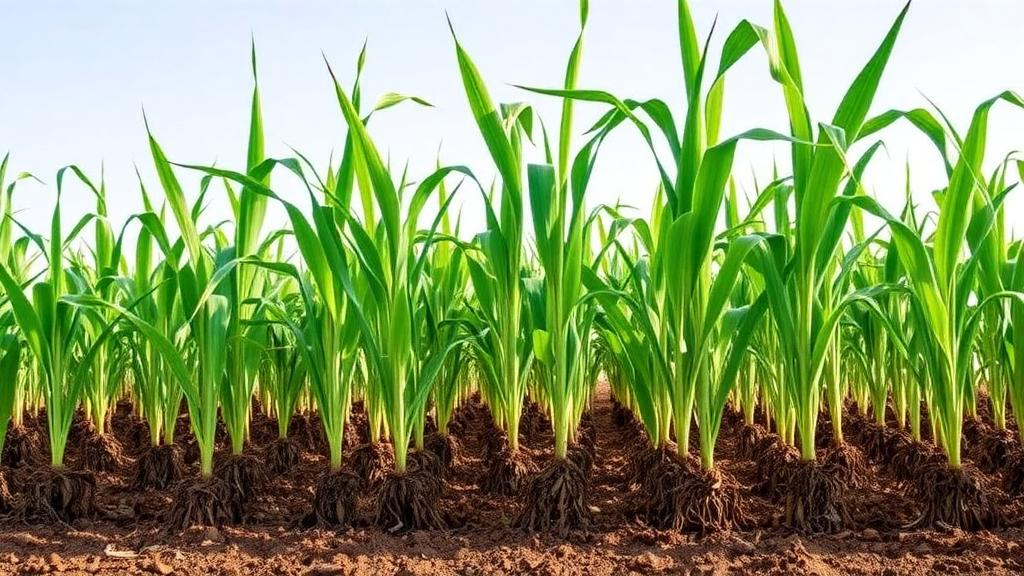
Beneath every sugarcane field lies an invisible negotiation between plant and soil. Roots must force their way through a matrix of solid particles, water films and air-filled cavities, and when that matrix becomes too hard or too dry, growth stalls. A new study published in Plant and Soil has quantified, with unusual precision, just how much a preserved soil structure can help roots overcome these obstacles. Working with soil from a long-term experiment in Ribeirão Preto, São Paulo, Brazil, researchers found that sugarcane roots growing in a 31-year-old no-tillage system elongated up to 8.2 times faster under severe compaction and near-saturated moisture than roots growing in soil that had been disturbed and repacked. The finding offers some of the strongest experimental evidence yet that the architecture of the pore network itself, not merely the bulk density of the soil, governs how well crops cope with physical stress.
The research team, led by Luiz Henrique Quecine Grande and Moacir Tuzzin de Moraes of the University of São Paulo’s Luiz de Queiroz College of Agriculture, set out to fill a persistent gap in crop modelling. Semi-empirical models that link root elongation to soil penetration resistance and water status exist for soybean, wheat and maize, but no equivalent framework had been built for sugarcane. That omission matters because sugarcane is a semi-perennial crop: its root system is renewed after each harvest and must keep functioning across ratoon cycles lasting three to ten years, exposing it to soil physical constraints far longer than annual crops face. If soil structure shapes how roots respond to stress, then any model that ignores structure risks systematically misjudging how deep and fast sugarcane roots will grow, and therefore how much water they can extract during drought.
To isolate the effect of structure, the team designed an elegant three-way comparison. Soil cores with undisturbed structure were collected from a field trial established in 1993, which compares conventional tillage, last disturbed five years before sampling, with a no-tillage system that had gone 31 years without mechanical disturbance apart from furrow opening at planting. A third treatment consisted of repacked soil, sieved and compressed into cylinders at five bulk densities, deliberately destroying any continuous pore network. The soil itself was a clay-rich Rhodic Eutrudox, an Oxisol with roughly 70 percent clay, typical of Brazil’s premier sugarcane region. Sampling at 0 to 20 centimetres captured the topsoil where most early root activity occurs, and 100 undisturbed cores per tillage system ensured the natural field variability in compaction was represented rather than averaged away.
Each structural condition was then subjected to a matrix of five levels of mechanical stress and five levels of hydric stress. The researchers equilibrated the cores at matric potentials ranging from a wet −5 hPa to a dry −8000 hPa, producing degrees of water saturation between roughly 58 and 95 percent. Pre-sprouted sugarcane seedlings, 60 days old, had their existing root systems carefully removed so that only new, uniform first-order roots of 0.5 to 2 centimetres were transplanted into the cores. After about 95 hours in a growth chamber held at 27 degrees Celsius, the roots were extracted, washed and measured. The elongation rate, expressed in centimetres per day, became the response variable for every combination of structure, compaction and moisture, with a maximum observed rate of 3.62 centimetres per day under stress-free control conditions.
The results revealed a striking hierarchy of vulnerability. In the repacked soil, root elongation collapsed by up to 84 percent as compaction increased, falling from 3.04 to just 0.51 centimetres per day under near-saturated conditions. Conventional tillage soil showed intermediate losses, declining from 2.14 to 0.69 centimetres per day across the same compaction range. The 31-year no-tillage soil, by contrast, lost only about 30 percent of its elongation rate across the entire compactness range from 75 to 95 percent. Under the harshest combination tested, a penetration resistance of about 6.2 megapascals at 95 percent water saturation, roots in no-tillage soil grew 8.2 times faster than in repacked soil and 1.8 times faster than in soil under conventional tillage. Mechanical impedance, the team concluded, was the dominant stress, with water stress acting largely by amplifying it.
The mechanism behind this resilience lies in the pore network. As macropore volume, the fraction of pores larger than 50 micrometres, declined from 0.20 to 0.05 cubic metres per cubic metre, root elongation fell by only 38.5 percent in the no-tillage soil, but by 74.4 percent under conventional tillage and 83.1 percent in repacked soil. Remarkably, roots in no-tillage soil at a macropore volume of 0.05 grew as fast as roots in the other treatments at roughly 0.12, meaning the preserved structure effectively compensated for a loss of more than half the macroporosity. Saturated hydraulic conductivity told the same story: at equivalent macropore volumes, water moved through the structured soils up to 3.3 times faster than through the repacked samples, indicating that the remaining pores in undisturbed soil were better connected and more permeable.
From these data the researchers fitted a three-dimensional Gaussian model expressing root elongation rate as a joint function of penetration resistance and degree of water saturation, one model per structural condition. The models performed well, explaining 47 percent of elongation variability in conventional tillage, 71 percent in no-tillage and 78 percent in repacked soil, with determination coefficients above 0.87 and near-zero bias. The shape of the response surfaces carried the key message: the same nominal physical stress produced very different elongation rates depending on structure. The authors argue this means root elongation functions cannot simply be transferred between soils with contrasting structural histories, a caution that applies directly to the agro-hydrological models, such as Canegro and SWAP, which often assume constant root growth rates regardless of what the soil is doing.
To translate the laboratory measurements into architectural consequences, the team integrated their stress functions into RootBox, a three-dimensional functional-structural root model. Simulating 45 days of growth at a moderate water saturation of 81 percent, they found rooting depth reached 31 centimetres in the no-tillage scenario, 20 centimetres under conventional tillage and only 15 centimetres in repacked soil, roughly half the no-tillage depth. Under completely stress-free conditions, simulated roots reached about 65 centimetres, underscoring how much potential depth is forfeited to physical limitation. Deeper rooting is not an aesthetic detail: it determines access to subsoil water during dry spells, and previous field studies have linked no-tillage to greater sugarcane root biomass at depths of 80 to 100 centimetres.
The findings carry practical weight for one of the world’s largest sugar and bioenergy crops. Conventional tillage temporarily loosens compacted layers, but that loosening is short-lived and can leave subsurface plough pans while degrading load-bearing capacity under heavy harvester traffic. The new results suggest that abandoning disturbance, or simply leaving tilled soil undisturbed for five years as in the conventional treatment here, allows a continuous, biologically generated pore network to re-establish, giving roots low-resistance pathways through otherwise hostile ground. These biopores, left behind by decayed roots, also improve gas diffusion, which matters because waterlogged, compacted soil can suffocate the oxygen-hungry meristem at the root tip. The study notes that roots sense compaction partly through restricted ethylene diffusion, a hormonal signal trapped by dense soil, and that preserved pore continuity appears to blunt this stress perception.
The authors are careful about limits. Their models are calibrated for penetration resistances between 1 and 8 megapascals and water saturations between 50 and 95 percent, so drier conditions and full saturation remain outside their predictive range, and the RootBox simulations were illustrative rather than field-validated. The penetration resistance equation, fitted with the Busscher model, is best suited to soils with similar clay content. Even so, the central conclusion stands firmly: soil structure is not a passive backdrop to root growth but an active buffer against mechanical and hydric stress, and it deserves a place inside the soil–plant–atmosphere models that forecast crop water use. For an industry facing more erratic rainfall and heavier machinery, the message from this Brazilian Oxisol is that the cheapest root growth insurance may simply be to stop disturbing the ground.
Subject of Research: The effect of no-tillage soil structure on sugarcane root elongation under mechanical and hydric stresses in a Brazilian Oxisol
Article Title: No-tillage soil structure increases sugarcane root elongation under mechanical and hydric stresses in an Oxisol
Article References: Grande, L. H. Q., Macedo, M. D., dos Santos, J. K., da Silva, L. H. A., de Alencar, A. A., dos Santos Vianna, M., Bolonhezi, D., & de Moraes, M. T. (2026). No-tillage soil structure increases sugarcane root elongation under mechanical and hydric stresses in an Oxisol. Plant and Soil. https://doi.org/10.1007/s11104-026-09113-2
Image Credits: AI Generated
DOI: 10.1007/s11104-026-09113-2
Keywords: sugarcane, no-tillage, soil structure, root elongation, soil compaction, penetration resistance, biopores, macroporosity, Oxisol, soil physics, root growth modelling, hydric stress
Cite Scienmag News
Alan Morgan. (October 1, 2026). No-Tillage Soils Let Sugarcane Roots Push Through Compaction and Drought, Study Finds. Scienmag. https://scienmag.com/no-tillage-soils-let-sugarcane-roots-push-through-compaction-and-drought-study-finds/
Alan Morgan. "No-Tillage Soils Let Sugarcane Roots Push Through Compaction and Drought, Study Finds." Scienmag, 1 October 2026, https://scienmag.com/no-tillage-soils-let-sugarcane-roots-push-through-compaction-and-drought-study-finds/. Accessed 4 October 2026.
Alan Morgan. "No-Tillage Soils Let Sugarcane Roots Push Through Compaction and Drought, Study Finds." Scienmag. October 1, 2026. https://scienmag.com/no-tillage-soils-let-sugarcane-roots-push-through-compaction-and-drought-study-finds/


