


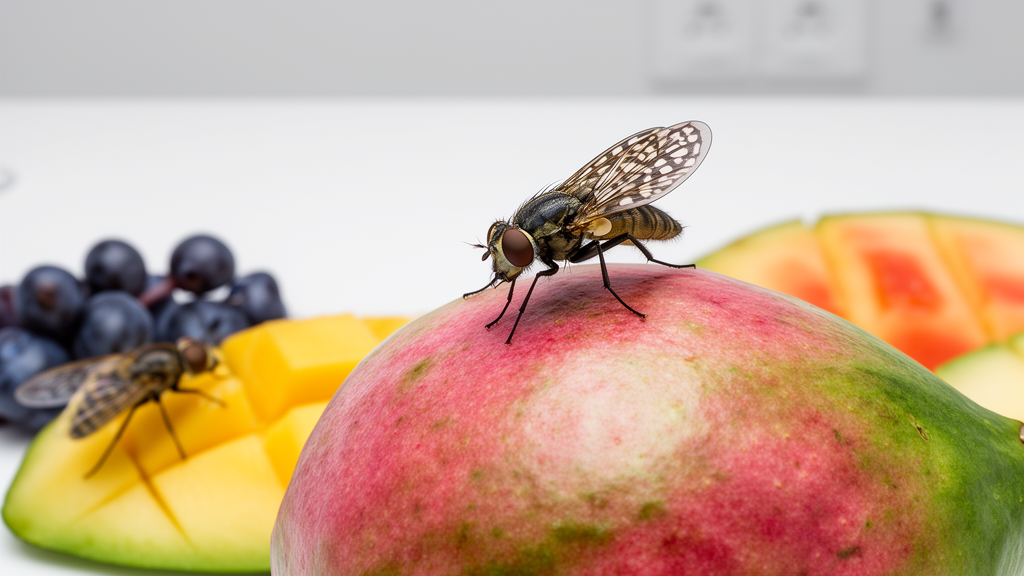
For a fruit fly mother, choosing where to lay her eggs is the single most consequential decision of her life. Her larvae cannot walk away from the fruit they hatch in; whatever that fruit offers—nutrients, toxins, moisture—defines their entire developmental world. A new study of the South American fruit fly, Anastrepha fraterculus, one of the continent’s most economically damaging agricultural pests, has now put that decision under the microscope with unusual thoroughness. The verdict is striking: there is no single best host. Every fruit species tested maximized some aspects of the fly’s life history while compromising others, a pattern of trade-offs that challenges long-standing assumptions about how polyphagous insects relate to their native host plants.
The research, conducted by a team of Argentine scientists at the National Institute of Agricultural Technology (INTA) and the National University of Tucumán, compared six host fruit species under controlled laboratory conditions: guava and feijoa, both native to South America, and grapefruit, peach, plum, and loquat, all introduced. The team reared fly larvae in each fruit and then measured an unusually comprehensive suite of traits spanning the entire life cycle: how long larvae took to reach pupation, how many pupae survived to adulthood, how large the resulting adults were, how well female ovaries developed, how quickly males reached sexual maturity, and how long adults survived without food.
The results, published in Frontiers in Insect Science, revealed that host species significantly affected every single trait measured. Guava, a native host and one of the fruits most heavily infested by this species in nature, supported the fastest larval development of all six fruits, with larvae pupating in just about 13 days. Grapefruit, by contrast, stretched development to nearly 30 days. Peach and feijoa fell in between at roughly 16 days, with loquat and plum taking around 19 to 21 days. On the surface, guava looks like the ideal nursery—fast development is generally considered a hallmark of host quality, because larvae that linger face greater exposure to predators, parasitoids, pathogens, and the vagaries of weather.
But the adult stage told a very different story. Flies reared in guava emerged as smaller adults, with shorter wings, reduced ovary development, and lower resistance to starvation. Females from guava also showed a higher proportion of atrophied, non-functional ovaries. Meanwhile, the exotic stone fruits—peach and plum—consistently produced the largest adults with the best-developed ovaries and the highest overall performance across multiple traits. Plum also conferred the greatest starvation tolerance, meaning that flies raised in this introduced host could survive longest without food. Loquat generally produced the poorest outcomes, yielding the smallest females, the smallest ovaries, and delayed male sexual maturation, although it did confer relatively good starvation resistance.
Some of the patterns were genuinely counterintuitive. Grapefruit, which forced the slowest larval development, nonetheless produced males that began their sexual calling behavior—the pheromone-releasing courtship display—earlier than males from any other host. Grapefruit females also showed no ovarian atrophy at all, and adult emergence from grapefruit was among the highest recorded. Feijoa, the other native Myrtaceae tested, behaved similarly to guava in supporting rapid development, but it had the lowest pupal survival of any fruit, with only about 17 percent of pupae reaching adulthood, even as it accelerated male sexual maturation. Each fruit, in other words, was a bundle of benefits and costs rather than a simple ranking of good and bad hosts.
To integrate these multidimensional results, the researchers built a heatmap of standardized trait values and performed a principal component analysis combining the biological data with published nutritional profiles of each fruit from the USDA nutrient database. The first two principal components explained roughly 71 percent of the total variance, and the analysis confirmed visually what the individual statistics implied: no fruit species sat at the optimum for all traits. Peach and plum overlapped almost completely in the PCA space, indicating similar nutritional and life-history profiles, while guava, grapefruit, and loquat each occupied distinct positions associated with different combinations of nutrients and performance outcomes.
The nutritional analysis added an intriguing layer of complexity. Guava had the highest protein, lipid, fiber, carbohydrate, and mineral content of all six fruits—on paper, it should have been the best host. Yet apart from fast development, guava performed poorly on nearly everything else. The authors suggest several non-exclusive explanations. Guava pulp contains phenolic compounds and tannins, potent anti-nutritional defenses that force developing larvae to divert metabolic energy into detoxification rather than growth. The ratio of sucrose to total phenolics in guava is dramatically lower than in peach, imposing a much heavier chemical burden. Guava’s high ash content may also disrupt osmotic balance and reduce nutrient absorption efficiency. Whatever the precise mechanism, the lesson is clear: macronutrient content alone cannot predict host quality, and the evolutionary history between insect and plant matters in ways that simple chemistry tables miss.
Perhaps the most provocative implication concerns the so-called mother-knows-best hypothesis, which holds that female insects preferentially oviposit on hosts that maximize their offspring’s fitness. Field surveys have long suggested that A. fraterculus predominantly infests native fruits, and guava and feijoa are among the most heavily attacked species in nature. Yet in the laboratory, these native hosts did not deliver superior offspring performance. The study’s authors are careful to note the caveats: laboratory conditions exclude many ecological factors—temperature fluctuations, desiccation risk, natural enemies, seasonal constraints—that shape host suitability in the real world, and field infestation levels are not always a direct proxy for female preference. Still, the results point toward a decoupling between where these flies lay their eggs and where their offspring actually thrive, a mismatch documented in other phytophagous insects as well.
One possible resolution, the researchers propose, is that different hosts are advantageous at different times. In temperate Argentina, native and exotic fruits ripen in different seasons, and a slow-developing larva inside a grapefruit may actually benefit when temperatures drop—citrus pulp stays moist for weeks and could even allow larvae to overwinter in place, a strategy documented in the Mediterranean fruit fly. Early-season hosts might favor rapid reproduction, while late-season hosts might enhance survival and stress tolerance. Under this view, no host is universally optimal because the demographic needs of the population shift across the year, and the very notion of a single best fruit dissolves into a seasonal mosaic of partial advantages.
Beyond its evolutionary interest, the work carries practical weight. A. fraterculus is actually a cryptic species complex, infests more than 177 reported host plant species, and triggers stringent quarantine restrictions that complicate fruit exports from South America. Understanding which hosts produce larger, more fecund, more stress-tolerant adults—and which merely produce fast ones—can improve predictions of pest population dynamics and sharpen integrated management strategies, from monitoring programs to sterile insect technique campaigns that depend on producing high-quality mass-reared flies. The study also flags clear priorities for future research: behavioral assays of oviposition preference paired with biochemical analyses of fruit chemistry, including secondary metabolites that current nutritional databases do not capture. For now, the message for anyone modeling this pest is sobering and liberating at once: the fruit fly’s world is not a ladder of better and worse fruits, but a landscape of trade-offs in which every host wins something and loses something else.
Subject of Research: Effects of host fruit species on larval development and adult life-history traits of the polyphagous pest Anastrepha fraterculus
Article Title: No single host is optimal: effects of fruit species on development and adult performance in Anastrepha fraterculus (Diptera: Tephritidae)
Article References: Pacelli, F., Ruiz, M. J., Devescovi, F., Nussenbaum, A. L., Garbalena, M. S., Bachmann, G. E., Milla, F. H., Vera, M. T., & Segura, D. F. (2026). No single host is optimal: effects of fruit species on development and adult performance in Anastrepha fraterculus (Diptera: Tephritidae). Frontiers in Insect Science, 6, Article 1832786. https://doi.org/10.3389/finsc.2026.1832786
Image Credits: AI Generated
DOI: 10.3389/finsc.2026.1832786
Keywords: Anastrepha fraterculus, Tephritidae, fruit flies, host plant use, life-history trade-offs, larval development, ovary development, sexual maturation, starvation resistance, polyphagy, pest management, entomology
Cite Scienmag News
Kennedy Frye. (October 18, 2026). No Perfect Fruit: South American Fruit Fly Reveals Life-History Trade-Offs Across Hosts. Scienmag. https://scienmag.com/no-perfect-fruit-south-american-fruit-fly-reveals-life-history-trade-offs-across-hosts/
Kennedy Frye. "No Perfect Fruit: South American Fruit Fly Reveals Life-History Trade-Offs Across Hosts." Scienmag, 18 October 2026, https://scienmag.com/no-perfect-fruit-south-american-fruit-fly-reveals-life-history-trade-offs-across-hosts/. Accessed 18 October 2026.
Kennedy Frye. "No Perfect Fruit: South American Fruit Fly Reveals Life-History Trade-Offs Across Hosts." Scienmag. October 18, 2026. https://scienmag.com/no-perfect-fruit-south-american-fruit-fly-reveals-life-history-trade-offs-across-hosts/


