


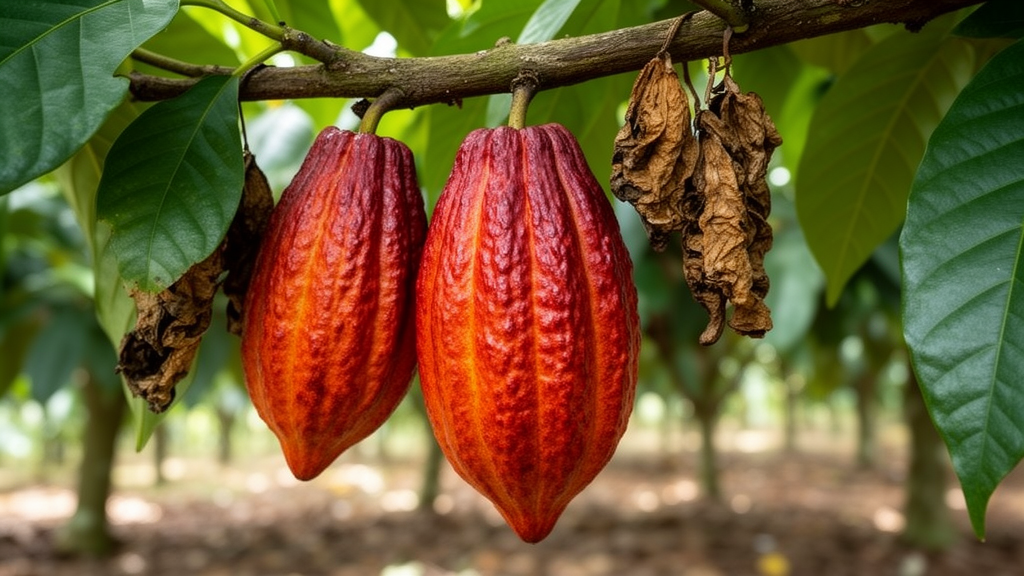
Cocoa trees are among the most prodigious flower producers in the plant kingdom, yet they are also among the most wasteful. A single mature tree can open thousands of small, pale blossoms directly on its trunk and main branches, a striking botanical habit known as cauliflory, but only a tiny fraction of those flowers, typically between 0.5 and 5 percent, ever develop into a pod. Even the young pods that do form face a second gauntlet: a physiological thinning process called cherelle wilt, in which developing fruits yellow, shrivel, blacken, and drop from the tree. For farmers in the humid tropics of India, where cocoa is increasingly grown as a profitable mixed crop beneath coconut, arecanut, and oil palm, this double attrition represents a fundamental constraint on yield. A new field study from India’s coconut and plantation crop research establishment now offers fresh insight into why some trees convert blossoms into beans far more efficiently than others, and it points to a single mineral nutrient as a surprising player in the process.
The research, conducted at the ICAR-Central Plantation Crops Research Institute’s Regional Station at Vittal in coastal Karnataka, set out to answer a deceptively simple question: how much of the variation in flowering, fruit set, and cherelle wilt is written into a tree’s genes, and how much is governed by the nutritional status of its leaves? The site could hardly be more typical of cocoa’s expanding frontier in Asia. Vittal sits at low elevation in a warm, humid coastal zone, receiving an average of 3,670 millimeters of rain each year, almost entirely concentrated between June and November, followed by a pronounced dry season from December through May. Temperatures in the study area ranged from a minimum of 21 degrees Celsius to a maximum of 36 degrees, with relative humidity fluctuating between 61 and 94 percent. Twenty cocoa genotypes, including released hybrids, their parental lines, and a set of upper Amazon clones, all grown as mixed crops with arecanut, formed the experimental material.
The measurement protocol was elegantly direct. On each tree, researchers marked a one-meter length of stem just below the jorquette, the point where the branches fork from the trunk, and counted every flower as it opened in that defined area. They then tracked which of those flowers set fruit, calculated a fruit set percentage for each genotype, and counted the resulting cherelles, separating healthy ones from those that wilted. To assess nutrition, the team sampled the second leaf of the last maturing flush on each tree, oven-dried the material to constant weight, and ran a full panel of elemental analyses: nitrogen by micro-Kjeldahl digestion, phosphorus by the vanado-molybdate colorimetric method, potassium by flame photometry, calcium, magnesium, iron, manganese, copper, and zinc by atomic absorption spectrophotometry, and boron by the azomethine-H method. The whole dataset, gathered across three replications of twenty genotypes, was subjected to standard analysis of variance and Pearson’s correlation statistics.
The results revealed a staggering spread in reproductive behavior across the twenty genotypes, even though all of them grew under the same climate, soil, and management. Flower counts on the marked one-meter stem section ranged from just 16 in the hybrid VTLCH 2 to 196 in the clone VTLC 05, a more than twelvefold difference. Fruit set, expressed as the raw number of flowers converting to fruit in the marked area, peaked at 13.7 in VTLC 05, statistically on par with several other high performers including VTLCC 1, VTLC 61, VTLC 185, VTLCH 1, VTLCH 4, and VTLC 151, while the clone VTLC 154 managed only a single fruit set. When fruit set was expressed as a percentage of opened flowers, the picture shifted in an instructive way: the top performer was VTLC 182 at 13.8 percent, a genotype that produced only 31 flowers in the marked area, while VTLC 30A languished at 1.3 percent despite producing 152 flowers.
That inversion between flower abundance and conversion efficiency is one of the most biologically interesting findings of the study. Several genotypes, including VTLC 05, VTLC 61, and VTLC 30A, produced between 152 and 196 flowers on the marked stem length yet achieved fruit set percentages of only 1.3 to 7 percent. The authors connect this pattern to the internal economics of flower production. Because flowering represents a considerable investment of plant resources, trees that pour resources into enormous flower crops may dilute the auxin supply available to each individual flower. Previous work has shown that endogenous auxin concentrations are significantly higher in clones that produce few flowers and lower in prolific flower producers, which would help explain why a modest-flowering genotype like VTLC 182 can outconvert a floral overachiever like VTLC 05 when it comes to actually setting pods.
Cherelle wilt, the second major source of yield loss, proved equally variable. Across the twenty genotypes, the proportion of cherelles lost to wilting ranged from 22.9 percent in the upper Amazon genotype VTLC 148 to a punishing 72.9 percent in the upper Amazon clone VTLC 155. The Nigerian clone VTLCC 1 produced the highest total number of cherelles at 132 and retained 66 healthy ones, while VTLC 150 held onto only 16 healthy cherelles from a modest crop. Notably, the study found a strong positive correlation, with a coefficient of 0.874, between the total number of cherelles a tree produced and the number that wilted. In other words, trees that set more fruit also lost more fruit, a pattern consistent with the long-standing interpretation of cherelle wilt as a self-thinning mechanism by which the tree adjusts its pod load to what its resources can actually support.
This interpretation is reinforced by earlier research the authors cite. Hand-pollinated cocoa trees, which set more pods than naturally pollinated ones, also suffer correspondingly higher levels of cherelle wilt, with the result that both categories of tree end up carrying roughly the same number of mature pods. Peaks of cherelle wilt also coincide with heavy leaf flushing, pointing to intense internal competition for photosynthates and mineral nutrients between the developing fruit and the expanding vegetative tissue. Leaf nutrient content in cocoa is known to decline during minor and major harvest periods, further implicating nutrient partitioning in the wilt phenomenon. Yet when the Indian team correlated cherelle wilting percentage against the full suite of leaf nutrients they measured, no significant association emerged, suggesting that the tree’s internal carbon and hormone economy, rather than leaf mineral levels alone, drives this thinning process.
The nutrient correlation analysis did, however, deliver one clear and actionable signal. Among all the elements tested, only calcium showed a significant positive association with fruit set percentage, with a Pearson correlation coefficient of 0.596. Nitrogen, phosphorus, potassium, magnesium, iron, manganese, zinc, copper, and boron all failed to reach statistical significance in their relationship with fruit set, despite the well-documented roles of phosphorus in stimulating cocoa flowering and boron in auxin metabolism and transport. The boron connection is particularly notable in the broader literature: boron deficiency has been shown to increase wilted cherelles, presumably by disrupting auxin movement within the developing fruit. But in this Indian dataset, under these specific soil and climatic conditions, calcium stood alone as the nutrient whose leaf concentration tracked with successful fruit set.
The significance of calcium fits with what is known about the demands of early fruit development. Calcium is essential for cell wall structure and cell division, and rapidly expanding young tissues such as newly set pods have high calcium requirements. Because calcium moves through the plant primarily in the transpiration stream and is relatively immobile once deposited, maintaining adequate leaf calcium levels may reflect a tree’s overall capacity to supply this structurally critical element to its developing fruit. For growers, the practical implication is straightforward: the study’s authors conclude that an optimum level of calcium should be maintained in the leaf to support better fruit setting in cocoa. In the coconut and arecanut gardens of coastal Karnataka and Kerala, where cocoa is rapidly becoming a favored intercrop, leaf nutrient analysis could become a routine diagnostic tool for identifying orchards where calcium nutrition is limiting pod set.
Beyond the nutrient finding, the study delivers a broader message for cocoa breeding and improvement programs in India and across the humid tropics. The existence of wide genotypic variation in flowering intensity, fruit set efficiency, and susceptibility to cherelle wilt, demonstrated here across twenty genotypes under identical conditions, gives breeders raw material to select for trees that convert flowers to pods efficiently rather than simply producing more blossoms. Genotypes such as VTLC 182, with its modest flower crop and exceptional 13.8 percent fruit set, and VTLC 148, with the lowest cherelle wilt at 22.9 percent, illustrate the kind of reproductive efficiency that future varieties could combine with high bean yield and quality. As global chocolate demand continues to rise and smallholder cocoa systems expand under shade trees across South and Southeast Asia, understanding the genetics and physiology of the flower-to-pod pipeline may prove just as important as fighting pests and diseases. This study shows that the answers lie partly in the tree’s genes and partly, quite literally, in its leaves.
Subject of Research: Genotypic variation in flowering, fruit set, and cherelle wilt and its relationship with leaf nutrient status in cocoa
Article Title: Genotypic variation in flowering, fruit set, and cherelle wilt, and their relationship with leaf nutrient status in cocoa ( Theobroma cacao L.) grown in humid tropics of India
Article References: Bhavishya, Bhat, R., Apshara, S. E., Pushpa, T. N., Prasad, D. S., Nayana, H., Thube, S. H., Pandian, R. T. P., & Ramesh, S. V. (2024). Genotypic variation in flowering, fruit set, and cherelle wilt, and their relationship with leaf nutrient status in cocoa (Theobroma cacao L.) grown in humid tropics of India. Innovations in Agriculture, 7, 1-5. https://doi.org/10.3897/ia.2024.124253
Image Credits: AI Generated
Keywords: cocoa, Theobroma cacao, fruit set, cherelle wilt, calcium, leaf nutrient status, genotypic variation, flowering, plantation crops, India, plant nutrition, agroforestry
Cite Scienmag News
Alan Morgan. (October 18, 2026). Calcium Holds the Key to Why Some Cocoa Trees Set Fruit and Others Fail. Scienmag. https://scienmag.com/calcium-holds-the-key-to-why-some-cocoa-trees-set-fruit-and-others-fail/
Alan Morgan. "Calcium Holds the Key to Why Some Cocoa Trees Set Fruit and Others Fail." Scienmag, 18 October 2026, https://scienmag.com/calcium-holds-the-key-to-why-some-cocoa-trees-set-fruit-and-others-fail/. Accessed 18 October 2026.
Alan Morgan. "Calcium Holds the Key to Why Some Cocoa Trees Set Fruit and Others Fail." Scienmag. October 18, 2026. https://scienmag.com/calcium-holds-the-key-to-why-some-cocoa-trees-set-fruit-and-others-fail/


