


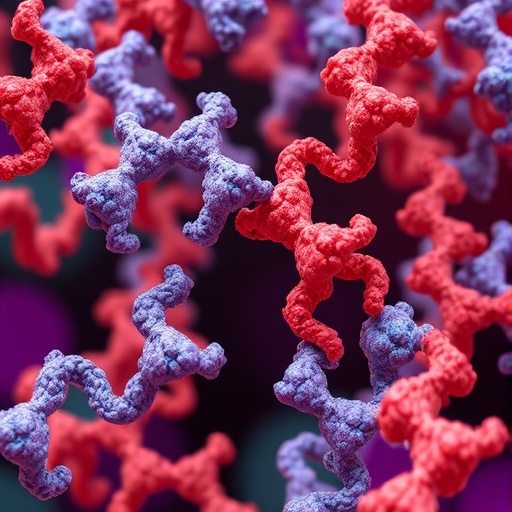
In a groundbreaking study recently published in Nature Chemistry, researchers have uncovered an extraordinary property of nucleoside diphosphate kinase A (NME1), a key enzyme historically recognized for its role in cellular nucleotide homeostasis. This enzyme, known for catalyzing the transfer of phosphate groups to nucleoside diphosphates, has now been shown to catalyze its own oligophosphorylation. This elusive biochemical phenomenon not only challenges prior assumptions about kinase activity but also unveils a novel layer of enzymatic regulation that could revolutionize our understanding of intracellular signaling and protein modification dynamics.
NME1, a highly conserved protein implicated in numerous cellular processes including signal transduction, metastasis suppression, and energy metabolism, has long been studied for its canonical function of phosphoryl transfer. However, the discovery that it possesses the capability to transfer phosphate groups onto its own residues, effectively oligophosphorylating itself, introduces a paradigm-shifting concept that enzymes may self-modify in complex, iterative fashions. This oligophosphorylation event appears to modulate NME1’s activity, stability, and interaction networks, suggesting feedback mechanisms previously unappreciated in kinase biology.
The study employed a suite of sophisticated biochemical and biophysical techniques including mass spectrometry, nuclear magnetic resonance spectroscopy, and cryo-electron microscopy to delineate the molecular underpinnings of NME1’s auto-oligophosphorylation. These methods allowed the investigators to map the precise phosphorylated residues and confirm the formation of polyphosphate chains in cis, firmly establishing that NME1 acts as both an effector and a substrate for its own enzymatic function. The meticulous structural characterization revealed that oligophosphorylation induces conformational shifts that stabilize specific oligomeric states of the enzyme, potentially fine-tuning its biochemical repertoire.
The implications of NME1’s self-modification extend far beyond a mere biochemical curiosity. Given that oligophosphorylation is a rare post-translational modification with distinct chemical and functional properties from simple phosphorylation, this discovery opens avenues for re-examining signaling cascades and protein regulation in broader cellular contexts. It challenges the dogma that kinases solely modify other proteins and posits that self-modification at higher phosphate states could regulate catalytic turnover and substrate specificity.
Intriguingly, NME1’s ability to autophosphorylate on multiple adjacent sites with polyphosphate chains hints at a form of molecular memory or a tunable regulatory “code.” This biochemical plasticity could enable the enzyme to integrate various cellular signals and adjust its function dynamically in response to fluctuations in nucleotide pools or cellular stress conditions. Such a mechanism may be critical in contexts where NME1 plays roles, including developmental processes, stress response, and pathological states such as cancer metastasis and neurodegeneration.
By elucidating the kinetics and structural basis of oligophosphorylation, the researchers provide compelling evidence that the phosphotransferase reaction can propagate across extended phosphate chains, a feature that might be harnessed by cells to control the amplitude and duration of signaling events. This self-catalyzed oligophosphorylation is reminiscent of other post-translational modifications, such as polyubiquitination, that regulate diverse aspects of protein fate, opening speculative lines of inquiry into ubiquitin-like signaling pathways governed by phosphate chain assembly.
From a mechanistic standpoint, the auto-oligophosphorylation phenomenon necessitates reconsideration of classical enzyme-substrate paradigms. It suggests an intrinsic catalytic versatility in kinases like NME1, which can utilize transiently activated intermediate states to self-assemble regulatory phospho-oligomers. This property may be evolutionarily conserved to optimize functional adaptability in fluctuating environments, enabling rapid, reversible modulation of enzyme complexes without reliance on external kinases or phosphatases.
Methodologically, the work also highlights advances in instrumentation and analytical frameworks required to detect and characterize polyphosphate modifications in proteins, which have traditionally been challenging due to their labile and heterogeneous nature. The use of enhanced mass spectrometry fragmentation techniques combined with isotope labeling allowed unambiguous differentiation between mono- and oligophosphorylation patterns, paving the way for future discovery of similar modifications in other protein systems.
The broader biological consequences of NME1 self-oligophosphorylation are likely profound. Given NME1’s known involvement in metastasis suppression, its oligophosphorylated states may alter its interactions with cellular partners, influencing signaling pathways that regulate tumor progression and cellular motility. Moreover, dysregulation of oligophosphorylation could represent a previously unappreciated mechanism in disease pathology, highlighting potential targets for pharmacological intervention.
Importantly, this discovery inspires a variety of questions about the cellular machinery controlling phosphate chain length and turnover on proteins like NME1. Are there dedicated phosphatases that reverse oligophosphorylation? How do cells sense and interpret these modifications to effect downstream responses? Could synthetic modulation of protein oligophosphorylation states be therapeutically viable? These inquiries present fertile grounds for future investigation.
This study also invites a broader reconsideration of nucleotide diphosphate kinase family members and other kinases for latent heretofore-undetected self-oligophosphorylation activities. If such mechanisms are widespread, they could reshape our current understanding of kinase-driven regulatory networks and the diverse chemical landscapes of cellular signaling.
The discovery of NME1’s self-oligophosphorylation thus represents a landmark advance in molecular enzymology, biochemistry, and cell biology. It challenges conventional wisdom, offers new mechanistic insights into kinase function, and heralds a new era in research centered on complex protein phosphorylation landscapes. Given the ubiquity of phosphorylation in biology, this could open novel pathways toward targeted drug development and biomolecular engineering.
As the scientific community digests these findings, the potential ripple effects span from synthetic biology to precision medicine. Leveraging NME1’s auto-catalytic abilities might allow the design of novel enzyme systems with tunable phosphorylation states for biotechnological applications. Clinically, understanding how oligophosphorylation modulates protein function could unearth biomarkers and therapeutic targets for diseases where NME1’s role is critical.
In summary, the revelation that NME1 catalyzes its own oligophosphorylation marks a transformative moment in biochemical research. This self-regulatory modification offers fresh insights into the complexity of intracellular enzyme control and uncovers a new dimension in kinase biology that promises to catalyze further innovation and discovery across multiple scientific disciplines.
Cite Scienmag News
Bethany Barker. (August 22, 2025). NME1 Enzyme Catalyzes Its Own Oligophosphorylation. Scienmag. https://scienmag.com/nme1-enzyme-catalyzes-its-own-oligophosphorylation/
Bethany Barker. "NME1 Enzyme Catalyzes Its Own Oligophosphorylation." Scienmag, 22 August 2025, https://scienmag.com/nme1-enzyme-catalyzes-its-own-oligophosphorylation/. Accessed 6 September 2026.
Bethany Barker. "NME1 Enzyme Catalyzes Its Own Oligophosphorylation." Scienmag. August 22, 2025. https://scienmag.com/nme1-enzyme-catalyzes-its-own-oligophosphorylation/


