

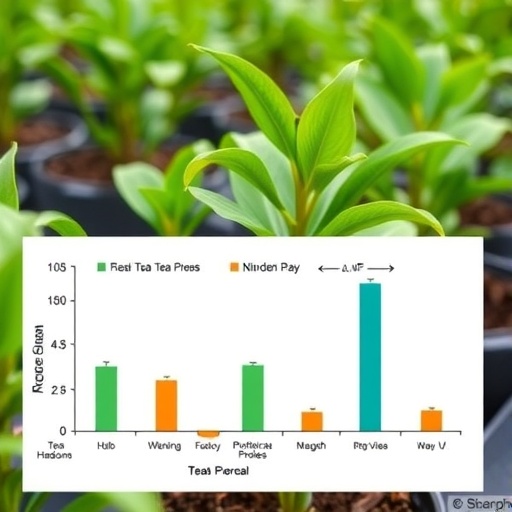
In a groundbreaking study poised to transform our understanding of tea cultivation and quality, researchers from South China Agricultural University have unveiled intricate molecular adaptations that tea plants undergo under nitrogen-deficient conditions. Traditionally, nitrogen has been recognized as a pivotal nutrient influencing plant growth and metabolite synthesis, but this new research reveals its deficiency does not merely stunt growth; it triggers a sophisticated reprogramming of metabolism that prioritizes survival over flavor.
Nitrogen, an essential macronutrient, underpins fundamental physiological processes in Camellia sinensis, including photosynthesis, growth, and the biosynthesis of key quality determinants like theanine, caffeine, and catechins. Prior investigations have extensively explored the root-level physiological responses to nitrogen scarcity, noting alterations in root architecture and amino acid metabolism. However, the novel focus on fresh tea shoots—primary components harvested for beverage production—unveils how nitrogen limitation strikingly reshapes the chemical landscape integral to tea’s sensory profile.
The research team spearheaded by Shaoqun Liu and Peng Zheng employed a multifaceted experimental framework involving hydroponic cultivation of two-year-old clonal tea plants subjected to nitrogen-free nutrient solutions for intervals extending up to 30 days. They integrated physiological data, volatile compound analyses via gas chromatography-mass spectrometry (GC-MS), high-throughput metabolomic profiling by ultra-performance liquid chromatography-tandem mass spectrometry (UPLC-MS/MS), and transcriptomic sequencing. This comprehensive approach illuminated temporal metabolic shifts and gene expression dynamics underpinning nitrogen stress responses.
Remarkably, the nitrogen content within tea shoots declined precipitously in the early stages of treatment, paralleled by a significant increase in the carbon-to-nitrogen (C/N) ratio. This alteration signifies a strategic reallocation of internal resources, prioritizing carbon-rich compounds potentially linked to structural integrity and defense. Concurrently, chlorophyll levels diminished, concordant with compromised photosynthetic capacity, yet carotenoid concentrations surged at later stages, ostensibly providing photoprotective benefits during stress.
In terms of flavor constituents, the team documented a profound diminution in theanine content by approximately 66.67% at the terminal sampling point, accompanied by reductions in caffeine and total catechin levels. These biochemical changes recalibrate the phenol-to-amino acid ratio, inducing a shift that could substantially affect the umami and bitterness balance that aficionados prize in high-quality tea. Complementary modifications in volatile profiles were also noted, with aldehydes such as (E)-2-hexenal and decanal markedly accumulating, conferring intensified “green” sensory notes, while key floral aroma compounds linalool and geraniol receded, suggesting a discernible alteration in olfactory characteristics.
Central to these metabolic transitions were dramatic elevations in stress-related metabolites, exemplified by jasmonoyl-L-isoleucine (JA-Ile) increasing over 20-fold, luteolin augmenting approximately eightfold, and gamma-aminobutyric acid (GABA) tripling in concentration. These molecules are well-documented mediators of plant defense and stress adaptation pathways, underscoring the notion that nitrogen deprivation activates a complex defense network rather than simply causing nutritional starvation.
From a molecular perspective, weighted gene co-expression network analysis identified pivotal transcription factor modules that orchestrate these metabolic reroutings. The study pinpointed bZIP11, bZIP23, and bHLH149 as central regulators interfacing with metabolic enzymes such as hydroxycinnamoyl-CoA shikimate/quinate hydroxycinnamoyltransferase (HCT) for luteolin biosynthesis. Similarly, a regulatory axis involving bZIPs, bHLH149, MYC2, and JAZ proteins appears to facilitate JA-Ile synthesis. Furthermore, a distinct network comprising RAV2, bZIP53, and ATH7 connects with asparagine synthetase (ASNS) to enhance GABA production.
Collectively, these findings articulate a scenario wherein tea shoots strategically suppress pathways linked to growth and flavor compound biosynthesis in favor of reallocating metabolic flux towards the generation of defense metabolites. This reprogramming likely confers resilience against abiotic stresses associated with nitrogen deficiency and reestablishes homeostasis under nutrient-limited conditions.
Beyond scientific insight, this study carries significant agricultural implications. Understanding how nitrogen scarcity modifies tea quality and defense opens avenues for developing tea cultivars with refined nitrogen-use efficiencies and stable organoleptic properties, a critical goal in the context of sustainable, low-input agricultural paradigms. It also informs fertilization strategies that balance productivity with quality retention under fluctuating soil nutrient profiles.
The integration of metabolomic and transcriptomic datasets exemplifies a powerful systems biology approach, revealing seamless coordination between gene expression shifts and metabolite accumulation. The temporal dimension of this research—tracking dynamics across 0, 7, 15, and 30 days—highlights that nitrogen deficiency induces a phased acclimation rather than abrupt metabolic collapse, offering potential windows for agronomic intervention.
This pioneering work has been published in the journal Beverage Plant Research (DOI: 10.48130/bpr-0025-0041), where it stands as a seminal contribution elucidating the metabolic and genetic basis of quality modulation under nutrient stress in tea plants. The research was supported by the Innovative Team Construction Project of the Modern Agricultural Industrial Technology System in Guangdong Province, underscoring regional commitment to advancing tea science.
As global demand for tea continues to escalate alongside environmental challenges, such studies will be instrumental in guiding breeding programs and cultivation practices. By deciphering the molecular strategies tea plants utilize to navigate nitrogen deficit, we gain tools to engineer resilience and maintain beverage quality in the face of resource constraints, ultimately benefiting producers, consumers, and ecosystems alike.
Subject of Research: Not applicable
Article Title: Metabolic and transcriptome analysis reveals metabolite variation in fresh shoots of tea (Camellia sinensis ‘Lingtou Dancong’) under nitrogen-deficient conditions
News Publication Date: 16-Mar-2026
References:
DOI: 10.48130/bpr-0025-0041
Keywords: Agriculture, Plant sciences, Biochemistry


