


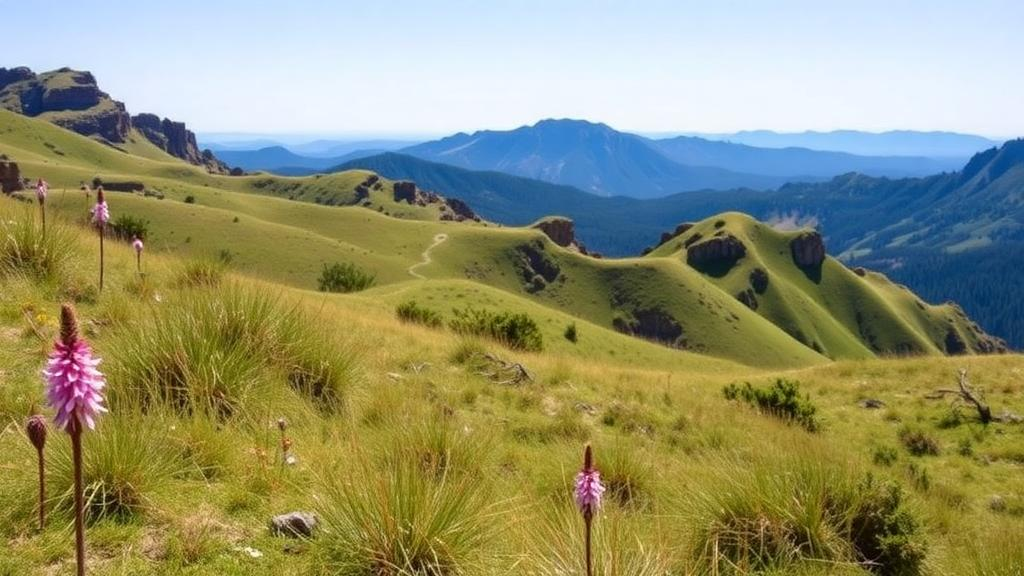
A comprehensive analysis of 399 vegetation plots across Poland’s Sudetes Mountains and their foothills identified nine associations of tall-herb plant communities, revealing two broad ecological divisions across an elevation gradient. Communities along streams at lower and middle elevations contained many nitrophilous and woodland species, while communities above the main forest zone were dominated by alpine, subalpine and acidophilic plants. The regional study found that measured environmental variables explained a limited part of the overall compositional variation, with elevation, slope, heat load and bedrock jointly accounting for 13.5% of the total in a distance-based redundancy analysis.
Its results provide a local classification that may inform, but cannot by itself revise, the wider European syntaxonomy of the Mulgedio-Aconitetea . The study combined 212 vegetation plots sampled by the authors between 1991 and 2020 with 187 records obtained from published studies, the Polish Vegetation Database and other sources. The sampled area covered the approximately 300-kilometre-long Sudetes range and its foothills, extending from 240 to 1,400 metres above sea level.
Original plots varied from 5 to 60 square metres, with a mean area of 21.5 square metres, and were located on stream terraces, stream banks and in tall-herb mires. Sampling was not evenly balanced among the vegetation types: some associations were represented by dozens of records, while Poo chaixii-Deschampsietum cespitosae had only 12 relevés. Researchers excluded plots with more than 30% shrub cover, merged records of the same species in different vegetation layers and omitted bryophytes because those were recorded in only part of the plots.
The researchers applied a Braun–Blanquet approach to recording plant cover and used a modified TWINSPAN algorithm in JUICE to divide the records into clusters. They then evaluated those clusters through expert assessment and the Phi coefficient, which measures how strongly species are concentrated in particular groups. A species was classified as diagnostic only if it met thresholds for fidelity, constancy, concentration and statistical significance, including Phi of at least 0.25, constancy of at least 20%, a constancy ratio of at least 1.3 and Fisher’s exact-test significance at p below 0.05.
The resulting terminal clusters were interpreted as previously described associations and placed within the higher ranks of the EuroVegChecklist. That placement, especially the selection of four orders and one alliance in each, involved expert judgment rather than a direct numerical determination of the European hierarchy. Environmental interpretation relied on elevation, slope, heat load and six broad categories of bedrock derived from a detailed geological map.
The bedrock categories included Quaternary Pleistocene and Holocene deposits, metamorphic rocks, plutonic rocks, sandstones and calcicolous rocks. They also used principal coordinates analysis, based on a square-root Jaccard distance matrix, to explore compositional differences, and permutation tests to examine relationships between ordination axes and indicator values. A distance-based redundancy analysis then tested the contribution of the measured topographic, thermal and geological variables.
Four of the nine associations were assigned to the order Petasito-Chaerophylletalia and alliance Petasition officinalis . Geranio phaei-Urticetum dioicae , represented by 33 plots, occurred from 200 to 750 metres above sea level, mainly on stream terraces over Quaternary deposits and often in openings associated with nitrophilous alluvial forests. Its diagnostic species included Geranium phaeum , Alliaria petiolata , Chaerophyllum aromaticum , Geum urbanum and Glechoma hederacea ; Urtica dioica was constant in the association but was not among the listed diagnostic species.
Petasitetum hybridi , represented by 59 plots, occupied open, sunny riparian clearings in stream valleys over Holocene deposits at 300–964 metres. Chaerophyllo hirsuti-Petasitetum albi , the most frequently sampled association with 74 plots, extended from 375 to 995 metres and was characterized by Petasites albus , Carex sylvatica , Impatiens noli-tangere and other woodland-associated plants. Prenanthetum purpureae , based on 51 plots, was more strongly associated with acidic beech and spruce forests at higher elevations.
The other five associations occupied generally higher, cooler and more open habitats. Rumicetum alpini comprised 20 plots at 840–1,190 metres, chiefly on granite in the Karkonosze Mountains, including disturbed sites near mountain hostels and abandoned pastures. Poo chaixii-Deschampsietum cespitosae was represented by only 12 relevés from wet meadows, spring zones and stream margins, a limited sample that restricted confidence in its regional delimitation.
The subalpine Crepido conyzifoliae-Calamagrostietum villosae accounted for 61 plots in the Karkonosze and included characteristic acidophilic plants such as Calluna vulgaris , Deschampsia cespitosa and Nardus stricta . Athyrietum filicis-feminae , represented by 59 plots, combined montane and subalpine species on granite slopes and metamorphic substrates. The ninth association, Cicerbitetum alpinae , was confined to high granite sites in the Karkonosze and contained Adenostyles alliariae , Aconitum plicatum , Lactuca alpina and other characteristic alpine plants.
Principal coordinates analysis revealed substantial overlap among several lower-elevation associations, particularly Geranio phaei-Urticetum dioicae with Petasitetum hybridi , and Chaerophyllo hirsuti-Petasitetum albi with Prenanthetum purpureae and Poo chaixii-Deschampsietum cespitosae . The three high-altitude associations were more clearly separated from one another. The first two ordination axes explained 8.8% and 4.2% of compositional variability.
The first axis was negatively correlated with indicator values for temperature, soil reaction and nutrients. The second correlated positively with light, and the third with moisture. A separate permutational analysis found that temperature was the only Ellenberg factor that significantly differentiated the nine associations as a whole; the other factors did not show significant overall separation in that analysis.
The redundancy analysis indicated that the measured geographic and geological predictors together explained 13.5% of total variation in species composition, with an adjusted value of 10.3%. Elevation produced the largest simple effect, accounting for 7.7%, and remained significant when the other variables were treated as covariates. Plutonic rocks had the next-largest simple effect, at 6.7%, exceeding the 4.7% simple effect of slope; heat load accounted for 1.8%, calcicolous rocks for 2.8%, Holocene deposits for 2.6%, metamorphic rocks for 1.2% and sandstones for 0.7%.
After adjustment, plutonic rocks, slope, calcicolous rocks, heat load and metamorphic rocks retained significant conditional effects, while Holocene deposits and sandstones did not. These results associate community composition with elevation, topography and substrate, while the low total explained variation cautions against treating any one measured factor as a complete explanation. Earlier monitoring discussed by the authors provides evidence of a separate, long-term ecological concern in the Karkonosze.
A published comparison reported that mean species richness in tall-grass plots declined from 21.8 to 13.7 between data collected in the 1970s and later observations, with complete losses including Aconitum plicatum , Lactuca alpina and Potentilla aurea . Another study reported a 28% reduction in the total number of species within 10 permanent plots. The authors of those studies linked the impoverishment to excessive atmospheric nitrogen deposition, measured at 1,138 milligrams per square metre per year, and to expansion of Calamagrostis villosa and Avenella flexuosa .
These were previously published findings rather than a new experimental test conducted by the present study, and they should not be confused with the statistical analysis of the 399 plots assembled for the regional classification. The proposed regional scheme placed four lower and middle-elevation associations in Petasito-Chaerophylletalia , Rumicetum alpini in Senecioni rupestris-Rumicetalia alpini , three associations in Calamagrostietalia villosae and Cicerbitetum alpinae in Adenostyletalia alliariae . This arrangement followed the EuroVegChecklist but differed from the synthesis of Michl and colleagues, which placed several of the communities within a single order and alliance.
The researchers noted that separating Mulgedio-Aconitetea from neighbouring classes requires analysis across a much wider European or Central European area, particularly at lower elevations where communities of Epilobietea angustifolii and Artemisietea vulgaris may contain similar diagnostic species. Limited samples for two associations and the regional extent of the dataset restrict firm conclusions. Broader syntheses are therefore needed to determine whether the observed two-part ecological pattern is peculiar to the Sudetes or should alter the general European classification.
Subject of Research: Regional vegetation classification of tall-herb plant communities in the Sudetes Mountains of Poland
Article Title: Diversity of Mulgedio-Aconitetea communities in the Sudetes Mts. (SW Poland) in the Central European context
Article References: Świerkosz, K., & Reczyńska, K. (2022). Diversity of Mulgedio-Aconitetea communities in the Sudetes Mts. (SW Poland) in the Central European context. Vegetation Classification and Survey, 3, 67-86. https://doi.org/10.3897/vcs.70200
Image Credits: AI Generated
DOI: 10.3897/VCS.70200
Keywords: Sudetes Mountains, plant communities, Mulgedio-Aconitetea, phytosociology, vegetation plots, elevation gradient, bedrock ecology, tall-herb vegetation, alpine flora, Diversity, communities, Sudetes
Cite Scienmag News
Violet Maxwell. (October 20, 2026). Nine plant associations map Sudetes tall-herb diversity across elevation and geology. Scienmag. https://scienmag.com/nine-plant-associations-map-sudetes-tall-herb-diversity-across-elevation-and-geology/
Violet Maxwell. "Nine plant associations map Sudetes tall-herb diversity across elevation and geology." Scienmag, 20 October 2026, https://scienmag.com/nine-plant-associations-map-sudetes-tall-herb-diversity-across-elevation-and-geology/. Accessed 20 October 2026.
Violet Maxwell. "Nine plant associations map Sudetes tall-herb diversity across elevation and geology." Scienmag. October 20, 2026. https://scienmag.com/nine-plant-associations-map-sudetes-tall-herb-diversity-across-elevation-and-geology/


