


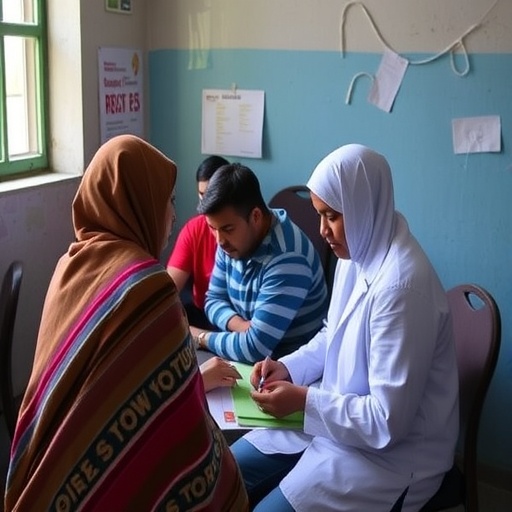
In the labyrinth of modern healthcare systems, access to medical services is often predicated on possessing the correct documentation—a reality that starkly marginalizes undocumented migrants worldwide. In the Netherlands, a country celebrated for its advanced healthcare infrastructure yet confronted with complex immigration challenges, this dynamic creates a unique and pressing issue. The recent qualitative study by Hanssen and Yerkes, published in the International Journal for Equity in Health, sheds new light on how non-governmental organizations (NGOs) operate as vital mediators to bridge this critical gap, ensuring undocumented migrants receive needed healthcare despite systemic barriers.
The study underscores a paradoxical truth: While health is an unequivocal indicator of human capital and societal wealth, the currency to unlock these services is often bureaucratic documentation—papers that many undocumented migrants simply cannot obtain. This disconnect situates NGOs not merely as service providers but as essential advocates and facilitators of healthcare equity in an environment where legal status dictates the breadth of care one can access. By diving deep into the experiences of both migrants and NGO workers, the research unravels the multifaceted strategies these organizations deploy to circumvent red tape.
The researchers engage a comprehensive qualitative approach, utilizing in-depth interviews and participant observation to capture the nuanced realities faced by undocumented migrants seeking healthcare. Their methodology honors the complexity of lived experiences beyond mere statistics, providing rich, contextual understanding. This immersive approach reveals the everyday negotiations and hurdles that refugees and undocumented workers endure, often navigating labyrinthine healthcare systems that are structurally predisposed to exclude them.
Central to the narrative is how NGOs embrace a dual function: they are both translators of the healthcare system and advocates in legal and policy arenas. The study details how NGO workers invest immense effort in educating migrants about their rights and available services while simultaneously lobbying for policy reforms. This ambivalence between immediate care facilitation and systemic change advocacy reflects the NGO community’s profound commitment to reshaping healthcare accessibility for marginalized populations.
One pivotal technical challenge exposed is the fragmentation of healthcare entitlements within Dutch law. Undocumented migrants often qualify only for emergency care under statutory provisions, with elective or preventive treatment remaining inaccessible. While the law’s intent is to prioritize urgent health threats, this approach inadvertently relegates many migrants to a state of chronic vulnerability, where treatable conditions can escalate unchecked. NGOs work tirelessly to provide referrals, financial assistance, and sometimes direct care to mitigate these consequences.
Hanssen and Yerkes also detail the legal ambiguities around patient confidentiality and data privacy, which further complicate service provision. Fear of detection and deportation dissuades undocumented migrants from seeking care, underscoring the critical trust building that NGOs must undertake. The research captures how organizations employ culturally sensitive communication strategies, confidentiality assurances, and safe spaces to encourage healthcare engagement, often acting as the only accessible point of contact within formal systems.
The study expands on the operational logistics of these NGOs, including partnerships with clinics, mobile health units, and volunteer medical professionals. Through these mechanisms, NGOs orchestrate a patchwork of healthcare access points, each addressing specific gaps in coverage. This decentralized model, while innovative, also highlights systemic inadequacies and reflects a healthcare ecosystem reliant on the goodwill and improvisation of civil society rather than coherent public policy.
From a technical perspective, the authors analyze the funding streams and resource allocation, illuminating how NGOs struggle with financial sustainability. Many organizations depend on short-term grants or donations with fluctuating availability, impeding long-term strategic planning. This precariousness threatens the continuity and quality of healthcare services, illustrating the broader vulnerability of reliance on non-state actors in fulfilling essential social functions.
Furthermore, the research engages with the psychological and social dimensions of healthcare access for undocumented migrants. Beyond physical ailments, access—or lack thereof—to medical care deeply influences migrants’ mental health, social integration, and trust in public institutions. The study reveals how NGOs address these interconnected challenges through holistic care models incorporating psychological support and social services, thereby promoting overall well-being rather than isolated clinical interventions.
Crucially, the authors situate their findings within a global and policy-oriented context, recognizing that the Dutch experience epitomizes broader trends in Europe and beyond. They argue for the urgent need to disentangle legal residency from healthcare entitlement, proposing reforms that guarantee universal health coverage irrespective of documentation status. This argument challenges entrenched policy paradigms and invites a reevaluation of health as a fundamental human right rather than a privilege contingent on legal identity.
The research also contributes methodologically to public health scholarship by illustrating the power of qualitative inquiry in illuminating marginalized voices often absent from quantitative datasets. By prioritizing lived experiences, Hanssen and Yerkes offer a compelling case for inclusive research frameworks that can inform evidence-based policymaking attuned to social justice imperatives.
In essence, this study acts as both a call to action and a blueprint for enhancing healthcare equity. It challenges governments, policymakers, and healthcare providers to reconsider the exclusionary effects of documentation requirements and to acknowledge the indispensable role NGOs play in safeguarding health rights within precarious populations. The findings emphasize that true health equity demands systemic restructuring alongside targeted support for frontline organizations.
The implications of this work resonate beyond the Netherlands, touching on universal questions of migration, human rights, and social determinants of health. By foregrounding the experiences of undocumented migrants and the NGOs that serve them, the research fosters a deeper understanding of how health systems can either perpetuate inequality or serve as instruments of inclusion.
As migration trends persist and global health challenges evolve, studies like this provide an empirical foundation for policies that recognize the intrinsic value of every human life. In a world increasingly defined by mobility yet constrained by borders, ensuring equitable healthcare access is not just a medical or legal challenge but a profound moral imperative.
The study by Hanssen and Yerkes thus emerges as a seminal contribution to health equity literature, blending rigorous qualitative methods with passionate advocacy. It highlights the dynamic interplay between policy, practice, and lived reality, urging a reconsideration of how societies conceive healthcare entitlement in the face of global migration pressures.
Ultimately, the research points to a future where NGOs, policymakers, and communities collaborate more effectively to dismantle barriers, redistribute resources, and create a healthcare landscape inclusive of the most vulnerable. It is a nuanced reminder that health systems are only as just as the margins they accommodate and that documents should facilitate, not obstruct, the universal currency of life — access to health.
Hanssen, I.R.M., Yerkes, M.A. Health is wealth and documents are the currency: exploring the role of NGOs in facilitating healthcare access for undocumented migrants in the Netherlands – a qualitative study. Int J Equity Health 24, 219 (2025). https://doi.org/10.1186/s12939-025-02594-0
Cite Scienmag News
Courtney Benton. (August 11, 2025). NGOs Bridging Healthcare Gaps for Undocumented Migrants. Scienmag. https://scienmag.com/ngos-bridging-healthcare-gaps-for-undocumented-migrants/
Courtney Benton. "NGOs Bridging Healthcare Gaps for Undocumented Migrants." Scienmag, 11 August 2025, https://scienmag.com/ngos-bridging-healthcare-gaps-for-undocumented-migrants/. Accessed 4 September 2026.
Courtney Benton. "NGOs Bridging Healthcare Gaps for Undocumented Migrants." Scienmag. August 11, 2025. https://scienmag.com/ngos-bridging-healthcare-gaps-for-undocumented-migrants/


