


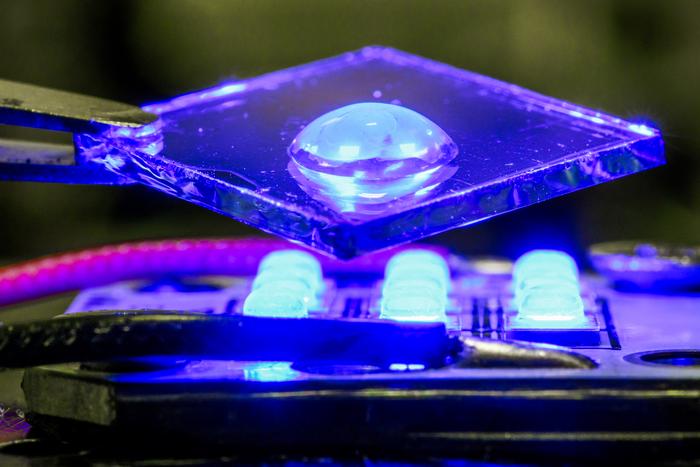
Semiconductors are the foundation of all modern electronics. Now, researchers at Linköping University, Sweden, have developed a new method where organic semiconductors can become more conductive with the help of air as a dopant. The study, published in the journal Nature, is a significant step towards future cheap and sustainable organic semiconductors.

Credit: Thor Balkhed
Semiconductors are the foundation of all modern electronics. Now, researchers at Linköping University, Sweden, have developed a new method where organic semiconductors can become more conductive with the help of air as a dopant. The study, published in the journal Nature, is a significant step towards future cheap and sustainable organic semiconductors.
“We believe this method could significantly influence the way we dope organic semiconductors. All components are affordable, easily accessible, and potentially environmentally friendly, which is a prerequisite for future sustainable electronics,” says Simone Fabiano, associate professor at Linköping University.
Semiconductors based on conductive plastics instead of silicon have many potential applications. Among other things, organic semiconductors can be used in digital displays, solar cells, LEDs, sensors, implants, and for energy storage.
To enhance conductivity and modify semiconductor properties, so-called dopants are typically introduced. These additives facilitate the movement of electrical charges within the semiconductor material and can be tailored to induce positive (p-doping) or negative (n-doping) charges. The most common dopants used today are often either very reactive (unstable), expensive, challenging to manufacture, or all three.
Now, researchers at Linköping University have developed a doping method that can be performed at room temperature, where inefficient dopants such as oxygen are the primary dopant, and light activates the doping process.
“Our approach was inspired by nature, as it shares many analogies with photosynthesis, for example. In our method, light activates a photocatalyst, which then facilitates electron transfer from a typically inefficient dopant to the organic semiconductor material,” says Simone Fabiano.
The new method involves dipping the conductive plastic into a special salt solution – a photocatalyst – and then illuminating it with light for a short time. The duration of illumination determines the degree to which the material is doped. Afterwards, the solution is recovered for future use, leaving behind a p-doped conductive plastic in which the only consumed substance is oxygen in the air.
This is possible because the photocatalyst acts as an “electron shuttle”, taking electrons or donating them to material in the presence of sacrificial weak oxidants or reductants. This is common in chemistry but has not been used in organic electronics before.
“It’s also possible to combine p-doping and n-doping in the same reaction, which is quite unique. This simplifies the production of electronic devices, particularly those where both p-doped and n-doped semiconductors are required, such as thermoelectric generators. All parts can be manufactured at once and doped simultaneously instead of one by one, making the process more scalable,” says Simone Fabiano.
The doped organic semiconductor has better conductivity than traditional semiconductors, and the process can be scaled up. Simone Fabiano and his research group at the Laboratory of Organic Electronics showed earlier in 2024 how conductive plastics could be processed from environmentally friendly solvents like water; this is their next step.
“We are at the beginning of trying to fully understand the mechanism behind it and what other potential application areas exist. But it’s a very promising approach showing that photocatalytic doping is a new cornerstone in organic electronics,” says Simone Fabiano, a Wallenberg Academy Fellow.
Journal
Nature
Article Title
Photocatalytic doping of organic semiconductors
Article Publication Date
15-May-2024
COI Statement
Wenlong Jin, Chi-Yuan Yang, and Simone Fabiano have applied for patents based on the work in the study, and the latter two are founders of n-Ink AB, a spinout of Linköping University.
Cite Scienmag News
Denise Maddox. (May 15, 2024). Next-generation sustainable electronics are doped with air. Scienmag. https://scienmag.com/next-generation-sustainable-electronics-are-doped-with-air/
Denise Maddox. "Next-generation sustainable electronics are doped with air." Scienmag, 15 May 2024, https://scienmag.com/next-generation-sustainable-electronics-are-doped-with-air/. Accessed 4 September 2026.
Denise Maddox. "Next-generation sustainable electronics are doped with air." Scienmag. May 15, 2024. https://scienmag.com/next-generation-sustainable-electronics-are-doped-with-air/

