


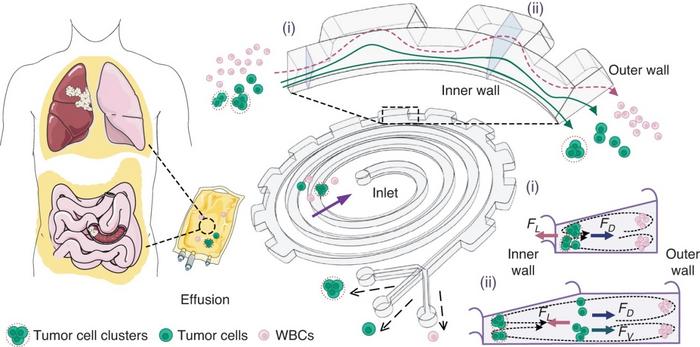
Researchers have unveiled a microfluidic device that significantly improves the separation of tumor cells and clusters from malignant effusions. This novel technology promises to advance the diagnosis and treatment monitoring of cancer by enabling the high-throughput, continuous-flow ternary separation of single tumor cells, tumor cell clusters, and white blood cells (WBCs) from clinical pleural or abdominal effusions.

Credit: Microsystems & Nanoengineering
Researchers have unveiled a microfluidic device that significantly improves the separation of tumor cells and clusters from malignant effusions. This novel technology promises to advance the diagnosis and treatment monitoring of cancer by enabling the high-throughput, continuous-flow ternary separation of single tumor cells, tumor cell clusters, and white blood cells (WBCs) from clinical pleural or abdominal effusions.
Understanding the nature of malignant effusions, teeming with tumor cells and clusters, is critical in comprehending the breadth of cancer’s impact. The significant role of tumor clusters, with their heightened potential for metastasis compared to individual cells, cannot be overstated in the context of comprehensive cancer care. While traditional techniques have shown adeptness in isolating single tumor cells, they often fall short when it comes to tumor clusters, thus limiting the scope of clinical research. The evolution of microfluidic technologies has introduced high-throughput, label-free approaches for the separation of these cells, leveraging their physical characteristics for more precise analyses. However, the challenges presented by tumor cell clusters—primarily their rarity and fragility—call for innovative solutions to ensure their efficient yet careful separation, maintaining their viability for downstream applications.
In response to this challenge, a team of researchers from Southeast University has unveiled a microfluidic device, designed to achieve the precise separation of tumor entities with unprecedented efficiency. These findings were detailed in an article (DOI: 10.1038/s41378-024-00661-0) published on March 12, 2024, in Microsystems & Nanoengineering. This research introduces a device that skillfully integrates slanted spiral channels with periodic contraction-expansion arrays.
This design utilizes inertial forces to adeptly separate single tumor cells, tumor cell clusters, and WBCs from clinical samples of pleural or abdominal effusions—key indicators of cancer metastasis. Operating at a brisk flow rate of 3500 µL/min, the device not only manages large volumes efficiently but also ensures an exceptionally high degree of separation accuracy. With over 94% of WBCs effectively removed, the recovery of more than 97% of tumor cells and the preservation of over 90% of vital tumor cell clusters, this technology heralds a new era in cancer diagnostics, facilitating early detection, prognosis evaluation, and the monitoring of treatment outcomes.
Professor Nan Xiang, the study’s lead author, remarked, “Our device represents a substantial advancement in the analysis of malignant effusions. By efficiently isolating tumor cell clusters, known for their considerable metastatic potential, we’re forging new pathways for the early detection and treatment of cancer.”
This innovation marks a significant milestone in the realm of cancer diagnostics, enhancing the efficiency and throughput of tumor cell and cluster separation from malignant effusions. As such, it sets the stage for more nuanced cancer detection, ongoing monitoring, and the personalization of treatment strategies, heralding a promising future for cancer care.
###
References
Original Source URL
Funding information
This research was supported by the National Natural Science Foundation of China (52375562, 51875103, and 81727801), the Natural Science Foundation of Jiangsu Province (BK20190064), and the ‘333’ Project of Jiangsu Province.
About Microsystems & Nanoengineering
Microsystems & Nanoengineering is an online-only, open access international journal devoted to publishing original research results and reviews on all aspects of Micro and Nano Electro Mechanical Systems from fundamental to applied research. The journal is published by Springer Nature in partnership with the Aerospace Information Research Institute, Chinese Academy of Sciences, supported by the State Key Laboratory of Transducer Technology.
Journal
Microsystems & Nanoengineering
Subject of Research
Not applicable
Article Title
High-throughput and simultaneous inertial separation of tumor cells and clusters from malignant effusions using spiral-contraction-expansion channels
Article Publication Date
12-Mar-2024
COI Statement
The authors declare that they have no competing interests.
Cite Scienmag News
Nathaniel Bowman. (April 11, 2024). Next-gen lab chip transforms cancer detection: triple-threat cell sorting unveiled. Scienmag. https://scienmag.com/next-gen-lab-chip-transforms-cancer-detection-triple-threat-cell-sorting-unveiled/
Nathaniel Bowman. "Next-gen lab chip transforms cancer detection: triple-threat cell sorting unveiled." Scienmag, 11 April 2024, https://scienmag.com/next-gen-lab-chip-transforms-cancer-detection-triple-threat-cell-sorting-unveiled/. Accessed 4 September 2026.
Nathaniel Bowman. "Next-gen lab chip transforms cancer detection: triple-threat cell sorting unveiled." Scienmag. April 11, 2024. https://scienmag.com/next-gen-lab-chip-transforms-cancer-detection-triple-threat-cell-sorting-unveiled/

