


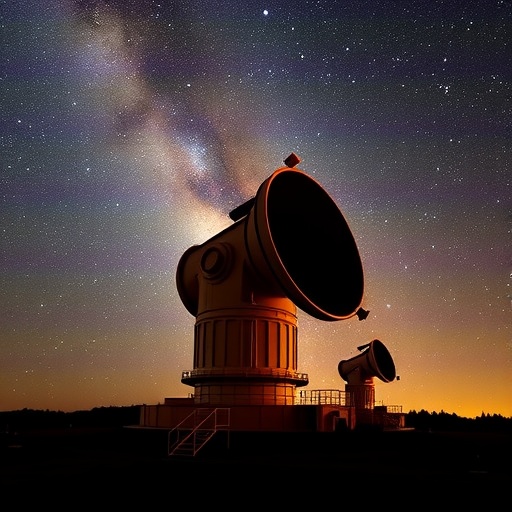
The Event Horizon Telescope (EHT) has significantly redefined the boundaries of astrophysics since its inception. This international collaboration has provided unprecedented insights into the heart of our galaxy and beyond, resulting in a wealth of data that can be analyzed to enhance our understanding of fundamental physics. In 2025, a pivotal paper outlines new opportunities for research that the next-generation EHT will provide, addressing crucial questions in both astrophysics and fundamental physics.
The fundamental premise of the EHT revolves around its ability to image the event horizon of black holes, the point beyond which light cannot escape. However, this telescope is not merely focused on black holes alone; it extends to elucidating various phenomena associated with space-time and gravitational physics. The quest to observe black holes with greater clarity and resolution marks a significant step forward, with researchers poised to exploit advancements in technology and data processing techniques.
The initial success of the EHT was marked by its groundbreaking image of the black hole in the center of the M87 galaxy, which not only confirmed the existence of supermassive black holes but also validated predictions made by Einstein’s theory of general relativity. This monumental achievement ignited a surge of interest and investment in further research. As a natural evolution, the subsequent generation of the EHT is expected to push these frontiers even further, allowing scientists to explore areas of fundamental physics that were previously unreachable.
One of the most exciting prospects of the next-generation EHT is its potential to probe deeper into the intricacies of black hole physics, such as spin, mass distribution, and the surrounding accretion disks. Understanding these parameters is essential for developing a comprehensive model of black hole formation and evolution. The implications stretch beyond black holes, as these findings could offer new perspectives on the genesis of galaxies and the large-scale structure of the universe itself.
Moreover, the next-gen EHT is expected to increase its observational capabilities by deploying an array of telescopes across the planet, resulting in a larger effective aperture. This enhancement will not only augment image resolution but also allow for continuous monitoring of black hole behavior over extended periods. The ability to capture dynamic events, such as flares from the accretion disk or interactions with nearby celestial bodies, could unveil groundbreaking insights into relativistic jet formation and the surrounding environment of black holes.
Another compelling area of research for the next-generation EHT is the study of gravitational waves. The interplay between gravitational waves and black holes presents a rich tapestry for exploration, allowing scientists to test the boundaries of general relativity. Enhanced sensitivity will enable the detection of gravitational waves emanating from more subtle interactions, paving the way for groundbreaking discoveries.
Furthermore, the advances in machine learning and artificial intelligence are anticipated to play a transformative role in analyzing the vast amount of data collected by the EHT. By employing sophisticated algorithms, researchers can uncover correlations and patterns that were previously imperceptible using traditional methods. This modern approach could potentially lead to new theories and models, revitalizing our understanding of essential astrophysical processes.
As the journey toward a new generation of the Event Horizon Telescope unfolds, the scientific community is aware of not just the technical hurdles that lie ahead but also the philosophical questions that emerge from studying the universe’s most enigmatic features. Black holes challenge our understanding of physics at a fundamental level, raising questions about quantum mechanics and gravitational interactions. The next-gen EHT is expected to facilitate a dialogue between these complex realms, serving as a bridge that connects observational data with theoretical physics.
Engagement with the public is crucial for the advancement of science, especially in such an esoteric field as black hole research. The findings and methodologies that emanate from the next-generation EHT will likely serve as a catalyst for public interest and investment in scientific pursuits. Educational programs can be created to communicate the significance of these discoveries, fostering a connection between concepts like black holes and everyday life.
In conclusion, the next-generation Event Horizon Telescope is poised to unlock a treasure trove of opportunities in astrophysics and fundamental physics. As researchers harness the combined power of international collaboration, cutting-edge technology, and novel analytical techniques, the potential for groundbreaking discoveries is immense. By continuing to delve into the mysteries surrounding black holes, we may not only deepen our grasp of the universe but also pave the way for innovative paradigms in physical science.
With an expanding array of observational capabilities and the insights gleaned from the interconnectedness of physics and astrophysics, the next generation of the EHT stands on the brink of redefining our understanding of the cosmos. Scientists are excited and intrigued by the opportunities that wait on the horizon, as they endeavor to expand the frontiers of human knowledge through exploration, innovation, and a commitment to truth in science.
Cite Scienmag News
Grant Pearson. (September 22, 2025). Next-Gen Event Horizon Telescope: Physics Breakthroughs Ahead. Scienmag. https://scienmag.com/next-gen-event-horizon-telescope-physics-breakthroughs-ahead/
Grant Pearson. "Next-Gen Event Horizon Telescope: Physics Breakthroughs Ahead." Scienmag, 22 September 2025, https://scienmag.com/next-gen-event-horizon-telescope-physics-breakthroughs-ahead/. Accessed 3 September 2026.
Grant Pearson. "Next-Gen Event Horizon Telescope: Physics Breakthroughs Ahead." Scienmag. September 22, 2025. https://scienmag.com/next-gen-event-horizon-telescope-physics-breakthroughs-ahead/


