


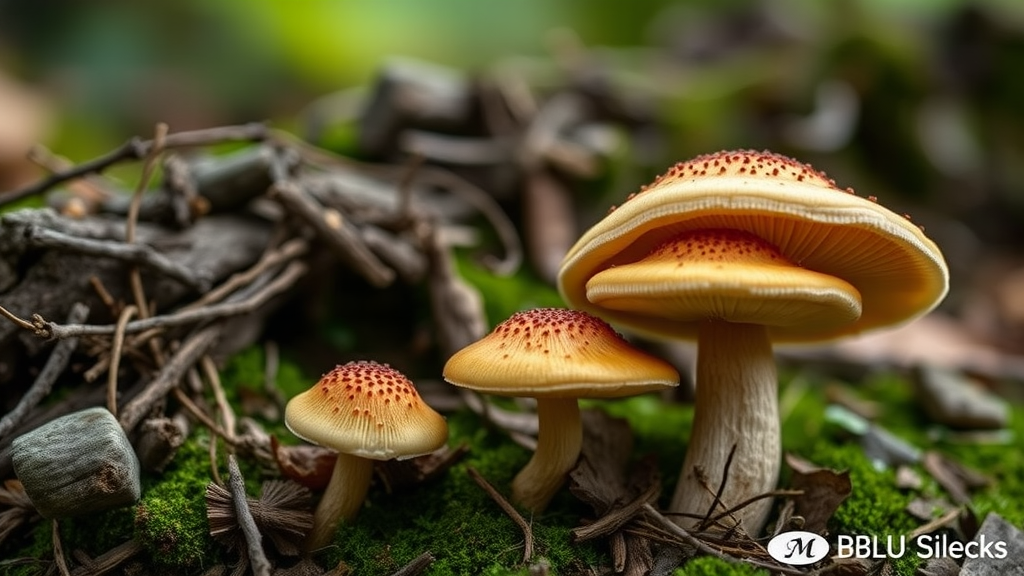
High in the forested slopes of Khanspur, in Khyber Pakhtunkhwa province of northern Pakistan, mycologists have identified a mushroom species previously unknown to science. The fungus, formally named Stropharia khanspurica, belongs to the family Strophariaceae within the mushroom-forming order Agaricales, and its discovery adds a fresh branch to the growing inventory of wood-rotting fungi documented from the Himalayan foothills. The species was described by Arooj Naseer, Ayesha Faryad and Abdul Nasir Khalid of the Institute of Botany at the University of the Punjab in Lahore, in a study published in the journal Plant Biosystems. The name khanspurica honors the locality where the specimens were collected, a small hill station famed for its moist, moss-draped forests that harbor a remarkable diversity of agaric mushrooms.
The new species is a wood-rotter, meaning it subsists by decomposing dead woody material, a lifestyle that places it among the crucial recyclers of forest ecosystems. Saprotrophic fungi like Stropharia khanspurica deploy suites of enzymes capable of dismantling lignin and cellulose, the structural polymers that make wood one of nature’s most recalcitrant materials. Without such fungi, fallen branches and decaying trunks would accumulate indefinitely, and the carbon and nutrients locked inside them would remain unavailable to plants and soil organisms. Each newly documented wood-decay species therefore carries implications not only for taxonomy but for understanding how nutrient cycling operates in particular forest types, especially in underexplored regions such as the western Himalaya.
Macroscopically, Stropharia khanspurica presents a distinctive profile that immediately set it apart from its relatives during fieldwork. The cap, or pileus, is yellow and bears an obtuse umbo, a blunt central bump that gives the mushroom its characteristic silhouette. The margin of the cap ranges from crenate, with softly scalloped edges, to appendiculate, meaning remnants of the partial veil cling to the rim in delicate patches. The gills, or lamellae, are white rather than the grayish or purplish-brown tones found in many other members of the genus, and the stipe, the stalk supporting the cap, tapers toward its base, a subtle but taxonomically meaningful trait. Colors were assessed against the Munsell soil color charts, a standard reference system that allows mycologists to record hues in a reproducible, comparable way across laboratories and continents.
Under the microscope, the defining characters became even clearer. The basidiospores, the reproductive cells produced on the gills, measure 6 to 8.8 micrometers long and 3.4 to 4.6 micrometers wide, a range described as slightly narrow for the genus and one of the key diagnostic measurements separating the new species from morphologically similar taxa. Equally important is the presence of caulocystidia arranged in clusters on the stipe surface. These sterile cells, which protrude from the fungal tissue and help regulate the microenvironment around the developing fruiting body, vary in shape and arrangement between species and serve as some of the most reliable anatomical markers in Strophariaceae taxonomy. Together, the spore dimensions, cap morphology and clustered caulocystidia formed a coherent morphological case for treating the Khanspur collections as something genuinely new.
Morphology alone, however, is no longer sufficient currency in modern fungal taxonomy, and the Pakistani team reinforced their diagnosis with molecular phylogenetic analyses. The researchers sequenced the internal transcribed spacer (ITS) region and the large subunit (LSU) of the nuclear ribosomal DNA, the two genetic loci that serve as the workhorses of fungal barcoding and higher-level phylogenetics. The ITS region, often dubbed the fungal barcode, evolves rapidly enough to distinguish closely related species, while the LSU region provides the deeper evolutionary context needed to confirm placement within a genus. Amplified with established basidiomycete-specific primers, the sequences were aligned and analyzed to reconstruct the evolutionary relationships of the new fungus within Stropharia and its closest allies.
The phylogenetic results were unambiguous. Stropharia khanspurica clustered with S. microaeruginosa, S. aeruginosa and S. jilinensis, a group of species distributed across Asia and beyond, and the clade received strong bootstrap support, a statistical measure of confidence in the branching pattern. Bootstrap values reflect how consistently a particular grouping appears when the underlying dataset is resampled, and high values indicate that the relationship is unlikely to be an artifact of the data. Placing the new species within this well-supported lineage confirmed both its generic assignment and its distinctness: its DNA sequence diverged from those of its nearest neighbors even as its morphology corroborated the genetic separation. The combined morphoanatomical and molecular approach follows the current best practice for describing fungal species, reducing the risk of either splitting trivial variants or lumping genuinely distinct lineages.
The discovery also resonates within a broader context of rapidly expanding Stropharia taxonomy in Asia. In recent years, mycologists have described a string of new species from the region, including S. atroferruginea from Battagram District in Pakistan, S. jilinensis, S. populicola and S. lignicola from China, and S. daliensis from Yunnan Province. Each addition reshapes the understood boundaries of the genus, a group that has historically been difficult to delimit because its members share generalized agaric features and differ mainly in fine anatomical detail and ecology. The genus has attracted attention well beyond pure taxonomy: Stropharia rugosoannulata, the wine cap mushroom, is cultivated commercially as an edible fungus, and other members of the family have been studied for their ecological roles in forests, gardens and even coffee plantations in the Americas.
For Pakistan, the description of Stropharia khanspurica adds to evidence that the country’s Himalayan and Hindukush forests remain significantly under-sampled. The region around the Murree Hills and the adjacent Khanspur area supports highly disturbed but biologically rich forests, and field surveys there continue to yield species new to science or new records for the country. Fungi are among the least catalogued of the large eukaryotic groups, with only a fraction of estimated global diversity formally described, and mountainous monsoon-influenced forests in South Asia are widely regarded as biodiversity frontiers for mycology. Documenting species before habitat disturbance erases them is an urgent task, and wood-inhabiting fungi, tightly tied to deadwood availability and forest continuity, are especially sensitive indicators of ecosystem health.
The taxonomic placement within the S. aeruginosa species complex also hints at fascinating biogeographic questions. S. aeruginosa itself, the verdigris roundhead familiar to European collectors, has long been treated as a species aggregate whose true boundaries remain unsettled. Finding a distinct member of this lineage in the western Himalaya suggests that diversification within the group may track the great mountain ranges of Asia, with geographic isolation across disjunct forest habitats driving speciation. As more collections are sequenced from intervening regions, mycologists may be able to reconstruct how ancestral populations spread and split across the continent’s forest corridors, a story written as much in DNA barcodes as in cap colors and spore measurements.
The work, conducted entirely by researchers at the University of the Punjab, underscores the growing capacity of Pakistani mycology to contribute original species descriptions grounded in both classical morphology and molecular systematics. For now, Stropharia khanspurica stands as the newest formally recognized member of its genus, a yellow-capped wood-rotter hiding in plain sight among the mosses of Khanspur, and a reminder that even familiar-looking mushrooms can conceal evolutionary stories still waiting to be read.
Subject of Research: Description of the new wood-rotting mushroom species Stropharia khanspurica (Strophariaceae) from Khanspur, KPK, Pakistan, using morphological and molecular phylogenetic evidence.
Article Title: Stropharia khanspurica (Agaricomycota, Strophariaceae) a new wood-rotten mushroom from Khanspur, KPK, Pakistan
Article References: Naseer, A., Faryad, A., & Khalid, A. N. (2026). Stropharia khanspurica (Agaricomycota, Strophariaceae) a new wood-rotten mushroom from Khanspur, KPK, Pakistan. Plant Biosystems, 160(5), Article 247. https://doi.org/10.1007/s44473-026-00244-z
Image Credits: AI Generated
DOI: 10.1007/s44473-026-00244-z
Keywords: Stropharia khanspurica, Agaricales, Basidiomycota, Strophariaceae, wood-rotting fungi, molecular phylogenetics, ITS, LSU, taxonomy, Pakistan, new species, Khanspur
Cite Scienmag News
Roger Howard. (September 22, 2026). New Wood-Rotting Mushroom Species Unearthed in Pakistan’s Himalayan Foothills. Scienmag. https://scienmag.com/new-wood-rotting-mushroom-species-unearthed-in-pakistans-himalayan-foothills/
Roger Howard. "New Wood-Rotting Mushroom Species Unearthed in Pakistan’s Himalayan Foothills." Scienmag, 22 September 2026, https://scienmag.com/new-wood-rotting-mushroom-species-unearthed-in-pakistans-himalayan-foothills/. Accessed 5 October 2026.
Roger Howard. "New Wood-Rotting Mushroom Species Unearthed in Pakistan’s Himalayan Foothills." Scienmag. September 22, 2026. https://scienmag.com/new-wood-rotting-mushroom-species-unearthed-in-pakistans-himalayan-foothills/


