


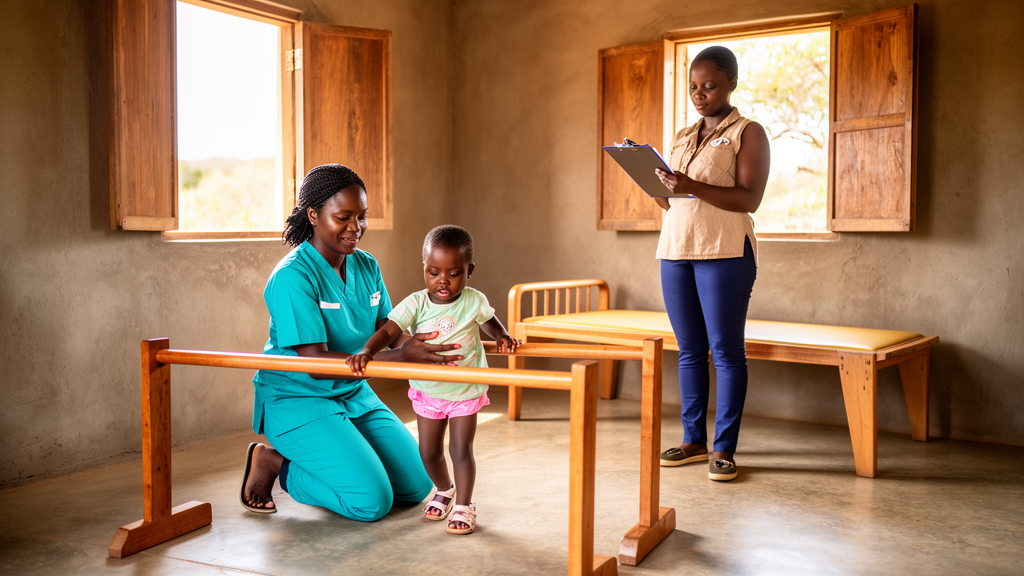
In Northern Tanzania, a research team has now built and tested the first standardized instrument designed to measure how well healthcare providers know, feel, and act when it comes to rehabilitating children after injury. The study, published in Frontiers in Rehabilitation Sciences, describes the development and psychometric validation of a knowledge, attitudes, and practices (KAP) tool intended for the multidisciplinary clinicians who care for injured children in a resource-limited setting. The rationale behind the work is straightforward.
Rehabilitation after pediatric injury, whether for fractures, burns, head trauma, or soft-tissue damage, is essential for improving long-term outcomes, and its effectiveness depends heavily on the competence and commitment of the providers delivering it. Until now, however, no validated tool existed to assess those providers' knowledge, attitudes, and practices specifically in pediatric injury rehabilitation. To fill that gap, the team, led by Baraka Moshi of the Kilimanjaro Clinical Research Institute and KCMC University in Moshi, Tanzania, conducted a methodological study with a cross-sectional validation design.
The target population was multidisciplinary healthcare providers involved in the rehabilitation of injured children, reflecting the reality that pediatric rehabilitation in such settings is shared among physicians, nurses, rehabilitation therapists, and other clinical staff rather than confined to a single specialty. The tool's construction followed a staged process. The researchers began with a literature review and methodological guidance to draft an initial pool of 72 items covering the three KAP domains.
They then submitted the draft to formal content evaluation by five experts, who judged the relevance and clarity of each item, and followed this with pilot testing among 10 healthcare providers to check how the instrument performed in practice before large-scale validation. This iterative process trimmed the instrument down and sharpened its focus. Content validity proved strong.
The Content Validity Index, a standard metric reflecting the proportion of items judged relevant and clear by expert reviewers, reached 0.88 for the final instrument, a value generally interpreted as indicating excellent agreement among experts. The final tool settled at 42 items, distributed across 23 knowledge items, 9 attitude items, and 10 practice items, a substantial reduction from the original 72-item draft. The validation then moved into large-scale statistical testing using two independent samples of providers.
Exploratory Factor Analysis (EFA), conducted on responses from 102 healthcare providers, is a technique that searches for latent structure in item responses, asking whether items cluster together in ways that suggest underlying dimensions. The EFA supported a three-factor structure within the knowledge domain, meaning knowledge items grouped into three distinct sub-areas, while the attitude and practice domains each behaved as single, unified factors. Confirmatory Factor Analysis (CFA) provided the second, stricter test.
Using a separate sample of 210 healthcare providers, CFA checks whether a pre-specified factor structure, here the one suggested by the EFA, fits new data adequately. The CFA results supported the proposed structure, demonstrating acceptable model fit across all three domains. Reliability, the degree to which the tool produces consistent measurements, was assessed with two complementary coefficients.
Cronbach's alpha, the classic index of internal consistency, ranged from 0.78 to 0.88 across the domains, while McDonald's omega, a more modern coefficient that accounts for unequal item contributions, ranged from 0.79 to 0.89. Values in this range are conventionally described as acceptable to good, indicating that items within each domain hang together coherently without being so redundant as to waste respondents' time. The authors conclude that the validated KAP tool demonstrates acceptable psychometric properties and can be used to assess healthcare providers' competencies in pediatric injury rehabilitation.
They position it as a standardized instrument for research and program evaluation in settings similar to Northern Tanzania, where resource limitations shape the structure of care and where off-the-shelf instruments developed in high-income countries may not translate well. The study's scope and limitations deserve clear statement.
Subject of Research: Development and psychometric validation of a knowledge, attitudes, and practices assessment tool for pediatric injury rehabilitation providers in Northern Tanzania
Article Title: Development and psychometric validation of a tool to assess healthcare providers' knowledge, attitudes, and practices in pediatric injury rehabilitation in Northern Tanzania
Article References: Moshi, B., Mmbaga, B. T., Keating, E. M., Staton, C. A., Moshi, H., Mahande, M. J., & Nickenig Vissoci, J. R. (2026). Development and psychometric validation of a tool to assess healthcare providers' knowledge, attitudes, and practices in pediatric injury rehabilitation in Northern Tanzania. Frontiers in Rehabilitation Sciences, 7, Article 1960075. https://doi.org/10.3389/fresc.2026.1960075
Image Credits: AI Generated
DOI: 10.3389/fresc.2026.1960075
Keywords: pediatric injury, rehabilitation, Tanzania, psychometrics, tool validation, healthcare providers, knowledge attitudes practices, factor analysis, global health, health workforce, resource-limited settings, Development
Cite Scienmag News
Harold Sullivan. (October 26, 2026). New validated tool measures pediatric injury rehabilitation skills among Tanzanian health workers. Scienmag. https://scienmag.com/new-validated-tool-measures-pediatric-injury-rehabilitation-skills-among-tanzanian-health-workers/
Harold Sullivan. "New validated tool measures pediatric injury rehabilitation skills among Tanzanian health workers." Scienmag, 26 October 2026, https://scienmag.com/new-validated-tool-measures-pediatric-injury-rehabilitation-skills-among-tanzanian-health-workers/. Accessed 26 October 2026.
Harold Sullivan. "New validated tool measures pediatric injury rehabilitation skills among Tanzanian health workers." Scienmag. October 26, 2026. https://scienmag.com/new-validated-tool-measures-pediatric-injury-rehabilitation-skills-among-tanzanian-health-workers/


