Engineers have reported a new three-port DC–DC converter design that uses an improved nature-inspired optimization algorithm to reduce conduction losses, according to a peer-reviewed study published in Scientific Reports on 27 October 2026.
The converter, called a 3L2C2 multi-resonant-element three-port converter, transfers power through both the fundamental and third-harmonic components. A key feature is topology-level decoupling between its second and third ports.
Because conduction losses in this converter are dominated by the root-mean-square values of the resonant currents, the researchers built a converter-specific optimization model. The model targets five triple phase-shift variables while keeping two prescribed power-transfer constraints satisfied, so the modulation remains feasible while the current metric is minimized.
To solve the optimization problem, the team developed an improved Gray Langurs Optimizer, or IGLO. The algorithm combines Logistic-map initialization with dynamic opposition-based learning, two techniques intended to improve the coverage of the initial search population and reduce stagnation during the search.
The optimizer was assessed through statistics over independent runs and through comparisons with representative population-based algorithms. The authors note that the results support the proposed method for the reported converter, voltage, and operating-point range, and that universal superiority over other optimizers is not claimed.
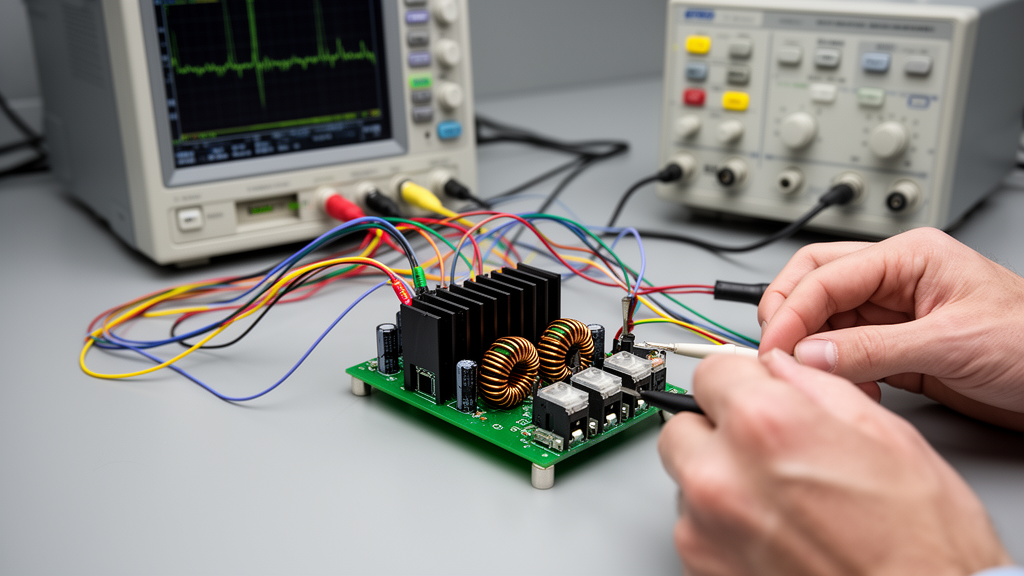
A laboratory prototype was used to verify both the topology-level power decoupling and the optimized modulation scheme in practice, providing experimental rather than purely simulated confirmation of the design’s behavior.
At the same power command, the measured weighted RMS-current metric fell from 71.27 A² at a feasible nonoptimal operating point to 58.70 A² at the IGLO-derived point. That corresponds to a reduction of approximately 17.6 percent in the reported current metric.
The study was published as an open-access article in Scientific Reports, and the version shared at publication is citable and carries a permanent DOI, subject to further editorial edits before the final version of record. The work was authored by Xinsheng Zhang, Chao Ma, Chong Zhang, Pengcheng Lu, Duanjun Zhang, Jie Liu, Yuehe Zhao, and Hong Fu.
The findings are specific to the reported converter topology, voltage levels, and operating-point range tested in the study, and the authors explicitly avoid claiming broader dominance of the optimizer over competing algorithms beyond the comparisons reported.
Subject of Research: Optimization of a three-port DC–DC converter topology to reduce conduction losses using an improved Gray Langurs Optimizer-based modulation scheme.
Article Title: A 3L2C2 DC–DC three-port converter with topology-level power decoupling: conduction loss optimization via improved Gray Langurs Optimizer-based triple phase-shift modulation
Article References: Zhang, X., Ma, C., Zhang, C., Lu, P., Zhang, D., Liu, J., Zhao, Y., & Fu, H. (2026). A 3L2C2 DC–DC three-port converter with topology-level power decoupling: conduction loss optimization via improved Gray Langurs Optimizer-based triple phase-shift modulation. Scientific Reports. https://doi.org/10.1038/s41598-026-76502-z
Image Credits: AI Generated
DOI: 10.1038/s41598-026-76502-z
Keywords: power electronics, DC-DC converter, three-port converter, conduction loss, triple phase-shift modulation, Gray Langurs Optimizer, metaheuristic optimization, resonant converter, power decoupling, Scientific Reports, L2C2, three-port
Cite Scienmag News
Denise Maddox. (October 29, 2026). New three-port converter cuts conduction losses with optimized modulation. Scienmag. https://scienmag.com/new-three-port-converter-cuts-conduction-losses-with-optimized-modulation/
Denise Maddox. "New three-port converter cuts conduction losses with optimized modulation." Scienmag, 29 October 2026, https://scienmag.com/new-three-port-converter-cuts-conduction-losses-with-optimized-modulation/. Accessed 1 November 2026.
Denise Maddox. "New three-port converter cuts conduction losses with optimized modulation." Scienmag. October 29, 2026. https://scienmag.com/new-three-port-converter-cuts-conduction-losses-with-optimized-modulation/